 Back to blog

An enterprise AI agent platform enables organizations to build, deploy and manage autonomous AI agents at scale, providing the orchestration, governance, security, and tool integration required to run complex, multi-step business workflows accurately and reliably in production.
- Enterprise AI agent platforms provide the orchestration, governance, and tool integration that raw LLMs and personal productivity AI tools cannot deliver for production back-office workflows.
- Production-ready architecture requires business context delivered through a semantic data layer, deterministic execution logic, natural language Runbooks, fail-closed design, and memory persistence.
- The SAFE framework – Secure, Accurate, Fast, Extensible – is the governance standard for enterprise-grade AI agent deployment.
- Sema4.ai is purpose-built for complex back-office workflows; ecosystem vendors (Copilot Studio, Agentforce, ServiceNow) are optimized for their own data silos; developer frameworks (LangChain, CrewAI, OpenAI Agents SDK) require full custom builds; legacy RPA (UiPath, Automation Anywhere) is brittle at scale.
- Scaling AI agents in production is not just about faster inference; it requires human-in-the-loop controls, fail-closed guardrails and three-lens observability. (Watching the system, the reasoning, and the business outcome together, to ensure the agent is working properly).
Understanding the enterprise AI landscape
In 2026, the enterprise AI landscape has a clear dividing line. On one side: organizations still running generative AI pilots that stall the moment compliance asks, “Can you prove what it did?” On the other: enterprises that are deploying production-ready AI agents that process invoices, reconcile accounts, and onboard suppliers autonomously across live business systems.
The difference is not ambition. It is architecture.
Personal productivity AI tools fail in the back office because they lack document intelligence, cross-system semantic understanding, and deterministic execution. In finance and procurement, a probabilistic guess is a liability, not an answer. When the audit team asks for reproducibility, “close enough” is not an option.
Scaling agentic AI requires re-evaluating platform architecture, adopting strict governance, and choosing a platform built for the needs of the business – not developer sandboxes. This article breaks down what separates a true enterprise AI agent platform from prototypes, compares the vendor landscape, and defines the governance framework production deployments demand.
If you are still exploring the fundamentals, start with what are AI agents.
Key takeaways
- An enterprise AI agent platform provides orchestration, governance, and tool integration that LLMs or chatbots alone cannot deliver for production workflows.
- Production-ready architecture requires business context delivered through a semantic data layer, deterministic execution, natural language Runbooks, fail-closed design, and agent memory persistence.
- The SAFE framework – Secure and Governed, Accurate and Explainable, Fast and Easy, Extensible and Adaptable – is the governance standard for enterprise AI agent deployment.
- Vendor fit depends on workflow type: Sema4.ai for back-office complexity; ecosystem vendors for CRM/M365-native work; developer frameworks for custom builds; RPA for rigid structured processes.
- Scaling agents in production requires human-in-the-loop controls, three-lens observability, and fail-closed guardrails.
What is an enterprise AI agent platform?
An enterprise AI agent platform is not a chatbot. It is not a developer framework. And it is not a single LLM wrapped in a user interface.
It is a sophisticated software layer between AI models and enterprise operations – purpose-built to orchestrate autonomous agents across live business systems with the governance, security, and auditability that production environments demand.
Where a general-purpose LLM generates text, an enterprise platform coordinates multi-step workflows: reading invoices, querying ERPs, applying business rules, routing exceptions, posting to systems of record, and logging every decision for audit.
Where a developer framework gives engineers building blocks, an enterprise platform gives business users natural language authoring, pre-built connectors, and deterministic execution – without writing code or waiting in an IT queue.
The distinction matters because production-ready AI agents need more than generative output capabilities. They need agentic reasoning combined with orchestration, data governance, enterprise connectors, business-user configurability, and complete auditability.
The architecture of a production-ready enterprise AI agent platform
Six architectural components separate a production-ready platform from a prototype. Each addresses a specific failure mode that causes AI pilots to stall before reaching production.
Natural language Runbooks. Business users define agent behaviors, guardrails, and standard operating procedures (SOPs) in plain English – no IT queue, no Python. Finance and procurement teams configure exception handling, approval thresholds, and escalation paths without engineering involvement. The people who know the process best control how agents execute it.
Semantic data layer. Instead of generating raw SQL on the fly – which produces non-deterministic results – the platform maps natural language to a verified business context layer. The same query returns the same mathematically precise result every time by performing calculations and validation checks on structured data with repeatable, transparent logic within the Sema4 Data Frame. This prevents hallucinated calculations in financial workflows where accuracy is non-negotiable.
Model orchestration. Enterprise platforms coordinate multiple models across a workflow: a reasoning model for document interpretation, a structured execution engine for calculations, a retrieval layer for knowledge base lookups. No single LLM handles everything. The orchestrator routes each task to the right component.
Deployment models. Enterprise platforms support VPC-native deployment (inside the organization’s own cloud perimeter), hybrid deployment (on-premise data with cloud orchestration), and Snowflake-native deployment via Snowpark Container Services – zero-copy, zero data movement.
Fail-closed design. If an agent cannot evaluate a business rule with 100% certainty, it halts and escalates to a human – it never guesses. This is the architectural principle that makes deterministic AI agents safe for finance, procurement, and compliance workflows.
Agent memory and context persistence. Agents retain user preferences, corrections, and outcomes over time, building institutional knowledge without retraining. Working memory holds context across a multi-step workflow. Long-term memory carries learning across sessions. The 500th invoice costs a fraction of the first.
Learn more about our enterprise AI agent platform architecture, and how it is purpose-built to automate complex, document- and data-heavy back-office operations.
Data access, AI actions, and enterprise connectors
Enterprise platforms control what agents can see and do. Unconstrained tool access is a security risk. Production platforms use pre-defined AI Actions and governed connectors – not open-ended API calls.
Data access. Agents access live data warehouses (Snowflake, Redshift, PostgreSQL) directly – no data movement, no replication, no external copies. Role-based permissions mirror the organization’s existing access controls so agents can only see what their authorized role permits.
AI Actions. Pre-defined, sandboxed code snippets execute specific operations (read an invoice, query an ERP, draft a purchase order) with defined access rights, audit logs, and mandatory approval gates. Agents cannot take arbitrary actions – only actions explicitly defined and approved by the enterprise.
MCP and enterprise connectors. Model Context Protocol standardizes how agents interact with external systems across vendors. Pre-built connectors to SAP, Oracle, Salesforce, Workday, Snowflake, and banking APIs eliminate custom integration builds for common enterprise systems. This is agentic workflow automation with guardrails built in.
Governance, security, and observability: the SAFE framework
What is the best AI agent governance framework for enterprises? The answer must address four requirements that most AI pilots fail on: data security, mathematical accuracy, business-user accessibility, and cross-system extensibility.
The SAFE framework operationalizes all four.
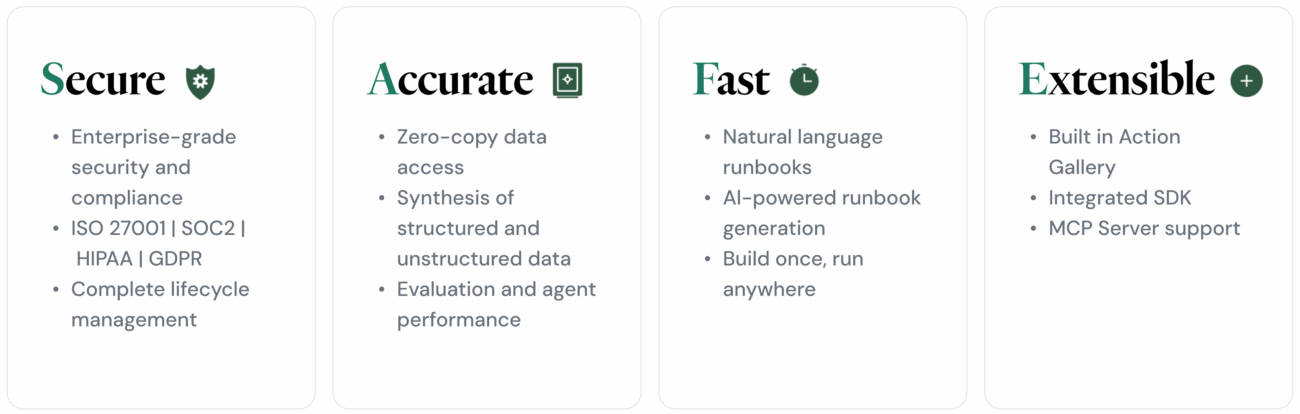
Secure and governed. VPC-native, zero-copy architecture. Agents operate inside the enterprise data perimeter. Proprietary data never moves to a public cloud prompt log or trains a third-party model. Role-based access controls mirror the organization’s existing authorization matrix.
Accurate and explainable. Deterministic outcomes with mathematical correctness. The semantic data layer ensures the same query returns the same result every time. Three-lens observability gives analysts, compliance auditors, and engineers the exact reasoning path, tool call, and data access log behind every agent decision – essential for SOX and regulated finance environments.
Fast and easy. Business users deploy custom agents in hours using natural language Runbooks. No code, no IT tickets, no waiting on engineering backlogs. The platform is designed for finance operations teams, not data scientists.
Extensible and adaptable. Pre-built connectors across ERP, CRM, HRIS, and data warehouses. MCP standardizes integration. Agents adapt as business rules and data structures change without manual reconfiguration.
Human-in-the-loop design. The platform defines specific decision points where the agent pauses for human approval – by transaction amount, exception type, or data sensitivity. The agent presents full context for one-click approval in the Work Room, then resumes execution once authorized.
Enterprise AI agent platform comparison: Sema4.ai vs. the field
Choosing the right platform depends on the workflow type, not brand loyalty. Here is an honest architectural evaluation.
| Dimension | Sema4.ai | Ecosystem vendors | Dev frameworks | Legacy RPA |
| Best for | Complex back-office, finance, document-heavy workflows | CRM/M365-native productivity (Copilot Studio, Agentforce, ServiceNow) | Custom stateful loops (LangChain, CrewAI, OpenAI Agents SDK) | Structured process steps and screen-scraping (UiPath, Automation Anywhere) |
| Execution logic | Deterministic + semantic – fail-closed business rules | Primarily probabilistic – loose guardrails | Graph-based code state – flexible but no governance | Deterministic but brittle when layouts change |
| Data control | VPC-native, zero-copy | Forces data replication for external silos | Custom build required for data security | Hybrid cloud; API/UI-level integrations |
| Authoring | Natural language Runbooks – business users, no IT backlog | Low-code builders require specialist architects | Pure pro-code (Python, YAML) | Complex Studio environments; steep learning curve |
| Auditability | Three-lens visibility: analyst, auditor, engineer views | Platform-centric logs – opaque outside ecosystem | None out of the box | Strong trace history via Orchestrator |
vs. ecosystem vendors (Microsoft Copilot Studio, Salesforce Agentforce, ServiceNow). Strong choice for workflows living entirely within the Microsoft 365, Salesforce, or ServiceNow ecosystem. Limitations emerge for cross-system back-office workflows requiring document intelligence, deterministic accuracy, or data that lives outside the vendor’s native environment.
vs. developer frameworks (LangChain, CrewAI, OpenAI Agents SDK). Maximum flexibility for engineering teams building custom reasoning loops. The tradeoff: compliance, hosting, security, business-user authoring, and audit trails are entirely your build. Not appropriate for regulated back-office workflows without significant additional engineering.
vs. legacy RPA (UiPath, Automation Anywhere). Mature trace history and strong coverage for structured, rule-based processes. Fundamentally brittle when document layouts change or UI-level integrations break. Transitioning to agentic workflows from an RPA foundation requires architectural re-evaluation – RPA and agentic AI solve different problem classes.
Enterprise teams moving past AI pilots are choosing platforms built for production – not prototypes. Learn how Sema4.ai’s enterprise AI agent platform works – delivering deterministic accuracy, SAFE governance, and zero-copy security for complex back-office workflows.
Lifecycle management and scaling AI agents in production
Deployment is not the finish line. Production-ready AI agents require continuous validation, performance monitoring, version control for Runbooks, and a governance process for expanding agent scope.
Shadow mode validation. Run agents in parallel with the manual process before granting posting authority. Validate accuracy against known outputs. Build team confidence before expanding scope.
Confidence-tiered posting. Auto-post high-confidence matches. Surface medium-confidence items for one-click human review. Escalate genuine exceptions with full context. This tiered model scales throughput while maintaining human oversight where it matters.
Runbook version control. As business rules change, Runbook updates must be tracked, tested, and deployed without disrupting live agent workflows. Enterprise platforms maintain Runbook history and support staged rollouts.
Performance monitoring at 30/60/90 days. Track auto-match rate, exception escalation rate, and average time-to-complete. These three metrics tell you whether the deployment is working and where to optimize. Drift detection ensures model outputs maintain accuracy over time.
Expanding agent scope. Prove the model on one workflow, document the governance approach, and replicate across adjacent processes before scaling across business units. Intelligence carries over – each deployment is faster than the last.
FAQs on enterprise AI agent platforms
What is an enterprise AI agent platform?
An enterprise AI agent platform enables organizations to deploy autonomous AI agents at scale. It provides the orchestration, governance, tool integration, and security required to run complex, multi-step business workflows reliably in production – beyond what a general-purpose LLM or developer framework delivers alone.
What is the best AI governance framework for enterprise AI agents?
The SAFE framework – Secure and Governed, Accurate and Explainable, Fast and Easy, Extensible and Adaptable – is the governance standard for enterprise AI agent deployment. It addresses the four requirements that most AI pilots fail on: data security, mathematical accuracy, business-user accessibility, and cross-system extensibility.
What is the AI governance framework for enterprises?
Enterprise AI governance requires four capabilities working together: human-in-the-loop controls at defined thresholds, deterministic execution that produces verifiable results, three-lens observability for analysts, auditors, and engineers, and zero-copy data security that keeps proprietary information inside the enterprise perimeter. The SAFE framework operationalizes all four.
How is Sema4.ai different from Microsoft Copilot Studio or Salesforce Agentforce?
Copilot Studio and Agentforce are optimized for productivity workflows inside the Microsoft 365 and Salesforce ecosystems. Sema4.ai is purpose-built for complex, document-heavy back-office operations – invoice reconciliation, procurement, supply chain – requiring deterministic accuracy, zero-copy data security, and governance that extends beyond any single vendor’s ecosystem.
How is an enterprise AI agent platform different from RPA tools like UiPath?
RPA automates structured, rule-based processes by scripting UI interactions. Enterprise AI agent platforms handle unstructured documents, multi-system reasoning, and dynamic exception handling that RPA cannot. RPA breaks when layouts change; AI agents adapt. The two are complementary for different workflow types, not interchangeable.
What is deterministic AI execution and why does it matter in the back-office?
Deterministic execution means the platform produces the same mathematically correct result every time for the same input. In finance and procurement workflows – invoice matching, GL reconciliation, PO validation – a probabilistic guess is a compliance risk. Deterministic execution, powered by a semantic data layer and SQL logic, eliminates that risk.
How do you scale AI agents in production without losing governance?
Scale through confidence-tiered posting: auto-execute high-confidence actions, route medium-confidence items for human review, escalate genuine exceptions with full context. Maintain Runbook version control, monitor performance at 30/60/90-day intervals, and expand agent scope one workflow at a time. Governance scales with the agents, not after them.
Next steps
See Sema4.ai Worker Agents in action – automating invoice reconciliation, procurement workflows, and operations processes with full auditability and configurable human-in-the-loop controls.
Explore Agent Studio to build and deploy enterprise AI agents using natural language Runbooks – no engineering overhead, no IT backlog.


 Read more