 Back to blog

The five pillars that predict production success
Sixty to seventy-two percent of enterprise AI agent pilots stall before reaching production, according to 2026 research aggregated from BCG, McKinsey, and IDC. That number should frame how you evaluate AI agent platforms. The problem is rarely the model. It is the gap between a polished demo and the messy reality of production agents, data and document complexity, multi-system workflows, and audit and governance requirements.
Meanwhile, vendors marketing “agentic” capabilities have multiplied faster than buyers can verify them. According to the 2026 INFUSE Voice of the Buyer study, only 47% of enterprise buyers cite integration as their top evaluation criterion, and far fewer systematically test those claims before signing. This guide gives you a structured, weighted scorecard to evaluate any enterprise agentic AI platform on the five capabilities that actually predict production success, so your next evaluation ends in a deployment, not a write-off.
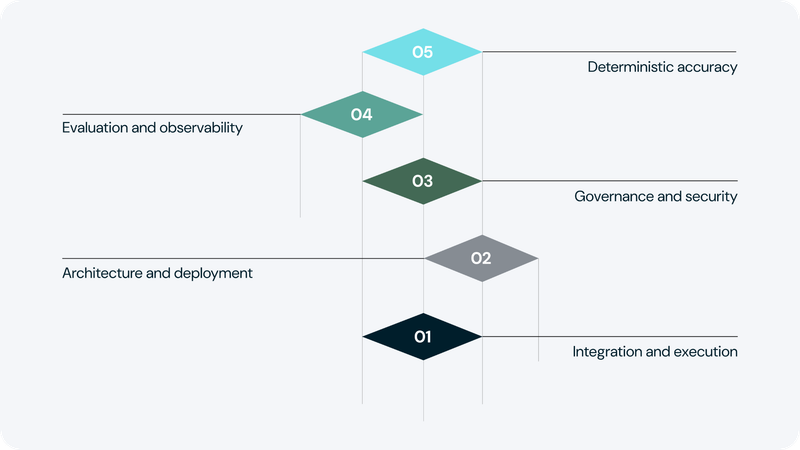
This checklist scores every enterprise AI agent platform across five core evaluation pillars: integration and execution, architecture and deployment flexibility, governance and security, evaluation and observability, and deterministic accuracy for financial and numeric data.
Most generic evaluation frameworks cover only four of these pillars and skip numeric accuracy entirely – a critical gap for finance and back-office use cases where a wrong number creates audit exposure, not just a bad answer.
Cross-system stateful orchestration and write access (not just read-only data retrieval) are the two capabilities most evaluations overlook – and the two that separate production-grade platforms from demo-grade ones.
The single biggest evaluation mistake: testing on a vendor’s scripted demo with clean, pre-formatted data instead of loading your own messy, real-world documents and workflows.
A full downloadable scorecard template with RFP questions pre-loaded is available in the scoring section below.
Why do most enterprise AI agent evaluations fail?
Vendor claims of “agentic” capability are inconsistent and largely untested by buyers. The 2026 INFUSE Voice of the Buyer study found that buyer questions have moved past whether a vendor has AI and into specifics about how the AI behaves inside the stack, what data it touches, and where it fails. Yet most evaluations still rely on demos that run on clean, pre-formatted sample data. Those demos succeed because they avoid the edge cases, document variability, and cross-system complexity that define real production environments.
The result: pilots that can pass an accuracy test in a sandbox stall at scale because governance, integration depth, and observability were never scored during evaluation. Industry root-cause analyses of failed deployments consistently attribute negative-ROI outcomes to unclear success criteria and insufficient tool or data access – both issues a structured evaluation would have surfaced before purchase. The dominant failure modes in production are not hallucination. They are tool errors (approximately 28% of incidents), memory and state issues (approximately 22%), and unhandled edge cases (approximately 18%).
The fix is straightforward. Apply a consistent, weighted scorecard to every vendor on the shortlist. Score the same five pillars, with the same data, under the same conditions. That is what the rest of this article provides.
What are the core evaluation pillars for enterprise AI agent platforms?
The best AI agent platform for your organization depends on how each vendor scores across five non-negotiable pillars. These pillars reflect the actual production requirements that determine whether an enterprise AI agent platform ships or stalls. Each pillar below includes questions to ask the vendor and red flags that signal a gap.
What integration and execution capabilities should you require?
An agent that can read data but not write it back to your ERP, AP system, or GL is a reporting tool, not a production agent. Require native, bi-directional integration with your core systems of record – and test it with real data.
Ask the vendor:
- Can the agent write back to our ERP, AP/AR, and procurement systems – or only read from them?
- How does the platform handle multi-step workflows that span multiple systems (for example, pulling an invoice from email, matching it against a PO in the ERP, and posting the result to the GL) and maintain state across steps?
- How does agent trust formally progress from human in the loop (HITL) always, to non-critical write-back, full trusted write-back?
Red flag: The demo only shows data retrieval. No write-back, no cross-system orchestration, no stateful execution.
How flexible is the platform’s architecture and deployment model?
Enterprise buyers need deployment options that fit their infrastructure – not a one-size-fits-all SaaS model that moves data outside the security boundary.
Ask the vendor:
- Can we deploy within our own cloud VPC?
- Which LLM providers does the platform support, and can we swap models without re-architecting agents?
- What does the data residency model look like – does data leave our environment at any point?
Red flag: Single-cloud, single-model lock-in with no VPC deployment option.
What governance, security, and compliance controls are non-negotiable?
Only 21% of organizations have a mature governance model for autonomous agents (Deloitte, 2026). If a platform does not ship with governance built in, your compliance team will block deployment.
Ask the vendor:
- Does the platform provide a full reasoning trail for every agent action – viewable by analysts, auditors, and engineers?
- How are human-in-the-loop checkpoints configured? Can we define approval gates for specific actions (for example, payments above a threshold)?
- What role-based access controls exist? Can we scope agent permissions to specific data sources and actions?
Red flag: Audit logging is described as “available” but not demonstrated. No programmable approval gates. No role-based access control.
How do you evaluate and monitor agent quality over time?
Agents deployed without automated evaluation infrastructure have significantly higher rollback rates than those with full evaluation coverage. Observability is not optional.
Ask the vendor:
- Can you track which agents are being used, by whom, how often, and with what outcomes?
- Can we monitor detailed task information (success rate, error rate, volumes) and throughput in real time?
- Does the platform integrate with our existing observability stack (Datadog, Splunk, OpenTelemetry)?
Red flag: Monitoring is limited to basic uptime checks. No agent-level analytics. No integration with enterprise observability tools.
Can the platform guarantee deterministic accuracy for financial and numeric data?
This is the pillar most evaluations skip – and it matters most for finance and back-office use cases. LLMs are powerful reasoning engines, but they are unreliable calculators. A platform that uses an LLM to perform a three-way match or compute a variance is not production-ready for finance.
Ask the vendor:
- How does the platform handle mathematical calculations – through the LLM, through deterministic code execution, or both?
- Can we audit every numeric output back to its source data and the exact computation that produced it?
- What is the platform’s approach to reconciliation across large datasets (tens of thousands of rows)?
Red flag: The vendor cannot explain how calculations are performed. Numeric outputs are not traceable to source data. Reconciliation is limited to small sample sizes.
The platform evaluation checklist at a glance
| Pillar | What to test | Key question |
| Integration and execution | Bi-directional system access, stateful multi-step workflows | Can the agent write back to our ERP and maintain state across steps? |
| Architecture and deployment | VPC deployment, model flexibility, data residency | How do we securely deploy in our own cloud? |
| Governance and security | Audit trails, approval gates, RBAC | Does every agent action produce a full, auditable reasoning trail? |
| Evaluation and observability | Automated eval suites, cost/latency monitoring, observability integration | Do automated evaluations run on every change before deployment? |
| Deterministic accuracy | Code-native math, traceable outputs, large-scale reconciliation | Are numeric calculations performed by deterministic code, not the LLM? |
Where does legacy RPA fit in?
Legacy RPA tools score weakest on the integration and execution pillar. They require structured triggers, pre-formatted inputs, and rigid, pre-scripted workflows. They cannot hold state across steps, reason over unstructured documents, or adapt when an invoice format changes.
RPA served enterprises well for automating predictable, rules-based tasks. However, the complex, document-heavy, multi-step processes that define modern back-office work – invoice reconciliation, supplier onboarding, batch release review – require enterprise AI agents that reason, orchestrate, and learn. If your evaluation includes legacy RPA vendors, score them on the same five pillars. The gaps will surface quickly.
How do you run a proof-of-concept bake-off?
A structured proof-of-concept is what separates the best AI agent platform from one that only demos well. The pillars above tell you what to look for. This section tells you how to look for it.
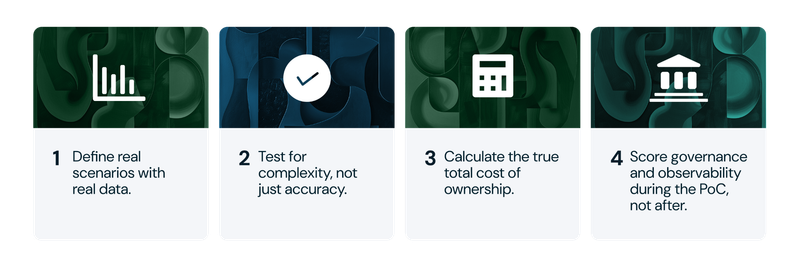
1. Define real scenarios with real data.
Pull actual documents, queries, and edge cases from your own production environment. Load the same data into every enterprise AI platform being tested. Never use a vendor-provided sample set – it is optimized for their strengths and will not reflect your production reality.
2. Test for complexity, not just accuracy.
Require multi-step workflows with backend system access. A three-way invoice match that reads from the ERP, validates against a PO, checks goods receipt, applies tolerance rules, and posts the result tests the integration and execution pillar in a way that a single-step FAQ retrieval never will. Include at least one scenario with messy, real-world documents – scanned invoices, inconsistent formatting, missing fields.
3. Calculate the true total cost of ownership.
Request a multi-year TCO from each vendor that includes integration and implementation effort, subscription cost, usage-based scaling (LLM tokens, compute), and ongoing maintenance. Do not compare list prices. Two platforms with identical subscription fees can differ by a factor of three or more when integration effort and token costs are included.
4. Score governance and observability during the PoC, not after.
Run the PoC with your compliance team in the room. Ask each vendor to produce an audit trail for a completed workflow. If they cannot produce one during the PoC, they will not have one in production.
A PoC run this way is what actually differentiates platforms. It tests whether the vendor’s claims hold under your conditions, with your data, at your scale.
Score it yourself: how do the pillars weigh against each other?
Use the scorecard below to compare any two enterprise AI platform vendors on the five pillars. Score each vendor from 1 (does not meet requirements) to 5 (fully meets or exceeds requirements), then multiply by the pillar weight to get a weighted score.
These are suggested default weights. Adjust them for your priorities. Finance-heavy buyers may want to increase the weight on deterministic accuracy to 25% or 30% and reduce architecture and deployment flexibility accordingly.
| Pillar | Suggested weight | Vendor A score (1-5) | Vendor B score (1-5) |
| Integration and execution | 25% | ___ | ___ |
| Architecture and deployment flexibility | 15% | ___ | ___ |
| Governance and security | 25% | ___ | ___ |
| Evaluation and observability | 15% | ___ | ___ |
| Deterministic accuracy | 20% | ___ | ___ |
| Weighted total | 100% | ___ | ___ |
This table works for a quick comparison. For a full evaluation, you need the detailed scorecard template – which breaks each pillar into its sub-criteria, supports scoring more than two vendors side by side, and includes the RFP questions from each pillar section above pre-loaded and ready to send.
Get the full evaluation checklist + scorecard template (gated download)
How does Sema4.ai score against this framework?
Here is how Sema4.ai fills in its own scorecard row, pillar by pillar. This is factual, not a pitch – evaluate it the same way you would any vendor.
Integration and execution: Agents write directly back to core finance systems (ERP, AP/AR, procurement) and maintain state across multi-step workflows. Agents handle complex, multi-intent requests – reading documents, validating against enterprise data, and posting results – in a single end-to-end run.
Architecture and deployment flexibility: Deploy within your own cloud VPC across AWS, Azure, Google Cloud, or Snowflake. Swap LLM providers (OpenAI, Anthropic, Google, Snowflake Cortex) without re-architecting agents. Zero-copy data access means data never leaves your security boundary.
Governance and security: Genuine exceptions are handed to a human with full context via programmable approval gates. The platform logs a full reasoning trail for every agent action – viewable through purpose-built lenses for analysts (plain-language summaries), auditors (compliance certificates), and engineers (raw execution traces). Enterprise SSO, role-based access control, and comprehensive audit logs are built in.
Evaluation and observability: Native integration with Datadog, Splunk, LangSmith, and OpenTelemetry. Agent-level analytics track conversations, work items, active users, and performance over time. Version history with comparison and rollback supports safe iteration.
Deterministic accuracy: This is the strongest row. LLMs handle document understanding, entity extraction, and reasoning. Deterministic SQL-powered DataFrames perform every calculation, reconciliation, and aggregation. Mathematical precision is enforced at the infrastructure level, not hoped for at the prompt level. Every numeric output is auditable back to its source data and the exact computation that produced it. No AI guessing at a dollar figure.
See how Sema4.ai’s Agents score against this framework
Visit our AI Agent Learning Center
FAQs on evaluating enterprise AI agent platforms
What is the main difference between an enterprise AI agent platform and traditional RPA?
AI agent platforms reason across unstructured documents, hold state across multi-step workflows, and adapt when data formats change. RPA follows rigid, pre-scripted rules and breaks when inputs vary from the expected template.
Can AI agent platforms update backend ERP records directly?
The best platforms can. Look for native write-back to systems of record such as SAP, Oracle, and NetSuite – not just read-only data retrieval. Cross-system write access is a key differentiator between production-grade and demo-grade platforms.
What security certifications should an enterprise AI agent platform have?
At a minimum, require SOC 2 Type II compliance and VPC deployment within your own cloud infrastructure. For regulated industries, confirm HIPAA readiness, data residency controls, and zero-copy data access to keep sensitive information within your security boundary.
How long does a typical enterprise AI agent implementation take?
Successful enterprise agent deployments typically take five to nine months from pilot to full production. The hardening phase – building evaluation suites, error handling, and edge-case coverage – accounts for the largest share of that timeline.
Start your evaluation this quarter
You now have the five pillars, the RFP questions, and the scoring framework. The scorecard table above works for a quick side-by-side comparison. For a comprehensive evaluation across your full vendor shortlist – with sub-criteria, weighted scoring, and pre-loaded RFP questions – download the complete template.
Get the full evaluation checklist + scorecard template (gated download)
Use it in this quarter’s vendor evaluation. Load the same data into every platform. Score the same five pillars. Let the numbers, not the demos, decide.


 Read more