Back to learning center
What is agentic reasoning?


Agentic reasoning is the ability of an AI agent to autonomously plan, use external tools, evaluate results, and iteratively refine its approach to accomplish a multi-step goal. It enables AI to move beyond generating text to completing work across enterprise systems.
Imagine asking AI to find overdue invoices across your ERP, check vendor contact history in your CRM, and draft follow-up emails. A single prompt-and-response interaction cannot handle this. The AI needs to reason about what to do, act on external systems, evaluate the result, and decide the next step.
This is where agentic reasoning changes the game.
Agentic reasoning is central to how modern AI agents operate. It powers the autonomous reasoning loops that allow agents to complete goals across enterprise systems. It enables tool use, the mechanism by which agents call APIs, run queries, and execute actions. And it demands governance, including guardrails, observability, and human-in-the-loop controls for production deployment.
The challenge is clear: most enterprise AI today is still prompt-and-response. For organizations running complex, multi-system workflows, a single LLM response is not enough. Agentic reasoning closes that gap by enabling AI to plan, act, evaluate, and iterate until the work is actually done. For organizations looking to drive concrete and measurable outcomes for their teams, a more sophisticated solution is needed.
AI agent platforms like Sema4.ai operationalize agentic reasoning by providing the orchestration, tool integration, and governance that make these capabilities production-ready at enterprise scale.
Agentic reasoning refers to the cognitive process by which an AI agent observes its environment, formulates a plan, selects and invokes external tools, evaluates the outcomes, and decides the next step in pursuit of a goal.
It is important to distinguish agentic reasoning from agentic AI more broadly. While “agentic AI” describes the overall system or paradigm, “agentic reasoning” is specifically the reasoning loop inside the agent that makes it agentic.
The core loop follows a consistent pattern:
Observe → Reason → Act → Evaluate → Iterate
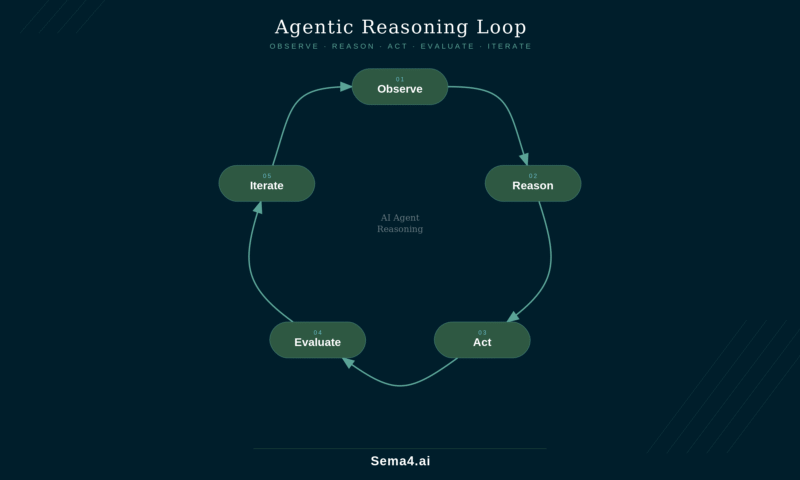
At each step, the agent assesses its current state, determines what information or action is needed, selects the appropriate tool, executes it, and then evaluates whether the result moves it closer to the goal. If not, it adjusts its approach and tries again.
This pattern draws on foundational research, including the ReAct framework (Yao et al., 2023) and Toolformer (Schick et al., 2023), which demonstrated that language models can learn to invoke external tools as part of their reasoning process.
For enterprises, agentic reasoning is the capability that moves AI from “answering questions” to “completing work” across business systems. It transforms AI from a passive assistant into an active participant in operational workflows.
Understanding where agentic reasoning fits requires looking at three levels of LLM capability:
Standard prompting is the simplest approach. A user sends a prompt and the model returns a single completion. There is no iteration, no tool access, and no self-evaluation.
Chain-of-thought (CoT) improves on this by having the model “think out loud” step by step within a single generation. This improves accuracy on complex problems, but it remains a single pass. The model cannot act on external systems or verify its conclusions against real data.
Agentic reasoning adds tool invocation, real-world interaction, self-evaluation, and iterative loop closure. The model reasons about what action to take, takes it, checks the result, and reasons again.
Here is a concrete example: Ask a standard LLM for the current stock price and it guesses based on training data. Ask a CoT-prompted LLM and it explains how one would find it. An agent with agentic reasoning calls a financial API, gets the live price, and reports it accurately.
| Capability | Standard prompting | Chain-of-thought | Agentic reasoning |
| Multi-step planning | No | Limited | Yes |
| Tool use / API calls | No | No | Yes |
| Self-evaluation | No | Implicit | Yes |
| Iterative refinement | No | No | Yes |
| Memory across steps | No | Within prompt | Yes (working memory) |
| Autonomous goal pursuit | No | No | Yes |
Great question! Here’s how LLM reasoning and AI Agent reasoning differ:
LLM reasoning refers to a large language model’s ability to process input and generate a response within a single interaction. It operates within the boundaries of its training data and the context window provided.
Characteristics:
AI agent reasoning builds on LLM capabilities but adds planning, tool use, memory, and autonomous action. An agent reasons about what to do, not just what to say.
Characteristics:
| Dimension | LLM Reasoning | AI Agent Reasoning |
| Scope | Single response generation | Multi-step goal pursuit |
| Actions | Text output only | Tool use, system interaction, data access |
| Memory | Limited to context window | Persistent across sessions |
| Autonomy | Reactive (responds to prompts) | Proactive (plans and executes) |
| Accuracy | Probabilistic | Can be deterministic through code execution |
In enterprise contexts like finance, procurement, and supply chain, LLM reasoning alone is insufficient. These processes require:
This is where AI agents shine. They use LLM reasoning as one component within a broader system that includes code execution, tool use, memory, and governance, delivering outcomes that enterprises can trust and audit.
Tool use is the mechanism that transforms agentic reasoning from an internal thought process into real-world action. When an agent determines it needs information or must perform an action, it generates a structured request, a function call, that invokes an external capability.
The tool-use cycle works like this:
In enterprise settings, the tools agents use mirror what human workers interact with daily:
Tool access is what makes agents useful in enterprise settings. Without it, an agent can only describe what should be done. With it, the agent can interact with the same systems human workers use and complete real work autonomously.
Several architectural patterns have emerged for implementing agentic reasoning. Each serves different use cases and complexity levels.
ReAct (Reason + Act) is the most widely adopted pattern. The model alternates between generating a reasoning trace and taking an action (tool call), with each observation feeding back into the next step. Developed by Yao et al. (2023), this framework demonstrated that interleaving reasoning and action significantly improves task completion across diverse domains.
Plan-and-execute takes a different approach. The agent first creates a full plan, then executes each step, adjusting as needed. This pattern is useful for tasks with predictable structure but variable details, such as financial close processes where the steps are known but the data changes each period.
Reflection and self-correction adds an evaluation layer. Agents assess their own outputs and decide whether to retry, revise, or escalate. This capability separates brittle automation from resilient agentic behavior. Research on Reflexion (Shinn et al., 2023) showed that agents with self-correction significantly outperform those without it.
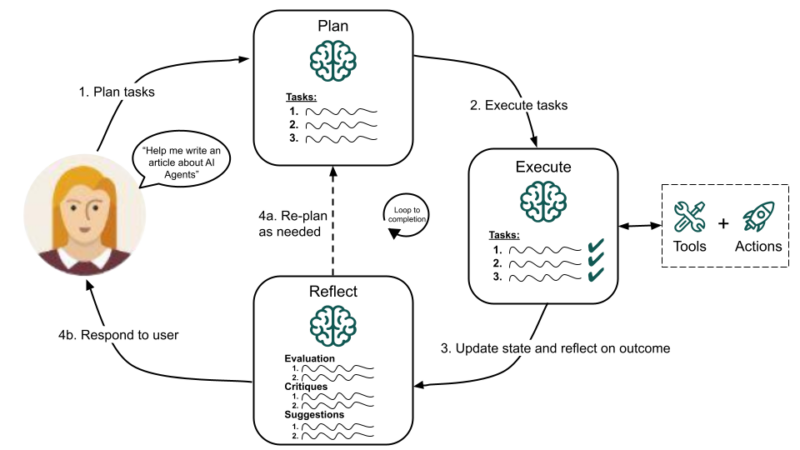
Multi-agent collaboration coordinates multiple specialized agents on complex tasks. Each agent has its own tools and domain knowledge, with an orchestrator managing the workflow. This pattern excels when a task spans multiple domains, such as processing a supplier onboarding that requires legal review, financial verification, and system provisioning.
Most enterprise AI today remains prompt-and-response. Employees ask questions and get answers. But the work that consumes operational teams is not about getting answers. It is about completing multi-step processes in complex workflows that span multiple systems.
Agentic reasoning enables end-to-end task completion across those systems. Gartner has identified agentic AI as a top strategic technology trend, projecting significant adoption across enterprise operations.
Here is how agentic reasoning translates to measurable enterprise outcomes:
| Department | Task | Tools and applications used | Outcome |
| Finance | Invoice reconciliation | ERP, banking APIs, email | 80% reduction in manual matching |
| IT Ops | Incident triage | Monitoring, ticketing, KB | 60% faster mean time to resolution |
| HR | Employee onboarding | HRIS, IT provisioning, calendar | Onboarding cut from days to hours |
| Supply chain | Purchase order generation | Inventory, supplier APIs, ERP | 40% faster procurement cycle |
The ability to reason across tools and systems is a compounding advantage. Organizations deploying enterprise AI agents automate workflows that competitors still handle manually, creating durable operational efficiency that scales without proportionally scaling headcount.
Agentic reasoning is powerful, but it introduces real challenges that enterprises must address:
Reliability and error propagation. Each step in a multi-step reasoning chain can introduce errors that compound downstream. An incorrect tool call early in a workflow can cascade through subsequent steps.
Latency and cost. Multi-step reasoning is inherently slower and more expensive than single-pass calls. Each reasoning cycle involves LLM inference, tool execution, and result evaluation.
Hallucination in reasoning chains. LLMs can hallucinate tool names, generate incorrect parameters, or misinterpret results. This is especially dangerous when agents act on external systems where incorrect actions have real consequences.
Scope creep and goal drift. Without proper constraints, agents may pursue tangential sub-goals or take unexpected actions that deviate from the intended workflow.
These challenges are not reasons to avoid agentic reasoning. They are reasons to choose platforms with built-in governance, monitoring, and human-in-the-loop capabilities rather than relying on raw LLM tool-calling alone.
Enterprise deployment of agentic reasoning demands robust governance. Four pillars make it production-ready:
Human-in-the-loop controls establish specific decision points where the agent pauses for human approval. This is critical for financial transactions, customer communications, and data modifications, where errors can have significant consequences.
Guardrails and policy enforcement define constraints on which tools the agent can access, what data it can read or modify, and what thresholds trigger escalation. These guardrails ensure compliance with organizational policies and regulatory requirements.
Observability and audit trails provide full trace logging of every reasoning step, tool call, input, output, and decision. This transparency is essential for debugging, compliance reporting, and continuous improvement of agent performance.
Testing and evaluation for agentic systems go beyond output accuracy. They require evaluation of reasoning traces, tool-selection quality, and end-to-end task completion rates to ensure agents perform reliably in production.
Platforms built with enterprise AI governance as a core principle integrate these capabilities natively, rather than requiring organizations to build governance infrastructure from scratch. Read our blog comparing enterprise AI agent platform architecture, governance, and vendors.
Operationalizing agentic reasoning for enterprise workflows requires several core capabilities working together:
Orchestration coordinates multi-step agent workflows across enterprise systems, managing the sequence of reasoning and action cycles needed to complete complex processes.
Tool integration provides pre-built connectors to ERP, CRM, HRIS, databases, and business applications, giving agents access to the systems where enterprise work actually happens.
Governance embeds human-in-the-loop checkpoints, configurable guardrails, and policy enforcement directly into the agent workflow, ensuring every action meets compliance requirements.
Observability traces every reasoning step, tool call, and decision, providing the transparency that operations leaders need to trust autonomous processing.
Sema4.ai’s Worker Agents execute agentic reasoning autonomously with enterprise-grade reliability. They operate 24/7, responding to business events, processing documents, executing multi-step workflows, and escalating to humans only when genuine judgment is required.
Agent Studio enables teams to build and deploy agents that leverage agentic reasoning without engineering overhead, using natural language Runbooks to define how agents should reason about and execute work.
Several trends are shaping how agentic reasoning evolves:
More capable reasoning models – Reasoning-specialized architectures, including models with extended thinking capabilities, are improving planning quality and self-correction accuracy with each generation.
Richer tool ecosystems – Standardization through protocols like Model Context Protocol (MCP) and OpenAPI tool schemas is expanding interoperability, making it easier for agents to connect with any enterprise system.
Multi-agent architectures at scale – The future is not single monolithic agents. It is through networks of specialized agents collaborating through orchestration layers, each with its own tools and domain expertise.
Agentic reasoning as infrastructure – The capability is shifting from a novel experiment to a foundational layer embedded in enterprise platforms, accessible to business users through natural language rather than requiring engineering teams.
Platforms like Sema4.ai are purpose-built for this future, enabling enterprises to deploy AI agents that reason, act, and adapt at scale with enterprise-grade governance.
What is agentic reasoning? Agentic reasoning is the process by which an AI agent plans actions, uses external tools, evaluates results, and iterates toward completing a goal. It enables agents to move beyond single-response interactions to autonomous multi-step task execution.
How does agentic reasoning differ from chain-of-thought prompting? Chain-of-thought improves reasoning within a single generation but cannot act on external systems. Agentic reasoning adds tool invocation, real-world interaction, self-evaluation, and iterative refinement across multiple steps.
How do AI agents use tools during reasoning? Agents generate structured function calls to invoke external capabilities, such as database queries, API calls, or code execution. They evaluate each result and decide whether to proceed, retry, or try a different approach.
What is the ReAct framework? ReAct (Reason + Act) is a framework where AI agents alternate between generating reasoning traces and taking actions. Each observation feeds into the next reasoning step, creating an effective loop for complex tasks.
Why does agentic reasoning matter for enterprises? Enterprise work involves multi-step processes spanning multiple systems. Agentic reasoning enables AI agents to complete these end-to-end workflows autonomously, reducing manual effort and accelerating cycle times.
What are the risks of agentic reasoning in production? Key risks include error propagation across steps, hallucinated tool calls, increased latency and cost, and goal drift. These risks are mitigated through governance frameworks, guardrails, and observability.
Can agentic reasoning work with any LLM? Most modern LLMs support tool calling, but reasoning quality varies significantly by model. Enterprise-grade agentic reasoning benefits from models with strong planning capabilities and reliable function-calling accuracy. Sema4.ai supports a variety of reasoning models. You can learn more about which models are supported and their benchmarking results in our agentic reasoning documentation.
How do you govern AI agents that use agentic reasoning? Governance requires human-in-the-loop controls at critical decision points, policy-based guardrails, full audit trails of every reasoning step and tool call, and systematic evaluation of agent performance.
Enterprise teams automating complex, multi-step business processes are moving beyond basic chatbots to AI agents that reason, use tools, and adapt in real time. Learn how Sema4.ai’s AI agent platform provides the orchestration, governance, and tool integration that makes agentic reasoning production-ready at enterprise scale.

 Learn about Agent Studio