 Back to blog

What defines an AI agent’s capabilities?
AI agent is a term that’s often hard to nail down and define precisely. This is because agentic behavior is a spectrum, and we don’t have a complete definition of the capabilities “an agent” should have.
To make things more confusing, “agent” is now applied to everything from a basic scripted response to a fully autonomous workflow, even as agentic AI has moved from hype into everyday production use. To cut through this noise and help companies set expectations, we introduce a way to categorize AI agents based on their capabilities and outcomes.
Our focus is on agentic automation systems that help organizations automate knowledge work, particularly in finance operations like accounts payable and accounts receivable. Two years after we introduced this framework, agentic AI has become a reality in many organizations, but the “AI agent” label still spans wildly different levels of capability, from single-step classifiers to multi-step autonomous workflows. This framework continues to evolve as we learn more about agentic systems and experience new breakthroughs in AI capabilities.
In brief:
- Agentic automation spans five levels, from fixed rule-based automation (Level 0) to full autonomy (Level 5).
- Most production systems in 2026 operate at Level 2 or Level 3, task-specific assistants and plan-and-reflect agents.
- Level 3 (“Plan and Reflect”) is the level most people mean today when they say “AI agent.”
- Level 4 (self-refinement) and Level 5 (autonomy) remain largely theoretical and unavailable for real-world deployment.
- The framework groups capabilities into reasoning, collaboration, and action to help teams evaluate what an agent can actually do.
- Use these levels to set realistic expectations and evaluate vendor claims for finance and back-office automation.
Why categorize agentic automation by level?
Like self-driving cars, agentic automation has different capabilities, and it’s useful to develop a similar way to categorize agents as we have for autonomous vehicles. We all understand what it means to call a level five self-driving car a robotaxi: The human in the car can focus on reading a book instead of worrying about traffic.
Using the same analogy, the level five equivalent for agentic automation is a system that can complete knowledge work tasks fully autonomously with very few guardrails. We can give the agent a domain like accounting, and it can work within a given set of boundaries and perform assignments it has never done before, using creative problem-solving and collaboration to formulate solutions.
But before we can proceed further in this classification, we need to define what it means to call a system agentic.
All agents are programs, but all programs are not agents. What separates these two is agency – the ability to take action or to choose what action to take to achieve a particular outcome.
All agentic automation systems exhibit some form of planning, reasoning, and decision-making that is more complex and nuanced than purely rule-based if-this-then-that type of logic. To classify the different levels of agentic automation, we can consider the distinguishing characteristics of AI agents:
Reasoning – The action of thinking about something in a logical, sensible way. How does the system formulate and reflect on its plan of action? This includes determining the intent and outcome of a task, inspecting ongoing work, and making decisions on future actions and plans.
Collaboration – The action of working with someone to produce something. How does the system interact with humans, tools, and other agentic systems to achieve an outcome? Can the system defer to other actors for decisions and seek guidance when needed? What level of human involvement is needed to complete a task?
Action – The process of doing something, typically to achieve an outcome. How does the system interact with the outside world? What range of tasks can it perform through actions?
With these questions in mind, let’s define levels of agentic automation from non-agentic automation to digital knowledge worker.
What are the five levels of agentic automation?
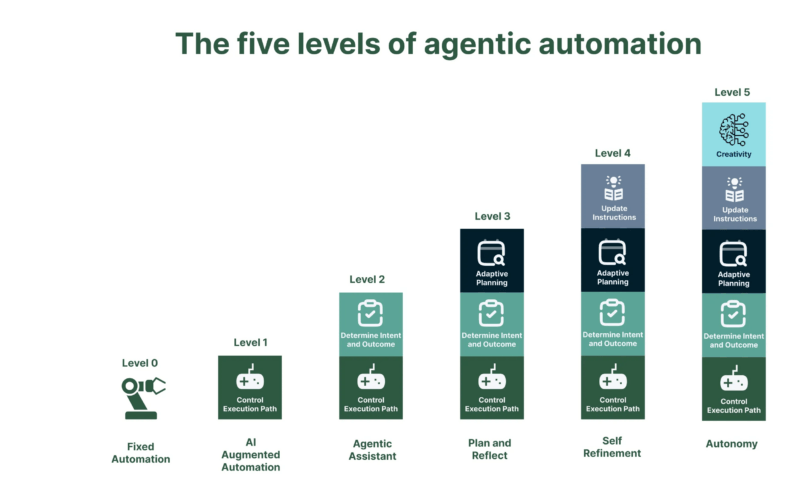
Level 0: Fixed Automation
At the ground level, fixed automation represents no true agentic behavior. It’s equivalent to traditional Robotic Process Automation (RPA) with a fixed set of rules and fully deterministic outcomes. There’s no planning or execution control, as everything is predetermined during programming. Human interaction is limited to handling exceptions, and the task range is confined to rule-based logic.
Example: Data entry to forms, websites, and business applications. Data collection and scraping.
Level 1: AI-Augmented Automation
To begin with, the first level introduces basic agentic behavior at the individual decision level. It’s essentially fixed automation with some steps augmented by large language models (LLMs). While it offers limited benefits over traditional automation, it represents the first step towards more advanced agency through constrained decision-making.
Example: Classifying customer support emails and forwarding them to the right teams.
Level 2: Agentic Assistant
As we move up a level, we see task-specific agentic automation assistants capable of using tool-calling. These systems can interpret user intent, determine the desired outcome, and take appropriate action – such as summarizing text, generating content, or using specific tools. However, they are limited to static, short-term plans.
Example: Conversational co-pilot for searching, summarizing, and drafting emails.
Level 3: Plan and Reflect
Today, this level is commonly called an AI agent, and it’s the first level to exhibit constrained autonomy. These agentic systems can create plans based on given intents, execute them, reflect on their success, and modify plans mid-execution if necessary. Many of today’s advanced AI agents operate at this level, capable of multiple reasoning cycles and planning to achieve desired outcomes.
Example: Reconciling a hundred-page invoice against internal systems based on a human-level set of rules and guidelines. Handles complexity, ambiguity, and variability in the process flow and data.
This is where most production finance-operations agents sit today, the level most vendors mean when they say “AI agent.”
Level 4: Self-Refinement
Level 4 agentic automation will be capable of meaningful self-improvement with or without human collaboration. It can examine and modify its instructions and learning data, create new tools, and connect to new data sources. This level of automation allows agents to keep up with evolving tasks and environments. While currently theoretical, we know that level 4 systems are possible. However, today’s AI models lack the reasoning power to support them in real-world business applications.
Example: Agent for complex invoice reconciliation that can add new vendors with minimal human coordination and improve accuracy over time.
Level 5: Autonomy
The highest level of agentic automation represents what many consider Artificial General Intelligence (AGI). These hypothetical agents exhibit original thinking and will synthesize solutions to previously unseen tasks. Leveraging advanced logical reasoning and creativity, Level 5 agents will be able to solve complex problems beyond their initial training.
Example: Digital knowledge worker capable of end-to-end processing of complex tasks with no oversight.
What’s next for agentic automation in 2026 and beyond?
As agentic AI matures, this framework remains a useful way to categorize the capabilities of agentic automation systems and set realistic expectations for what they can do. In 2026, most enterprise deployments still operate at Levels 2 and 3, task-specific assistants and plan-and-reflect agents capable of handling defined, if complex, workflows like invoice reconciliation and receivables matching. Level 4 and Level 5 remain future states: today’s models still lack the reasoning depth for reliable self-refinement or fully autonomous decision-making in high-stakes, regulated back-office work. As reasoning models and governance practices for agentic AI continue to mature, we expect gradual movement toward Level 4 capabilities, but Level 3, with strong human oversight, remains the practical ceiling for production finance operations today. This framework will continue to evolve as agentic systems and the standards around them develop.
Additional resources:
Blog: The AI Maturity Model and Strategic Differentiators
White paper: The enterprise maturity model
Frequently Asked Questions
What is agentic automation?
Agentic automation refers to AI systems that go beyond fixed, rule-based automation by exhibiting some degree of reasoning, collaboration, and independent action. Our five-level framework ranges from fixed automation (Level 0) to full autonomy (Level 5).
How is agentic automation different from RPA?
Traditional Robotic Process Automation (RPA) sits at Level 0 — fixed rules and fully deterministic outcomes with no planning or execution control. Agentic automation (Level 1 and above) adds reasoning and tool use that let a system adapt its approach rather than follow a fixed script.
What level of AI agent is most common in production today?
As of 2026, most enterprise deployments operate at Level 2 (agentic assistants) or Level 3 (plan and reflect), particularly for finance operations tasks like invoice reconciliation and accounts receivable matching.
What is a Level 3 “plan and reflect” AI agent?
A Level 3 agent can create a plan based on a given goal, execute it, reflect on the outcome, and adjust mid-execution. This is the level most vendors mean today when they use the term “AI agent.”
Is fully autonomous AI (Level 5) available today?
No. Level 5 — full autonomy comparable to artificial general intelligence, remains theoretical. Today’s models don’t yet have the reasoning power to support it in real-world business applications.
How does this framework apply to finance operations?
Finance and back-office teams can use these levels to evaluate vendor claims and scope automation projects realistically — for example, distinguishing a true Level 3 invoice reconciliation agent from Level 0–1 automation marketed as “AI.” See how Sema4.ai’s platform supports Level 3 finance operations workflows and beyond in production.


 Read more