 Back to blog

Finance transformation is the strategic modernization of enterprise financial operations – moving from manual processes, siloed and inflexible ERP systems that don’t communicate, and archaic policy manuals perpetually out of date to a modern, adaptable framework for business where humans and AI agents collaborate to accomplish the critical accounting and finance work with certainty, reliability and efficiency. This new world of finance accelerates insights and improves accuracy while ensuring compliance with accounting, governance and legal standards.
Transforming finance workflows with AI agents
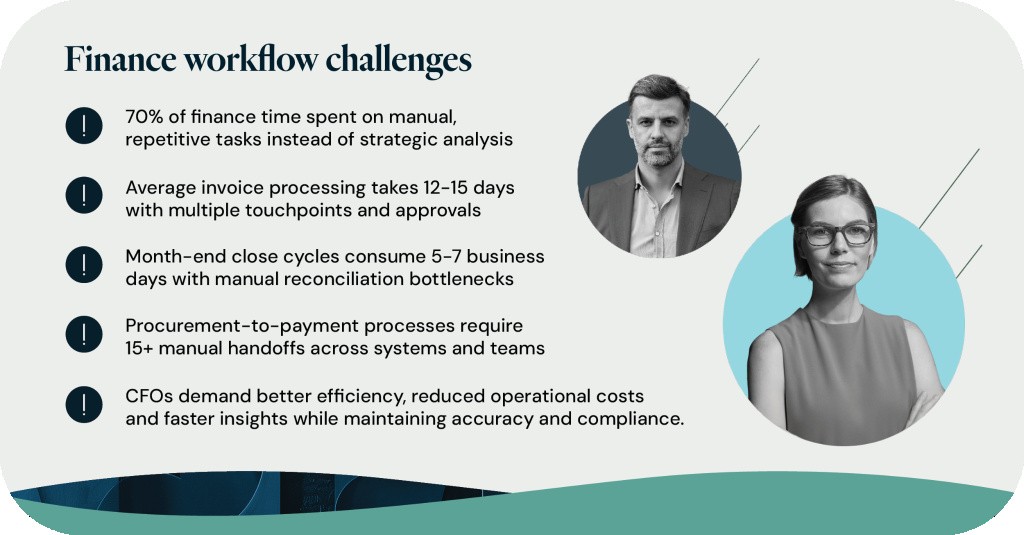
CFOs face an monumental equation. They’re expected to deliver faster closes, more accurate forecasts, tighter compliance, and strategic business partnership – all while managing the same headcount and an increasingly complex legal and business environment.
Finance transformation is central to solving this. It addresses:
- Operational efficiency – eliminating the manual, repetitive work that consumes 60-70% of finance team capacity
- Speed and accuracy – reducing financial close from weeks to days, and catching exceptions that manual review misses
- Strategic elevation – freeing finance teams from transaction processing to focus on analysis, planning, and business partnership
- Compliance and governance – embedding audit trails, policy enforcement, and controls directly into automated workflows
However, most finance transformation efforts to date have underdelivered. ERP upgrades are multi-year, multi-million-dollar projects. RPA automates only the simplest, most structured tasks. Spreadsheet-based processes persist across even the largest and most mature enterprises.
The missing capability is AI that can reason across systems, handle exceptions, and complete multi-step finance workflows end to end. AI agent platforms are enabling a new generation of finance transformation – one where intelligent agents handle the complex, judgment-intensive work that previous automation waves couldn’t touch.
Key takeaways about finance transformation
- Finance transformation is the strategic modernization of finance back-office operations from manual, siloed processes to AI-driven, end-to-end automated workflows.
- Traditional approaches (ERP upgrades, RPA, BI tools) address only structured, rule-based tasks and leave complex, exception-heavy processes untouched.
- Key use cases include accounts payable automation, three-way matching, financial close, reconciliation, compliance monitoring, and audit preparation.
- AI agents change the equation by reasoning across systems, handling exceptions, and completing multi-step finance processes autonomously.
- Enterprise deployment requires governance: human-in-the-loop controls, audit trails, policy enforcement, and observability.
- AI agent platforms like Sema4.ai operationalize finance transformation with built-in orchestration, ERP/banking integrations, and enterprise governance.
What is finance transformation?
Finance transformation encompasses automating transactional work, modernizing financial systems, elevating the finance team’s strategic role, and embedding real-time data and AI into financial decision-making.
The scope spans all accounting and finance functions including: accounts payable and receivable, general ledger and reconciliation, financial close and reporting, treasury and cash management, tax and regulatory compliance, and Financial Planning and Analysis (FP&A).
The evolution has followed a clear arc. First-wave transformation was ERP consolidation (SAP, Oracle). Second-wave was RPA for structured tasks. The third wave, now, is agentic AI that reasons, acts, and adapts across enterprise systems.
Why now? Increasing regulatory complexity, real-time reporting expectations, talent scarcity in skilled finance roles, and the maturity of AI agent technology have converged to make this the inflection point for CFO digital transformation.
Why do traditional finance automation approaches fall short?
Three waves of finance automation have each addressed part of the problem – but none has delivered the end-to-end finance digital transformation that enterprises need.
ERP upgrades consolidate data and standardize processes, but implementations are multi-year, rigid, and expensive. They improve the system of record but don’t automate the work that happens around and between systems.
Disparate systems remain. Enterprises greater than $500 million in annual revenue have yet to still have a significant number of business systems requiring coexistence, integration and collaboration
RPA (Robotic Process Automation) automates repetitive, rule-based tasks like data entry and report generation. But RPA bots break when formats change, can’t handle exceptions, and require constant maintenance. They automate keystrokes, not judgment.
BI and analytics tools improve visibility into financial data but still require humans to interpret, decide, and act. Dashboards surface insights; they don’t execute the resulting work.
Consider a three-way invoice match. RPA can pull data from three systems if the formats never change. But when a PO line item doesn’t match, when a vendor sends a non-standard invoice format, when a price variance needs escalation – the bot stops and creates a ticket for a human. An AI agent reasons through the exception, checks history, applies policy, and resolves it.
| Capability | ERP Upgrade | RPA | AI Agents |
| Multi-system workflow execution | Limited | Scripted sequences | Yes – dynamic orchestration |
| Exception handling | Manual escalation | Stops / flags for human | Reasons through exceptions |
| Unstructured data processing | No | No | Yes (invoices, emails, contracts) |
| Self-correcting | No | No | Yes (evaluates and retries) |
| Adapts to process changes | Requires reconfiguration | Requires re-scripting | Adapts with updated context |
| Time to value | 12-36 months | 4-12 weeks per bot | Days to weeks per workflow |
| Governance and audit trail | System-level logs | Limited | Full trace logging per step |
How do AI agents change what’s possible in finance transformation?
In the finance context, AI agents are autonomous systems that observe data across financial systems, reason about what actions to take, execute those actions using tool integrations with ERP, banking, and compliance systems, evaluate results, and iterate until the work is done.
The key capability shift is fundamental. Unlike RPA bots, AI agents don’t just follow scripts. They reason through exceptions, process unstructured data (invoices, emails, contracts), and make judgment calls within defined guardrails. This is what makes them suited for the 80% of finance operations automation that previous approaches couldn’t touch.
Enterprise tool integration means agents connect to ERP systems (SAP, Oracle, NetSuite), banking platforms, tax systems, document repositories, email, and communication tools – orchestrating work across the full technology landscape.
Critically, enterprise AI agents are designed with human-in-the-loop controls. They perform the repetitive tasks within the guidelines you establish while escalating to humans for high-value decisions, policy exceptions, and audit-sensitive transactions, thus maintaining control while automating the surrounding workflow.
What finance processes can AI agents automate?
| Process area | What the agent does | Systems involved | Business impact |
| Accounts payable | Invoice ingestion, three-way matching, exception resolution, payment scheduling | ERP, banking, email, vendor portal | 70-80% reduction in manual AP processing |
| Financial close | Journal entry preparation, intercompany reconciliation, variance analysis, checklist execution | GL, sub-ledgers, consolidation tools | Close cycle reduced from 10+ days to 3-4 |
| Accounts receivable | Cash application, deduction management, dunning/collections follow-up | ERP, banking, CRM, email | 50% faster cash application |
| Reconciliation | Bank reconciliation, intercompany matching, balance sheet substantiation | GL, banking APIs, sub-systems, treasury | 90%+ auto-match rate |
| Compliance and audit | Control testing, evidence gathering, regulatory report preparation | ERP, document repositories, policy engines | 60% reduction in audit prep time |
| FP&A support | Data aggregation, variance commentary drafting, forecast model population | ERP, data warehouse, planning tools | Analyst time elevated to strategic work |
Accounts payable automation in action – An AI agent handles an invoice from receipt to payment. It ingests the invoice (even non-standard formats), extracts key fields, matches against PO and receiving data, identifies discrepancies, reasons through exceptions using historical patterns and policy rules, routes for approval where required, and schedules payment. The agent handles the exceptions that break RPA – price variances, quantity mismatches, missing POs – by reasoning rather than stopping.
Financial close automation in action – AI agents compress the monthly close. They prepare and post journal entries, reconcile intercompany balances, identify and investigate variances, generate supporting documentation, and execute close checklists. The orchestration layer coordinates multiple agents working in parallel across sub-processes.
Compliance and audit preparation in action – Agents continuously monitor transactions against policy rules, gather evidence for control testing, flag exceptions for review, and compile audit-ready documentation packages. This shifts compliance from periodic, reactive fire drills to continuous, proactive monitoring.
Dive deeper into the top 5 use cases for transforming finance operations with AI agents.
What does a modern finance transformation roadmap look like?
A practical finance transformation strategy unfolds in four phases.
Phase 1: Assess and prioritize (weeks 1-4)
- Map current-state finance processes and identify highest-impact agentic automation candidates
- Quantify time spent on manual work, exception handling, and rework
- Identify quick wins (AP invoice processing, bank reconciliation) and strategic targets (financial close, compliance)
Phase 2: Pilot with high-impact workflows (weeks 5-12)
- Deploy AI agents on 1-2 high-volume, high-exception processes
- Establish governance framework: human-in-the-loop checkpoints, escalation policies, audit trail requirements
- Measure baseline vs. automated performance (cycle time, accuracy, exception rate)
Phase 3: Scale across finance operations (months 4-9)
- Expand to additional processes: AR, close, compliance, FP&A support
- Integrate multi-agent orchestration for cross-functional workflows
- Refine governance and change management based on pilot learnings
Phase 4: Continuous optimization (ongoing)
- Monitor agent performance through observability dashboards
- Expand tool integrations as business systems evolve
- Evolve from task automation to strategic finance partnership – agents handle operations, humans drive strategy
What are the business challenges in finance transformation?
Data quality and system fragmentation – Finance data lives across ERP, banking, spreadsheets, email, and other legacy systems. Agents need clear data context. Transformation stalls when integration is an afterthought.
Change management and adoption – Finance teams are risk-averse by design. Transformation requires demonstrating reliability, building trust through transparency (audit trails, explainability), and starting with quick wins.
Governance and compliance risk – Automating finance processes with AI introduces new compliance considerations. Every automated decision must be auditable, policy-compliant, and reversible.
Organizational alignment – Finance transformation is not just a technology initiative. It requires alignment between Finance, IT, and executive leadership on priorities, budgets, and success metrics.
Vendor and platform selection – The market is crowded with point solutions. Organizations need platforms that provide end-to-end orchestration, not just single-task automation.
These challenges are not reasons to delay finance transformation – they are reasons to choose platforms with built-in governance, enterprise integrations, and human-in-the-loop design rather than stitching together point solutions.
How do you govern AI agents in finance operations?
Governance is the non-negotiable requirement that separates production-ready AI from experiments. For enterprise finance automation, five capabilities are essential.
Human-in-the-loop controls – Configurable approval checkpoints for transactions above dollar thresholds, policy exceptions, new vendor payments, and any action with financial materiality.
Audit trail and traceability – Every reasoning step, tool call, data access, and decision is logged with full context. This isn’t optional for finance – it’s a regulatory requirement.
Policy enforcement – Guardrails that constrain agent behavior: which systems they can access, what data they can modify, what approval chains they must follow. Configurable per process, per entity, per jurisdiction.
Segregation of duties – AI agents must respect the same SOD controls as human users. An agent that creates a journal entry should not also approve it.
Continuous monitoring and alerting – Real-time observability into agent performance, exception rates, and anomaly detection. Finance leaders need dashboards, not black boxes.
How does Sema4.ai enable AI-powered finance transformation?
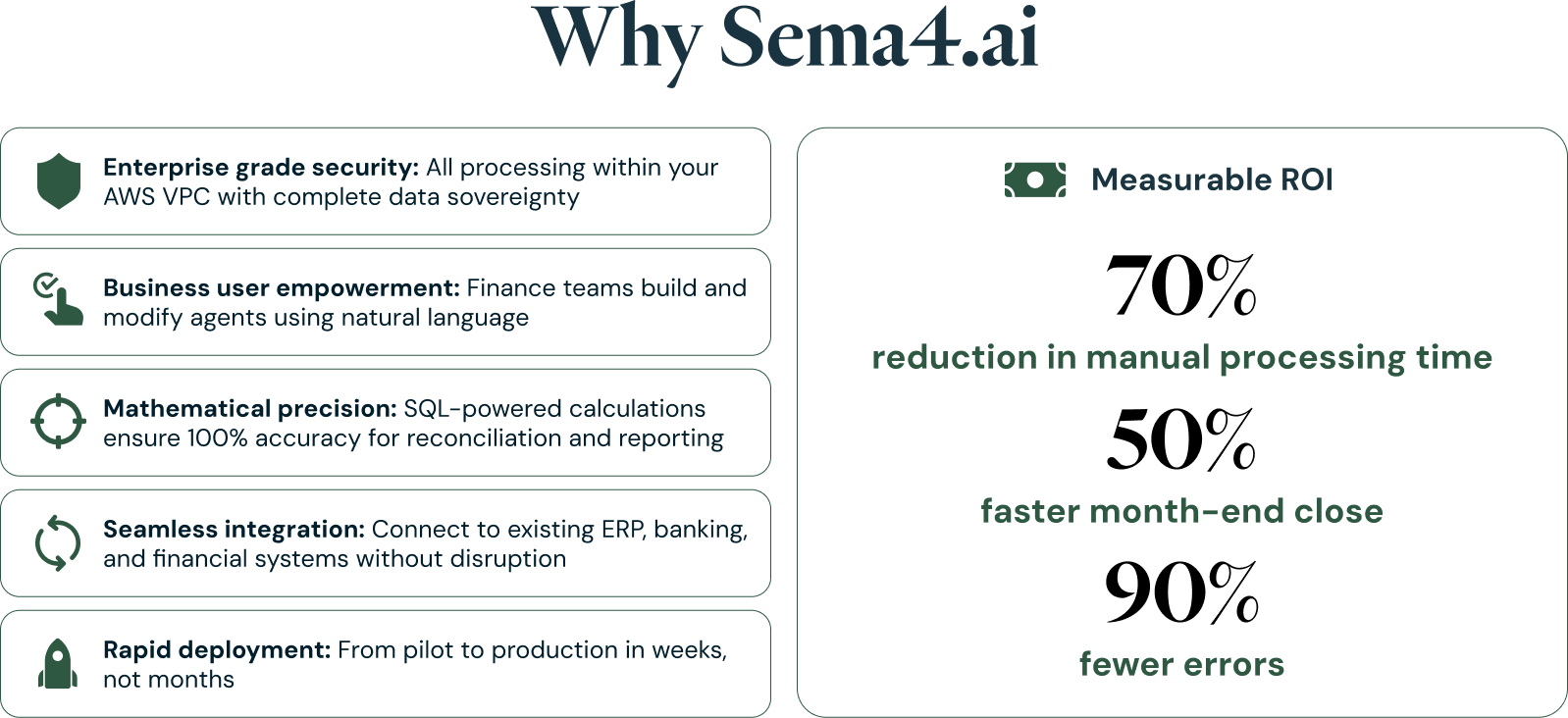
Sema4.ai’s AI agent platform operationalizes finance transformation with purpose-built capabilities for the complexity and governance requirements of enterprise finance.
- Orchestration – coordinates multi-step, multi-agent finance workflows across ERP, banking, compliance, and communication systems
- Tool integration – pre-built connectors to SAP, Oracle, NetSuite, banking APIs, tax systems, document repositories, and business applications
- Governance – human-in-the-loop checkpoints, configurable guardrails, policy enforcement, and segregation of duties built into every workflow
- Observability – full trace logging of every reasoning step, tool call, and decision for audit readiness and continuous improvement
- Worker Agents – execute finance workflows autonomously with enterprise-grade reliability, operating 24/7 on invoice processing, reconciliation, close tasks, and compliance monitoring
- Agent Studio – enables finance teams to build and deploy agents using natural language Runbooks, without requiring engineering resources
Finance leaders modernizing complex, multi-system operations are moving beyond RPA and spreadsheet-based processes to AI agents that reason across ERP, banking, and compliance systems in real time. Learn how Sema4.ai’s AI agent platform provides the orchestration, governance, and enterprise integrations that make finance transformation production-ready at scale.
How do you measure ROI on finance transformation?
| Metric category | KPIs | Typical impact |
| Efficiency | Cost per invoice, cost per transaction, FTE hours saved | 40-70% reduction in process cost |
| Speed | Days to close, invoice cycle time, reconciliation turnaround | 50-75% reduction in cycle time |
| Accuracy | Exception rate, error rate, first-pass match rate | 90%+ straight-through processing |
| Compliance | Audit findings, control exceptions, remediation time | 60%+ reduction in audit prep effort |
| Strategic value | % of finance team time on analysis vs. processing | Shift from 70/30 processing to 30/70 strategic |
The most compelling ROI metric for CFOs is the shift in team composition: from a finance function that spends most of its capacity on transactional processing to one that operates as a strategic business partner, with AI agents handling the operational workload.
Finance transformation resources
- Explore solutions for Office of the CFO
- Learn more about the top 5 finance use cases
- Customer success: Koch’s autonomous invoice reconciliation
- Get a demo
FAQs on finance transformation
What is finance transformation? Finance transformation is the strategic modernization of enterprise finance operations, moving from manual processes and siloed systems to AI-driven, end-to-end automated workflows that improve speed, accuracy, compliance, and strategic value.
How is AI changing finance operations? AI agents automate complex, multi-step finance workflows that previous technologies couldn’t touch. They reason through exceptions, process unstructured documents, and orchestrate work across ERP, banking, and compliance systems autonomously.
What is the difference between RPA and AI agents for finance? RPA automates structured, rule-based tasks and stops when exceptions occur. AI agents reason through exceptions, adapt to document variations, handle unstructured data, and complete multi-step workflows end to end without human intervention.
What finance processes can be automated with AI agents? Key processes include accounts payable, accounts receivable, financial close, bank reconciliation, intercompany settlement, compliance monitoring, audit preparation, and FP&A.
How long does finance transformation take? Initial pilot deployments can deliver measurable results in 5-12 weeks. Scaling across finance operations typically takes 6-9 months, with continuous optimization ongoing as processes and systems evolve.
What does a finance transformation roadmap look like? A modern roadmap follows four phases: assess and prioritize (weeks 1-4), pilot high-impact workflows (weeks 5-12), scale across operations (months 4-9), and continuously optimize (On-going) with observability and expanded integrations.
How do you govern AI in finance? Governance requires human-in-the-loop controls, full audit trails, policy enforcement guardrails, segregation of duties, and continuous monitoring – all configured per process and jurisdiction.
How do you measure ROI on finance transformation? Key metrics include cost per transaction, cycle time reduction, straight-through processing rates, audit prep time, and the percentage of finance team time redirected from processing to strategic analysis.
What are the biggest risks in finance transformation? Primary risks include data quality gaps, change management resistance, governance gaps in AI-driven decisions, organizational misalignment, and choosing point solutions that can’t scale across processes.
Can AI agents work with legacy ERP systems? Yes. Enterprise AI agent platforms connect to SAP, Oracle, NetSuite, and other legacy systems through APIs and pre-built connectors, orchestrating work across the existing technology landscape without requiring system replacement.


 Read more