 Back to blog

Last week, I attended Gartner’s Data and Analytics Summit, a key event illuminating the critical shifts in our industry as AI transforms the landscape of enterprise data and automation. Thank you to Gartner for providing a platform that highlights how AI is fundamentally changing our path forward.
Connecting with our community
One of the highlights for me was reconnecting with many of our Sema4.ai customers and partners who were in attendance. These conversations reinforced something we’ve believed from day one: the organizations that will thrive in the AI era are those that understand the fundamental difference between adding AI features and building on AI-native foundations. The insights shared by our community, ranging from transformation leaders to process owners to AI developers, continue to shape our understanding of enterprise AI agents and their transformative potential.
The AI washing reality check
However, I’d be remiss if I didn’t address the elephant in the room: the widespread “AI washing” that was evident throughout the summit. Legacy data and analytics vendors were out in full force, retrofitting and retreading AI capabilities onto decades-old platforms and marketing them as revolutionary breakthroughs.
We witnessed dashboard vendors claiming “AI-powered insights” that amounted to basic pattern recognition. Traditional ETL platforms touting “intelligent automation” still required extensive coding and configuration. Business intelligence tools promise “natural language queries” that work only for simple, predefined scenarios.
This surface-level approach to AI integration represents a fundamental misunderstanding of what makes AI transformative for enterprises. Bolt-on AI features may generate impressive demos, but they fall far short of delivering the autonomous intelligence that businesses need to truly reimagine how work gets done.
The AI-native platform advantage: Why architecture matters
The reality is that true AI success requires platforms built from the ground up on LLM and agent architectures. This isn’t just about having AI features; it’s about having AI intelligence woven into the very fabric of how the platform operates top to bottom.
What makes a platform truly AI-native
- Native understanding of business context: AI-native platforms don’t just process data; they understand it. This goes beyond simple keyword matching to sophisticated context engineering, which enables the ability to maintain business context, relationships, and meaning throughout complex, multi-step processes. When an AI agent understands that a “customer escalation” in your CRM relates to specific compliance requirements, delivery timelines, and stakeholder notification procedures, it can reason and act accordingly without explicit programming.
- Autonomous reasoning and decision-making: Unlike traditional platforms that execute predefined workflows, AI-native architectures enable agents to plan, reason, and adapt in real-time. They can handle exceptions, make judgment calls, and learn from outcomes, capabilities that are impossible to retrofit onto legacy systems designed for deterministic processing.
- Natural language as the primary interface: In AI-native platforms, business users define processes and logic using plain English, not code or complex configuration screens. This isn’t a thin veneer of natural language processing over traditional interfaces; it’s a fundamental reimagining of how humans interact with enterprise systems.
The Sema4.ai difference: Purpose-built for the AI era
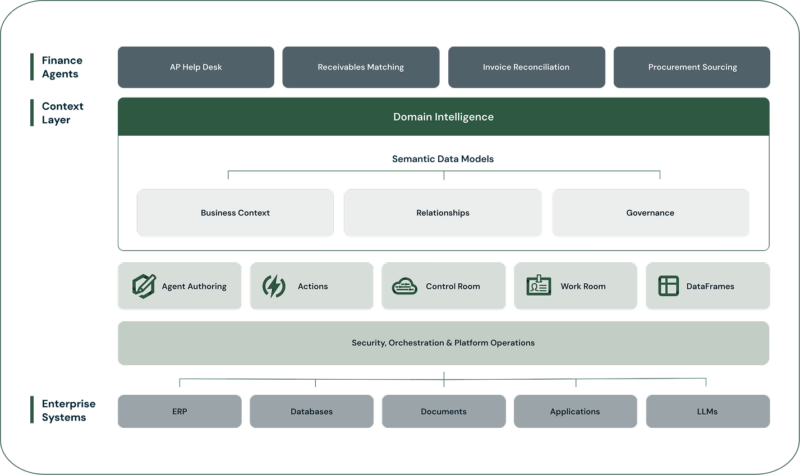
At Sema4.ai, we’ve built our Enterprise AI Agent Platform with this AI-native philosophy from day one. Our agents aren’t AI features added to an existing platform; they represent a fundamentally different approach to enterprise automation.
Business users create agents using natural language runbooks, eliminating the technical barriers that have traditionally limited automation to IT teams. Transparent reasoning ensures that every decision and action can be understood and validated by business stakeholders. Worker agents operate autonomously 24/7, handling complex document-centric processes while providing complete visibility into their work.
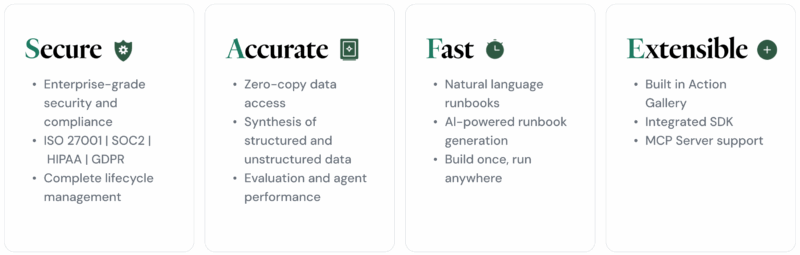
Our SAFE framework ensures enterprise readiness: Secure deployment in your AWS VPC or Snowflake environment, Accurate results through mathematical precision and enterprise-grade LLMs, Fast deployment with one-click agent publishing, and Extensible connectivity to any enterprise application.
This isn’t about making existing tools slightly smarter; it’s about reimagining work itself through agents that understand, reason, and act with human-like intelligence while maintaining the reliability and governance that enterprises require.
Looking forward: The competitive advantage of AI-native architecture
The conversations at the summit made one thing clear: we’re at an inflection point. Organizations that recognize the difference between AI washing and AI-native capabilities will build significant competitive advantages. They’ll automate processes that their competitors can’t touch, make decisions with insights their rivals can’t generate, and adapt to market changes with agility that traditional platforms simply cannot support.
The future belongs to enterprises that embrace purpose-built AI architectures, not those that settle for AI features bolted onto legacy systems.
The path forward
If the Gartner Data and Analytics Summit demonstrated anything, it’s that the AI era demands AI-native thinking. The organizations that thrive will be those that move beyond the comfort of familiar tools enhanced with AI features to platforms designed from the ground up for intelligent automation.
At Sema4.ai, we’re committed to leading this transformation, not by retrofitting yesterday’s technology with today’s AI capabilities, but by building tomorrow’s enterprise platform today.
Ready to experience the difference of an AI-native platform? Contact us to see how Sema4.ai enterprise AI agents can transform your most complex business processes into autonomous, intelligent workflows.


 Read more