 Back to blog

I’m going to make a bold statement: the semantic layer is the most underestimated capability in enterprise AI, and its absence is why most agent deployments fail to scale beyond pilots.
After years of building enterprise automation platforms and watching countless AI initiatives stall, I’ve become convinced that the industry has been solving the wrong problem. We’ve obsessed over making LLMs smarter, faster, and cheaper while ignoring a fundamental truth – agents are only as useful as their understanding of your data.
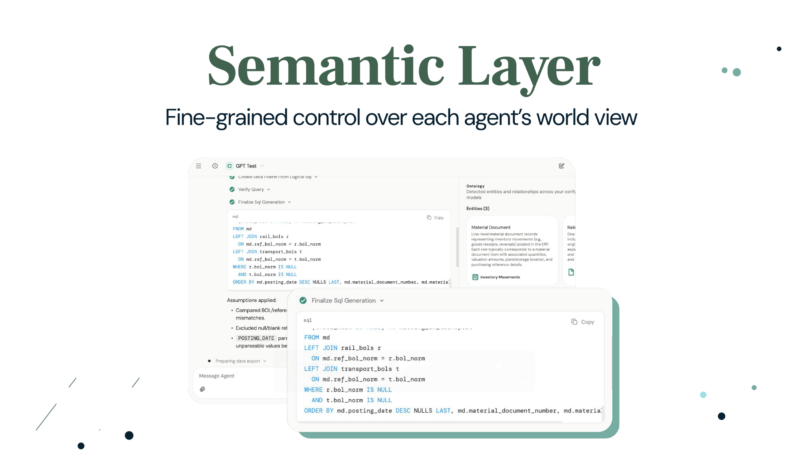
An enterprise semantic layer is a business-logic abstraction that sits between your raw data infrastructure and the applications including AI agents and LLMs that consume that data. It translates complex database schemas, table relationships, and metric calculations into standardized business terms, so that every query returns a consistent, accurate answer regardless of who or what is asking. For enterprises deploying AI agents at scale, the semantic layer is what turns raw data access into reliable business understanding.
The data access crisis no one talks about
Here’s what actually happens in most enterprises today: a business analyst needs to reconcile invoices against payment records. Simple enough, right? Except the invoice data lives in PDFs with dozens of different formats. The payment records are in Snowflake, but you need SQL expertise to query them. And when you finally extract both datasets manually, you’re stuck joining them in Excel – prone to errors, impossible to audit, and completely unsuited for the millions of rows enterprises actually process.
This isn’t an edge case. This is how work gets done in 2026.
The result? Business users waste days on tasks that should take minutes. Data engineering teams become bottlenecks for every analysis request. And AI agents, despite all their sophisticated reasoning capabilities, sit idle because they can’t access the data they need to actually do work.
Why LLMs alone will never solve this
The AI industry’s default answer has been to throw more powerful models at the problem. “Just use GPT-5!” “Claude Opus 4 can handle this!” But here’s the uncomfortable truth: even the most advanced LLMs fundamentally misunderstand enterprise data challenges.
LLMs see data syntactically, not semantically. They can generate SQL queries, sure but they don’t understand what your customer id field actually means to your business, how it relates to your account number in a different system, or why certain invoice formats require special handling. They can extract text from documents, but they can’t learn your business rules for validation or adapt to the endless variations in how vendors format invoices.
And critically, LLMs are terrible at math. When you need mathematically accurate reconciliation of financial data across millions of rows, sending everything through an LLM’s context window isn’t just expensive – it’s fundamentally unreliable. You can’t build auditable financial processes on technology that occasionally hallucinates numbers.
How do semantic layers help LLMs understand business data?
Large language models are powerful at interpreting natural language, but they have no inherent understanding of your business data. When an LLM receives a question like “What was Q2 revenue by region?”, it needs to know which table contains revenue data, how “revenue” is calculated (gross vs. net vs. recognized), what “region” maps to, and what date range defines Q2 in your fiscal calendar.
Without a semantic layer, the LLM either hallucinates an answer, generates an incorrect query, or requires a data engineer to hand-craft the translation. With a semantic layer, these business definitions are codified once and served to every LLM, AI agent, and analytics tool consistently.
A semantic layer provides LLMs with:
• Standardized metric definitions – so “revenue” means the same thing in every query
• Entity relationships – so the model knows how customers, orders, and products connect
• Business context – so time periods, regions, and hierarchies map correctly
• Query translation – so natural language questions become accurate SQL or API calls
This is what makes the difference between an LLM that gives plausible-sounding but wrong answers and one that returns the same number your finance team would.
The three-dimensional solution enterprises actually need
This is why we built our semantic layer as an integrated system combining three capabilities that must work together:
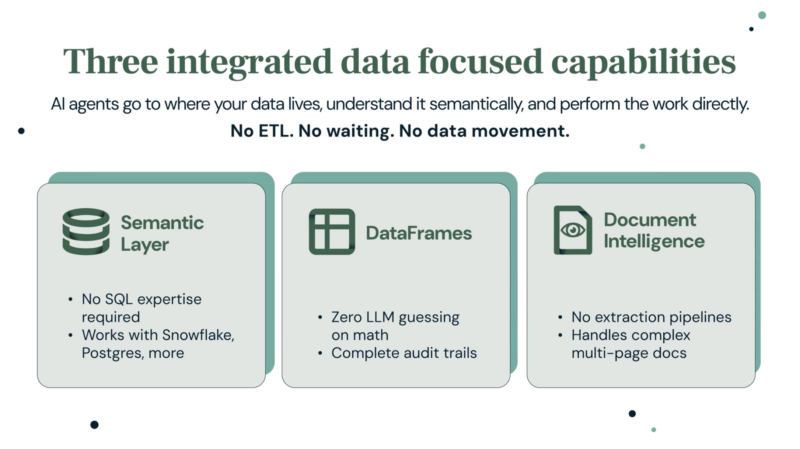
Semantic data models that teach agents what data means, not just where it lives. Our AI automatically profiles your database structures and learns business context, enabling agents to understand that “revenue” in your Snowflake warehouse relates to “total amount” on your invoices, even when the field names differ.
DataFrames that provide agents with an intelligent workspace for mathematically precise analysis. Unlike LLM-based approaches, DataFrames uses SQL for all calculations, ensuring complete accuracy and auditability when processing millions of rows across multiple data sources.
Document Intelligence that transforms unstructured data into agent-ready structured information. Business users teach the system how to understand their documents once through AI-guided configuration, then it automatically adapts to variations – handling 100+ page invoices with dense tables across any format or language.
The magic happens in how these capabilities integrate. When an agent queries your database through a semantic data model, results automatically become DataFrames for further analysis. When Document Intelligence extracts tables from a PDF, that data instantly becomes a structured DataFrame ready for joining with database queries. An agent can extract invoice line items from a complex PDF, join that with payment records from your ERP, and perform mathematically precise reconciliation analysis – all through natural conversation.
What does a semantic layer architecture look like for enterprise AI?
A semantic layer for enterprise AI agents sits at the intersection of your data infrastructure and your AI application layer. The architecture typically follows a four-tier model:
Data sources (bottom tier):
Your ERP systems, data warehouses, data lakes, SaaS application databases, and operational systems — the raw data in its native schemas and formats.
Semantic layer (middle tier):
The abstraction that maps raw data into business-meaningful entities, metrics, dimensions, and relationships. This is where metric definitions are standardized, access controls are enforced, and business logic is codified.
AI agent / LLM layer (application tier):
The AI agents and LLMs that consume the semantic layer to answer questions, execute workflows, and take actions. They query the semantic layer rather than raw databases, ensuring accuracy and consistency.
Business users (top tier):
Analysts, executives, and operational teams who interact with AI agents through natural language, dashboards, or automated workflows receiving answers grounded in a single source of business truth.
How semantic layers support multi-agent enterprise AI
As enterprises move from single AI agents to multi-agent architectures – where specialized agents handle finance, sales, operations, and customer service tasks simultaneously – the semantic layer becomes the shared context that keeps them aligned.
Without a shared semantic layer, each agent may interpret “customer” or “revenue” differently based on whatever data source it accesses. One agent’s “active customer” might include trial users while another excludes them. A semantic layer ensures every agent in the system operates from the same business definitions, the same metric calculations, and the same entity relationships regardless of which underlying data source it queries.
This shared context layer is what makes multi-agent orchestration reliable at enterprise scale. It’s the difference between agents that collaborate coherently and agents that produce contradictory outputs.
Why we built on open standards
We made a deliberate architectural choice to build our semantic data models using Snowflake’s Open Semantic Interchange (OSI) format. This wasn’t just about standards compliance – it reflects a core belief about how enterprise technology should work.
Your semantic understanding of data is too valuable to lock into a proprietary format. As the semantic layer ecosystem evolves, your models should be portable, shareable, and compatible with emerging tools and platforms. OSI provides that foundation, ensuring your investment in semantic modeling remains flexible as the landscape changes.
Real results that matter
I’m a builder, not a marketer, so I care most about what actually works in production. Our early customers are seeing results that validate this architectural approach:
A large manufacturer now reconciles gas invoices in 2 minutes instead of 3 hours, processing 350+ monthly invoices with over 90% autonomous accuracy. A financial services team reduced cash matching review from hours to minutes while increasing accuracy from 20% to over 80%. Process analysts complete complex data reconciliation across multiple sources in minutes versus weeks.
These aren’t incremental improvements. They’re order-of-magnitude transformations in how work gets done.
Real-world scenario:
“Our analysts keep asking for the same data in different formats, would a semantic layer help?”
This is one of the most common signs that an organization needs a semantic layer. When the same metric revenue, churn, pipeline returns different numbers depending on which dashboard, spreadsheet, or AI tool generates the answer, the root cause is almost always that business logic lives in multiple places instead of one. A semantic layer centralizes metric definitions, calculation logic, and dimensional hierarchies so that every consumer, whether it’s an analyst running a report, a BI dashboard, or an AI agent answering a Slack question gets the same answer. No more reconciling conflicting numbers across teams.
The bottom line for technical leaders
If you’re evaluating AI agent platforms, here’s my strong recommendation: don’t settle for solutions that only handle structured data or unstructured data. Don’t accept platforms that require your business users to know SQL. And absolutely don’t deploy agents that use LLMs for mathematical operations on business-critical data.
The semantic layer is not optional infrastructure. It’s the foundational capability that determines whether your agents can actually do useful work or remain expensive chatbots.
Enterprise AI agents will only deliver on their promise when they can understand all your data databases, documents, spreadsheets with true semantic comprehension and mathematical precision. That’s what we’ve built, and it’s available today.
Frequently Asked Questions About Semantic Layers for Enterprise AI
Q: What is a semantic layer for AI agents?
A: A semantic layer is a business-logic abstraction that sits between raw enterprise data and AI agents, translating complex database schemas into business terms so agents can accurately query, interpret, and act on data without requiring direct database knowledge.
Q: Why do enterprise AI agents need a semantic layer?
A: Without a semantic layer, AI agents must interpret raw table structures and column names, leading to inaccurate queries and hallucinated results. A semantic layer provides standardized metrics definitions, entity relationships, and business rules that agents need to return reliable, consistent answers.
Q: How does a semantic layer help LLMs understand business data?
A: A semantic layer maps natural language business concepts to underlying data structures, enabling LLMs to translate questions like “show me Q2 revenue by region” into accurate queries without needing to understand the schema directly. It provides the business context LLMs lack out of the box.
Q: What is the difference between a semantic layer and a data catalog?
A: A data catalog documents where data lives and who owns it. A semantic layer defines what the data means, standardizing metric calculations, dimension hierarchies, and business rules so that every AI agent, LLM, or analyst gets the same answer to the same question.
Q: Can a semantic layer work with multiple AI agents?
A: Yes. A semantic layer acts as a shared context layer for multi-agent architectures, ensuring that every agent whether handling finance, sales, or operations uses the same business definitions, metric logic, and data relationships when querying enterprise systems.
Q: Would a semantic layer help if analysts keep getting different answers from the same data?
A: This is one of the core problems a semantic layer solves. By centralizing metric definitions and business logic in a single layer, a semantic layer ensures every query whether from an analyst, a dashboard, or an AI agent returns the same consistent answer.
Paul Codding is co-founder and SVP of Product and Customer Experience at Sema4.ai. He has spent two decades building enterprise automation platforms and remains convinced that the best technology is the kind that disappears into how work gets done.


 Read more