Back to learning center
AI in finance: how it works, use cases, and real-world examples


AI in finance refers to the use of autonomous AI agents to automate, accelerate, and improve financial processes – including forecasting, reconciliation, payable,receivables and reporting – enabling finance teams to do more with less manual effort.
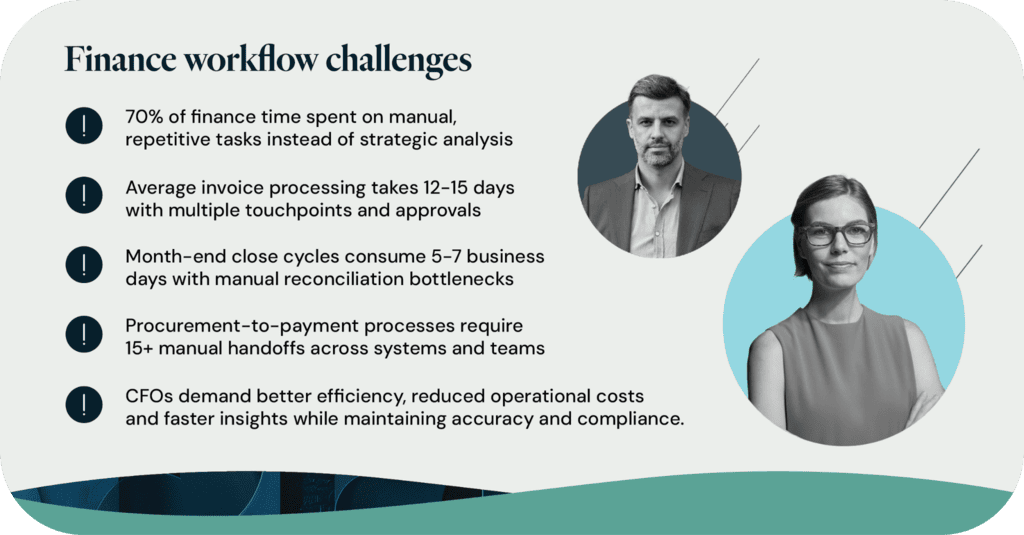
Every month-end, finance teams face the same grind. Analysts manually match thousands of invoices against purchase orders. Controllers reconcile accounts across subsidiaries line by line. FP&A leads spend days pulling data from disparate systems to assemble variance commentary. The work is critical, but it’s also repetitive, error-prone, and consumes the majority of your team’s capacity.
AI in finance is changing this reality. However, the shift isn’t about chatbots answering questions. It’s about intelligent systems that execute complex, multi-step financial workflows end-to-end.
Today, AI in corporate finance spans three levels of capability:
According to McKinsey, organizations deploying AI in finance operations report 30-50% reductions in manual processing time. The opportunity isn’t theoretical. It’s operational and measurable.
The question for finance leaders isn’t whether AI belongs in the finance department. It’s how to deploy with the accuracy, repeatability, governance, and auditability that financial operations demand.
Honest assessment of the Deployment and trust challenges builds the foundation for successful AI deployment:
Data quality and fragmented systems
Legacy infrastructure, disparate data spread across ERPs, banking platforms, and spreadsheets introduce real risks. AI in finance is only as good as the data it can access and the connections between systems.
Auditability hurdles
Black-box AI models are unacceptable in regulated finance environments. Every decision an AI system makes in a financial workflow must be traceable, explainable, and reproducible. This eliminates most general-purpose AI tools from consideration.
Accuracy requirements
Probabilistic models generating incorrect financial figures is not a minor inconvenience. It’s a compliance risk. Finance demands deterministic, mathematically precise outputs for reconciliations, GL postings, and compliance reporting.
These challenges aren’t reasons to avoid AI in the finance department. They’re requirements that the right platform must solve by design.
AI in finance is the application of autonomous agents to financial operations. It encompasses everything from simple rule-based automation to sophisticated agents that reason across systems and handle exceptions dynamically.
Understanding how AI is used in finance requires recognizing a maturity spectrum:
Finance is an ideal domain for AI because the data is structured, the processes are rule-rich, and volumes are high. However, there’s a critical distinction between point-solution AI tools that handle a single task and integrated, workflow-level platforms that orchestrate entire processes across multiple systems.
The most impactful implementations of AI in corporate finance operate at the workflow level, coordinating document extraction, data validation, system queries, exception handling, and posting in a single end-to-end flow.
How can AI be used in finance across different functions? Here’s how AI maps to specific tasks in the finance department:
| Finance function | Task | How AI is used | Outcome |
| Accounts Payable | Invoice processing | Extracts data, matches POs, flags exceptions, schedules payment | 80% reduction in manual processing time |
| Accounts Receivable | Collections | Monitors aging AR, drafts and sends collection emails, logs outcomes | DSO reduction, reduced write-offs, Improve customer satisfaction |
| Financial Close | Reconciliation | Matches transactions, identifies and categorizes variances, prepares workpapers | Close cycle reduced by up to 50% |
| Treasury | Cash flow forecasting | Analyzes open AR/AP, pipeline, and market signals for rolling forecasts | Real-time cash visibility |
| FP&A | Financial forecasting | ML models analyze historical data and external signals for rolling forecasts | 20-30% improvement in forecast accuracy |
| Audit & Compliance | Anomaly detection | ML scores every transaction against behavioral baselines, flags outliers | Up to 95% fraud detection rate |
| Financial Reporting | Report generation | AI drafts variance commentary, management accounts, and narratives | Hours of manual effort eliminated per cycle |
Each of these represents a real-world application of AI in the finance department, not a future vision but a present-day capability being deployed across enterprises today.
For finance leaders evaluating how to use AI in finance, a capability maturity model provides the clearest path forward:
Level 1 – AI-assisted
AI provides recommendations; humans decide and act. For example, an AP clerk reviews AI-flagged invoice exceptions before approving payment. The system does the analysis. The person makes the call.
Level 2 – AI-automated
AI executes tasks within defined rules and thresholds without manual intervention per transaction. A three-way PO match under $10K processes automatically, while transactions above the threshold are routed for human review.
Level 3 – AI-agentic
AI agents reason dynamically across systems, handle exceptions, and complete end-to-end workflows autonomously. They escalate only when human judgment is genuinely needed. An agentic reconciliation process pulls data from multiple sources, identifies variances, categorizes them, proposes adjusting entries, and prepares workpapers, only flagging truly ambiguous items for analyst review.
The key insight: enterprises don’t need to jump to Level 3 immediately. They mature each business process based on governance and readiness, starting with the highest-volume, most rule-bound tasks and progressing as AI confidence builds.
Here are concrete AI examples in finance that illustrate what’s possible today:
Invoice-to-pay automation
An AI agent monitors the AP inbox continuously. When invoices arrive, it extracts structured data from PDFs regardless of format, validates line items against the ERP, performs three-way matching with POs and goods receipts, and schedules clean payments. Exceptions route to analysts with full context. Processing time drops from hours per invoice to minutes.
Month-end close acceleration
Rather than analysts manually reconciling intercompany balances across subsidiaries, AI agents pull GL and subledger data, identify and categorize reconciling items, flag mismatches, and auto-prepare workpapers. The close cycle compresses from days to hours.
Predictive cash flow forecasting
ML models process 24 months of historical data alongside open AR, AP aging, and macroeconomic signals to produce daily rolling cash forecasts. Treasury teams gain real-time liquidity visibility rather than relying on weekly manual spreadsheet updates.
FP&A variance commentary
Agents compare actuals to budget across every cost center, identify the material deviations, determine the drivers, and draft narrative commentary for board packs. Analysts review and refine rather than starting from scratch each period.
The benefits of AI in corporate finance are measurable and well-documented:
Governance is what separates experimental AI pilots from production-grade enterprise AI automation. Effective AI governance in finance rests on four pillars:
Human-in-the-loop controls
Define clear dollar or process thresholds requiring manual approval. Payments above a certain amount, journal entries affecting specific accounts, or exceptions matching certain patterns are routed to humans with full context for decision-making.
Audit trails and explainability
Every reasoning pathway, data access point, and system action must be logged with complete traceability. When an auditor asks, “why did the system process this invoice this way?” the answer must be immediate and precise.
Data access boundaries
Role-based permissions should mirror the department’s existing authorization matrix. AI agents should access only the data and systems their role permits, exactly like human team members.
Continuous validation
Model outputs must be rigorously benchmarked against actual financial results. Drift detection, accuracy monitoring, and performance tracking ensure the system maintains the standards finance requires.
Sema4.ai’s enterprise AI agent platform is purpose-built for the document-heavy, data-intensive, multi-step work that defines finance operations:
See how Sema4.ai’s Worker Agents handle multi-step finance processes – from invoice matching to variance analysis – without manual intervention. Learn more →
Three trends are reshaping AI in corporate finance over the next two to three years:
Continuous accounting
The traditional month-end crunch is giving way to real-time, continuous processing. As AI agents continuously handle reconciliation, journal entry preparation, and variance analysis, the concept of a discrete “close period” becomes less relevant. Finance teams shift from batch processing to exception management.
Autonomous FP&A and treasury
AI agents will handle full forecasting cycles, from data gathering and model generation to scenario analysis and liquidity recommendations, under human sign-off. The analyst’s role evolves from building the forecast to validating and refining it.
Workflow redesign
Redesigned workflows incorporating agentic AI will fundamentally change the way finance functions are performed in the future. Layering AI on existing processes simply ‘papers over’ inefficiencies and adds another layer of complexity to be managed. Redesign will allow finance teams to work with trusted data at the root level and construct efficient workflows minimizing friction in the system
What is AI in finance?
AI in finance refers to the application of machine learning, natural language processing, and autonomous AI agents to financial operations. It encompasses automated data extraction, predictive analytics, intelligent workflow orchestration, and autonomous process execution across ERP, banking, and reporting systems.
How is AI used in finance today?
Finance teams currently use AI for invoice processing and three-way matching, account reconciliation, predictive cash flow forecasting, variance analysis and commentary generation, fraud and anomaly detection, and automated financial reporting.
How can AI be used in finance to improve efficiency?
AI eliminates manual, repetitive tasks that consume 60-80% of the finance team capacity. Organizations report 30-50% reductions in processing time, with some workflows like invoice reconciliation seeing time savings of 95% or more when AI agents handle end-to-end processing.
What are some AI examples in accounting ?
Common examples include three-way matching with Purchase Orders, receiving documents and accounts payable invoices, automated intercompany reconciliation at month-end close, ML-driven rolling cash forecasts in treasury, and AI-generated variance commentary for FP&A board packs.
How can teams use AI in corporate finance?
In corporate finance, AI is applied to treasury positioning and liquidity management, scenario modeling for strategic planning, multi-subsidiary data synthesis for consolidated reporting, and rolling forecast generation that incorporates both internal data and external market signals.
Will AI replace finance jobs?
AI does not replace finance professionals. It shifts their role from repetitive data processing to strategic analysis, exception management, and oversight. Finance teams become more valuable as they direct AI agents and focus on judgment-intensive work that requires human expertise.
What AI tools are used in finance departments?
Finance departments use a range of tools from basic ERP-embedded AI features to cross-application platforms. The most impactful tools are those that orchestrate entire workflows across multiple systems, like Sema4.ai’s enterprise AI agent platform, rather than point solutions addressing a single task. Deploying the correct AI approach finance departments will ensure the most appropriate solution to the requirements, whether it’s AI-assisted (providing recommendations), AI-automated (limited task execution) or agentic AI (dynamic reasoning, exception handling and task completion).
How do you govern AI in a finance department?
Effective governance requires human-in-the-loop safeguards at defined thresholds, role-based data access controls, immutable audit trails logging every decision and action, and continuous validation of AI outputs against actual financial results.
Ready to see AI in finance in action?

 Learn about Agent Studio