 Back to learning center
What is agentic AI and how it transforms enterprise automation

Sema4.ai Announces Semantic Layer Capabilities at the Gartner® Data & Analytics Summit 2026 → Read now


Agentic AI signals a powerful shift in enterprise technology, from systems that simply follow commands to intelligent agents that reason, collaborate, and act independently. Unlike traditional automation or generative AI, agentic AI enables systems to pursue business outcomes autonomously.
With 73% of enterprise leaders exploring these systems and considering the adoption of AI agents1, agentic AI is quickly emerging as a key driver of digital transformation, far surpassing the limitations of legacy RPA. For IT leaders and decision-makers, understanding this capability is critical to maintaining a competitive edge.
These advanced systems go beyond basic automation by integrating large language models, machine learning, and enterprise workflows. The result is intelligent agents that perform multi-step reasoning, make real-time decisions, and adapt to complex business environments.
As organizations strive to evolve past the limitations of chatbots and static automation, agentic AI is becoming essential for enabling scalable, intelligent business models that are built for the future.
This guide explores:
Agentic AI refers to autonomous, goal-driven systems capable of perceiving their environment, reasoning through options, and acting without constant human oversight. The concept is rooted in agency, the ability to make decisions and influence outcomes independently.
The meaning of agentic AI goes beyond automation. Unlike rule-based systems or prompt-driven generative AI, agentic systems combine perception, planning, and execution. They process complex data, set intermediate goals, and execute workflows across multiple systems without requiring constant human input.
Agentic AI represents a convergence of several technological advances: large language models for natural language understanding, machine learning for pattern recognition and adaptation, and enterprise integration technologies for seamless workflow execution. This combination enables AI agents to handle unstructured, dynamic business scenarios that previously required human intervention and judgment.
The enterprise implications are profound. Where traditional RPA excels at repetitive, rule-based tasks, agentic AI can handle knowledge work requiring reasoning, context awareness, and adaptive problem-solving. These systems can understand business intent expressed in natural language, translate that intent into actionable workflows, and execute complex operations across multiple systems and data sources.
Modern agentic AI systems operate on a continuous cycle of reasoning, collaboration, action, and learning. They gather information from various sources, analyze it within a business context, determine appropriate actions, execute those actions, and incorporate feedback to improve future performance. This creates a dynamic system capable of evolving with business needs and becoming more effective over time.
Unlike rule-based systems or prompt-driven generative AI, agentic systems combine:
These capabilities allow agentic AI to operate in dynamic enterprise settings. They manage complex workflows and adapt over time based on results.
Agentic AI systems are powered by a reasoning engine that evaluates data, chooses actions, and executes workflows aligned with business goals. The lifecycle includes:
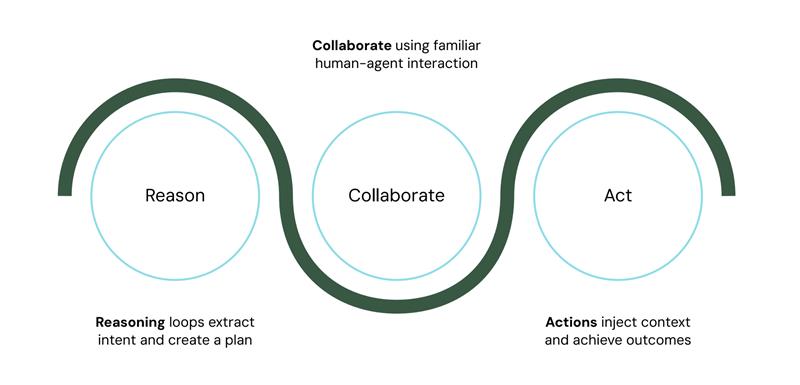
Platforms like Sema4.ai let teams create these workflows using natural language, so no deep technical knowledge is required.
| Feature | Chatbots | Traditional AI | Agentic AI |
| Goal-oriented | No | No | Yes |
| Multi-step workflows | No | Yes | Yes |
| Long-term context | No | No | Yes |
| Autonomy | No | Limited | Yes |
| Enterprise-ready | Limited | Yes | Yes |
Agentic AI is already delivering real results in several industries:
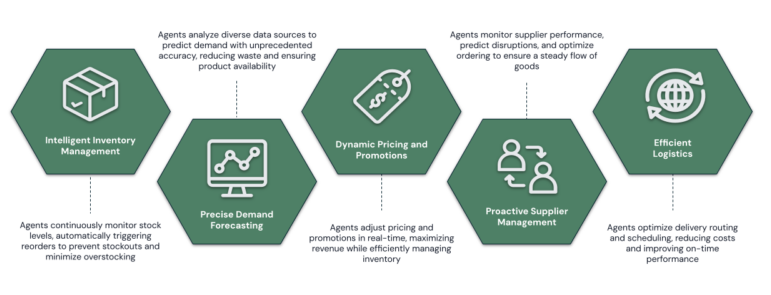
These use cases are live, not hypothetical. Agentic AI is already improving how teams work. Learn more about how leading enterprises are driving powerful business impacts with agentic AI.
Agentic AI delivers measurable business impacts like value across increased productivity, better scalability, easier collaboration, and it facilitates strategic decision-making. These systems run continuously, handle complex tasks across departments, and adapt in real time to shifting workloads.
Agentic AI delivers measurable improvements across the enterprise:
As adoption expands, organizations must also ensure agentic AI systems are deployed securely and governed responsibly.
Agentic AI systems bring big upsides, but their autonomy also introduces new governance and security challenges. Organizations need strong controls to ensure these systems stay aligned with business goals, protect sensitive data, and meet compliance standards.
Data protection
These systems often work with sensitive information. This data may be anything from customer data to internal processes, and likely a combination of different data sources that each come with different considerations. That means organizations need solid data governance. This includes encryption, access control, data minimization, and clear audit trails. Just as important is being able to explain how agents make decisions, especially when compliance is on the line.
Defined boundaries
Before deploying agentic systems, teams should define what agents can and can’t do. This means setting limits on their scope, approval thresholds, and escalation rules. Role-based permissions help keep agents operating within their intended lanes, so they don’t access or change the wrong data or systems.
Human oversight
Autonomous doesn’t mean unsupervised. For decisions that impact finances, compliance, or strategy, agentic AI should hand off to a human for approval. This hybrid approach gives teams speed without giving up control.
Transparency
To meet compliance requirements and improve system performance, organizations need full visibility into how agents think. That includes logging reasoning steps, data sources, decision rules, and actions taken. This transparency supports audits, troubleshooting, and trust.
Resilience planning
Things go wrong when systems fail, data gets messy, or mistakes happen. That’s why agentic AI systems need strong safeguards like automated testing, recovery plans, and response protocols designed specifically for autonomous workflows.
Ongoing review
Governance can’t be set and forgotten. As agents evolve and business needs shift, control frameworks need to evolve too. Regular reviews, audits, and policy updates keep things running safely and smoothly.
Sema4.ai supports all of these needs with enterprise-grade infrastructure, designed for secure and scalable deployment.
Rolling out agentic AI in an enterprise setting starts with finding the right entry point. Look for use cases that are clear in business value but simple enough to manage. Ideal candidates are data-rich, structured processes that run often or need fast responses including things like service requests, onboarding, or invoice reviews.
Start with use cases that are:
| Parameters to consider | Evaluation criteria |
| Does it solve a real urgent problem vs a nice to have issue? | Unless you are saving money, improving efficiency and solving a well understood acknowledged problem, even a successful solution will not translate into adoption gains. |
| How frequently are humans required to execute this business process? | Processes (like compliance at banks) have to be done continuously. Infrequent processes are less likely to translate into real gains. |
| Does 24*7 execution make the business more responsive? | If you can resolve a problem faster or get paid quicker or make decisions faster using agents, then it is a good candidate. Also if demand fluctuates and you need to auto scale, that is an even better candidate. |
| Is the problem repeatable across business divisions? | Solving repeatable mainstream problems will amplify adoption as subsequent efforts becomes easier. |
| Does the problem align with key imperatives of your organization? | If your CEO can talk about this on their earnings call, then it is definitely worth automating. |
Make sure you gather comprehensive baseline data, including current process metrics, pain points, and desired outcomes, to establish a clear starting point for the AI agent implementation. Because ROI requires you to understand the as-is state so that you can compare it to the new agentic implementation. Here is a framework you can use to get started as you build agents.
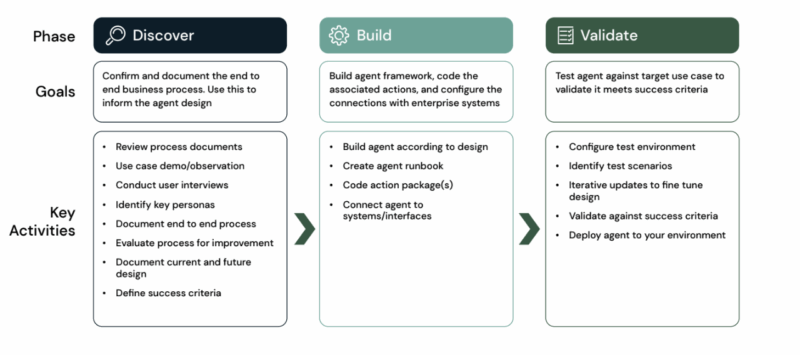
Platforms like Sema4.ai help teams get moving quickly by letting users describe what they want agents to do in natural language. With built-in integrations, strong security controls, and enterprise-grade infrastructure, these platforms reduce the need for heavy custom development. That means faster deployments and smoother governance from the start.
Change management is also key. Teams may have concerns about job impacts, accuracy, and reliability. Addressing those with open communication, hands-on training, and good support goes a long way toward building trust and long-term adoption.
Before scaling, make sure your technical foundation can support autonomous systems. This involves assessing the current infrastructure, planning for integrations, and upgrading as needed.
Start small, learn fast, and build on early wins. When teams monitor agent performance, gather feedback, and apply lessons to new workflows, they create a system that improves over time and delivers more value with every iteration.
Discover more best practices and recommendations for building an AI agent center of excellence.
Agentic AI is more than a technical advancement. It changes how businesses work. These systems reason through decisions, take action in real time, and improve continuously as they learn.
Agentic systems are positioned to:
Companies that invest in this model now will lead tomorrow’s enterprise transformation.
Explore how agentic AI can help your team scale, adapt, and transform. Sema4.ai provides everything needed to deploy intelligent agents that learn, act, and evolve, all within the guardrails of enterprise governance and security.
Source:



 Learn more about Studio