 Back to blog

A modern data analyst AI framework shifts business intelligence from passive, descriptive dashboards to active, operational execution. Teams can explore, join, and analyze enterprise data across sources using natural language, while work is mathematically precise and transparent, so analysts move faster while maintaining confidence in the results.
Introduction
Industry research suggests that data analysts spend up to 80% of their time on manual data cleansing, broken pipeline logic, and repetitive ad-hoc requests. The result? Strategic analysis takes a back seat to reactive ticket-handling.
Basic prompt-and-response chatbots don’t solve this problem for enterprise teams. They hallucinate calculations, lack live system context, and can’t safely interface with production databases. When a Chief Data Officer (CDO) or Analytics Director needs verified numbers, “close enough” is a liability.
The breakthrough is agentic AI – autonomous systems capable of reasoning, interacting with live environments, and solving multi-system problems securely. Unlike single-platform BI copilots that work within one vendor’s ecosystem, agentic systems plan, execute, verify, and adapt across complex workflows spanning your entire data estate. They bring data analyst AI from a concept into an operational reality that transforms how enterprise analytics teams work.
This post explores how AI augments everyday workflows, advances the quality of insights teams can produce, and creates a path from reactive reporting to predictive, autonomous execution for data analyst AI.
Key takeaways: the shift from reports to results
- Cross-warehouse federation: One workspace queries Snowflake, Redshift, Postgres, and uploaded files simultaneously – no data migration, no single-vendor lock-in.
- Agents without semantic-model authoring: Business users build custom data agents through natural language Runbooks in minutes, with no YAML definitions, no Unity Catalog metadata work, no IT ticket required.
- Full-loop execution, not just alerts: Agents produce real business artifacts – drafted dispute notices, staged invoice adjustments, backup purchase orders – not just notifications that someone else needs to act on.
- Compiled deterministic execution: Proven code patterns are automatically promoted to tested, versioned modules. Same input, same output, every run – auditable and reproducible.
- Advanced insight generation: AI correlates patterns across disconnected systems, surfacing predictive signals that no single-platform dashboard can structurally reveal.
Beyond dashboards: how AI augments the analytical lifecycle
Data analyst AI doesn’t replace analytical thinking. It removes the mechanical friction that prevents analysts from doing their best work. Here are three areas where AI agent reasoning upgrades daily workflows.
Conversational data engineering and shaping
Analysts can join separate datasets, reshape row structures, and clean null values through plain English instructions. No SQL expertise required. Instead of writing and debugging complex queries, analysts describe what they need and the system executes it with precision.
Automated multi-source aggregation
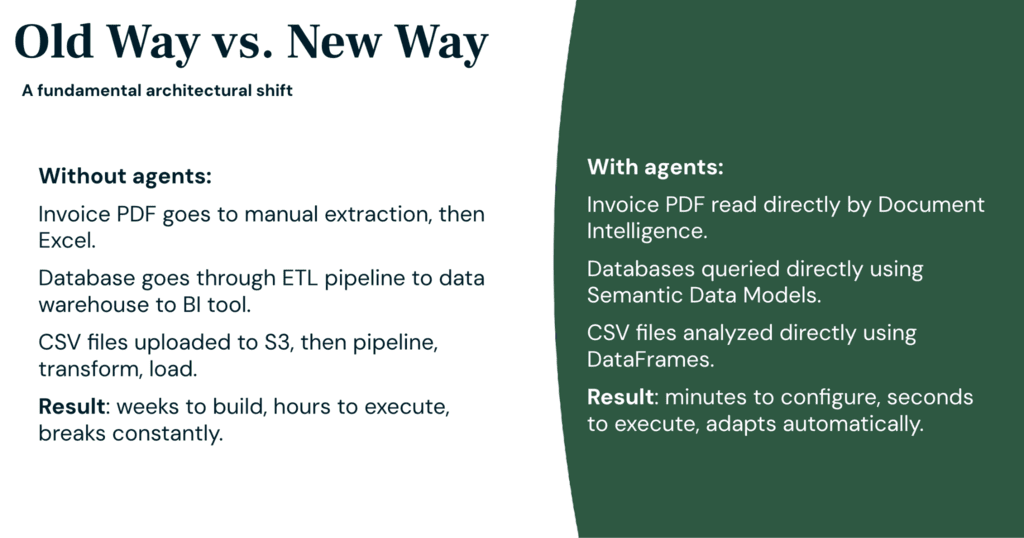
Instead of manually building ETL pipelines, AI automatically profiles incoming files, detects logical matching patterns, and normalizes schema mismatches across sources. What previously required a data engineering sprint now happens in minutes.
Document contextualization
Using intelligence extracted from documents, AI agents process text buried inside unstructured invoices, contracts, and transcripts – transforming them into structured, queryable data that can be joined with database tables in the same workspace. An invoice extracted from a PDF becomes immediately available alongside vendor records from your ERP, without a separate integration project.
What tasks does AI enhance for data analysts?
| Task | What AI does |
| Data cleaning and preparation | Automatically detects null values, schema mismatches, and formatting inconsistencies across uploaded files. |
| Natural language SQL generation | Analysts describe what they need in plain English; AI writes and executes the query. |
| Anomaly and outlier detection | Continuously monitors data streams and flags deviations before they surface in a weekly report. |
| Multi-source data aggregation | Profiles and normalizes data from disconnected spreadsheets, SQL tables, APIs, and text files. |
| Predictive signal identification | Surfaces leading indicators: churn risk, supply-delay signals, forecast-variance trends. |
| Workflow automation and execution | Agents complete multi-step operational tasks (reconciliation, dispute drafting, purchase orders) end-to-end – producing real business documents, not just alerts. |
One workspace, every warehouse: federated queries across your data estate
Most AI analytics tools are “warehouse-native” – meaning they work best (or only) when your data lives in a single platform. Cortex Analyst requires Snowflake. AI/BI Genie requires Databricks and Unity Catalog. Power BI Copilot requires the Microsoft ecosystem.
Enterprise data doesn’t live in one place. Invoices sit in Snowflake. Payment records live in Postgres. Vendor master data arrives as CSV exports from a procurement portal. Asking a cross-system question today means an engineering project.
Sema4.ai’s federated query capabilities changes this. Ask a question that spans invoices in Snowflake, payments in Postgres, and purchase orders in a CSV – and get a single answer. The platform decomposes the question into dialect-correct subqueries for each backend, pushes filters to the source databases before any data transfers, and joins only the relevant results. The difference between downloading 10 million rows to filter 100, and asking each database for exactly what you need.
This is the architectural distinction: vendor-neutral, zero-copy access across your entire data estate in one workspace – not the deepest possible integration with a single platform.
From reactive to predictive: how AI advances the quality of insights
The sections above cover augmentation – doing existing tasks better. This section covers advancement: surfacing insights previously impossible.
Anomaly detection at scale
AI continuously monitors data streams and flags outliers – pricing inconsistencies, usage spikes, inventory anomalies – before they surface in a weekly report cycle. Enterprise AI agents don’t wait for someone to ask the right question.
Predictive signal identification
Rather than describing what happened, AI agent reasoning models surface leading indicators: which accounts are trending toward churn, which suppliers are showing delay risk, which product lines are tracking below forecast.
Cross-system pattern recognition
Enterprise AI agents correlate data across disconnected systems – CRM, ERP, logistics, finance – uncovering patterns that siloed dashboards structurally cannot reveal. This is where federation becomes an analytical capability, not just an infrastructure feature: the agent can join supplier lead-time data from one system with inventory levels from another and production schedules from a third, surfacing a downstream stockout risk three weeks before any single-platform dashboard would catch it.
Standard chatbots vs. compiled execution: why accuracy claims need specifics
Every analytics vendor now claims “accurate AI.” The difference is the mechanism. Standard chatbots generate calculations via LLM token prediction – a process that is probabilistic by definition. Sema4.ai takes a fundamentally different approach. Our DataFrames are intelligent data workspaces that let agents analyze enterprise-scale datasets with mathematical precision using SQL, enabling multi-source analysis, transformation, and reconciliation of millions of rows without context window limitations.
| Analytical capability | Standard chatbot | Sema4.ai DataFrames | Why it matters |
| Execution model | LLM generates answers inline – probabilistic, non-reproducible. | Agents write real Python/SQL that executes in a secure sandbox. Results come from computation, not token prediction. | An auditor can verify the code that produced a number, not just the number itself. |
| Repeatability | Same question can produce different code on different runs. | Compiled Modules promote proven code patterns to tested, versioned, deterministic modules. Same input, same output, every run. | Satisfies SOX reproducibility requirements. Compliance teams verify a module once rather than evaluating output on every run. |
| Scalability | Restricted by LLM context windows and token costs. | Processes millions of rows locally using SQL-powered DataFrames with no window limits. Zero tokens consumed for data operations. | Enterprise-scale analysis without cost scaling or technical ceilings. |
| Transparency | Black box – users cannot audit the underlying logic. | Every execution step, join path, and calculation layer is displayed. Every module dispatch is logged with version and audit metadata. | Full auditability from question to result. |
The compiled execution model means accuracy improves automatically with volume. The platform observes when agents write the same code pattern repeatedly, promotes those patterns to deterministic modules, and the 500th analysis costs a fraction of the first – while being more reliable.
Build agents in minutes, no manual semantic model building
Warehouse-native AI tools like Cortex Analyst and Genie require upfront investment before analysts can ask their first question: author a YAML semantic model (Snowflake), configure Unity Catalog metadata (Databricks), or ensure Power BI’s semantic model quality (Microsoft). This work typically requires IT or data engineering support, takes days to weeks, and must be maintained as schemas change.
Sema4.ai’s Agent Studio takes a different approach entirely. Business users define how agents work through a visual Runbook Editor using plain English – no code, no flow diagrams, no semantic-model authoring.
Here’s what that means concretely:
- Time to first working agent: Minutes, not weeks. Write instructions describing how your team handles a workflow, connect data sources through Configuration Profiles, and publish.
- No IT dependency for changes: When a tolerance threshold changes or a vendor-specific rule needs updating, the process owner edits the Runbook directly. No ticket, no deployment cycle, no waiting.
- AI-powered data profiling fills the gap: Instead of requiring a manually authored semantic model, Sema4.ai’s AI automatically profiles connected databases, identifies relationships, and builds contextual understanding of your data. The platform learns what your tables and columns mean through use, not upfront configuration.
- Version history and rollback: Every publish creates a versioned snapshot. Compare changes, fork from past versions, and roll back with confidence – the release management discipline of production software, applied to agent logic.
The result: the people who understand the process best control how agents execute it, without becoming developers or waiting for IT to author metadata.
Turning insights into enterprise action: full-loop execution
Discovery without execution is just expensive curiosity. Many platforms now claim agents that “take action,” but the specificity of what gets produced matters.
Here’s how autonomous Worker Agents close the gap between finding an issue and resolving it – producing real business artifacts, not just sending notifications.
| Outlier detected | Legacy manual effort | What the agent actually produces | Business outcome |
| Revenue leakage: accounts missing subscription price updates. | Analyst flags gap, drafts ticket, waits for billing review. | Agent tracks the mismatch, syncs with billing software, and stages a corrected invoice adjustment ready for one-click approval. | Faster revenue recovery with a complete audit trail. |
| Procurement discrepancy: invoices don’t match contracted pricing. | Hours cross-referencing line items and purchase orders manually. | Agent audits every line item against the contract and drafts a supplier dispute notice with the specific discrepancies cited. | Reduces procurement leakage and accelerates dispute resolution from days to minutes. |
| Logistics delay: terminal logs flag a tier-one supplier interruption. | The problem goes unnoticed until an inventory check reveals a stockout. | Agent checks alternative suppliers, validates pricing against contracts, and prepares a backup purchase order for review. | Prevents downstream stockouts before they occur. |
The difference isn’t “agents that act” – every vendor claims that now. It’s agents that produce the specific document or staged transaction a human needs to review and approve, with the full context of why it was produced and what data informed the decision. Human-in-the-loop approval remains the final gate. The agent does the work; the human makes the call.
Ensuring trust: architecture-level governance
Every analytics vendor says “enterprise-grade security.” Here’s what Sema4.ai’s architecture does specifically.
Processing runs in your infrastructure
All agent execution happens within your cloud provider’s VPC – not in a shared multi-tenant environment. Data never leaves your security boundary. This isn’t a contractual promise about data retention; it’s an architectural fact about where code executes.
Zero-copy data access with inherited permissions
Agents query live data warehouses (Snowflake, Redshift, PostgreSQL) directly through your existing access controls. No data replication, no extract pipelines, no secondary copies with divergent permissions. The agent operates under the same identity and access rules as the human user who configured it.
Every decision is traceable at three levels
Agents produce audit trails viewable through purpose-built lenses: analysts see plain-language summaries of what was checked and decided, auditors see compliance certificates with control evidence, and engineers see raw execution traces. Every module dispatch is tagged with enterprise AI governance metadata for SOX-ready evidence generation.
Human-in-the-loop as an operating model
While agents handle processing and drafting at scale, humans retain final approval authority before any record system is altered. Escalations arrive with full context – the complete processing history, identified issues, and supporting data – so approvers make informed decisions rather than rubber-stamping opaque outputs.
How enterprise data teams get started with AI
Stage 1 – Crawl (weeks 1-4)
Connect a single data source to a Sema4.ai. After you pick a source, the platform automatically generates the semantic layer by detecting entities, relationships, and metrics from your data. Run natural language queries against it. Validate accuracy against known outputs. Build team confidence before expanding the scope.
Stage 2 – Walk (months 2-3)
Introduce autonomous Worker Agents on one repeatable workflow – a weekly report, a reconciliation task, or an anomaly alert. Establish human-in-the-loop approval checkpoints. Watch compiled modules begin forming as the agent processes volume.
Stage 3 – Run (month 4+)
Expand agent coverage across multiple data systems using federated queries. Connect ERP, CRM, and logistics data in a single workspace. Begin surfacing cross-system predictive insights for leadership – the kind only possible when an agent can reason across your entire data estate simultaneously.
Scale your strategic data team with Sema4.ai
The data analyst role isn’t going extinct. It’s evolving from data processor to strategic operator – the person who configures agent logic, validates cross-system insights, and directs autonomous execution rather than writing routine queries.
Sema4.ai AI Agent Studio lets data teams build, configure, and optimize custom data workflows using natural language Runbooks – no semantic-model authoring, no engineering dependency, no waiting for IT.
Sema4.ai DataFrames gives analysts an intelligent data workspace that spans every warehouse and file format in their organization, with compiled execution that gets faster and cheaper with every run.
Sema4.ai’s Semantic Layer gives data analysts the business context behind the data, not just access to tables and fields. It automatically profiles data, captures relationships and terminology, and enables analysts to ask questions in natural language while generating precise, context-aware queries.
Together, they give enterprise analytics teams the infrastructure to move from reactive, single-platform reporting to proactive, cross-system autonomous execution.
Frequently asked questions about data analyst AI
Q: What is the difference between standard dashboards and agentic AI analytics?
A: Traditional BI dashboards provide static views of historical data within a single platform. Agentic analytics systems reason across multiple data sources simultaneously, execute multi-step operations autonomously, and produce business artifacts (drafted documents, staged transactions) that close the gap between insight and action.
Q: If AI can write SQL and build charts, is the data analyst role going extinct?
A: No. The role evolves from query writer to Agent Supervisor. Analysts define the logic agents follow through natural language Runbooks, validate cross-system outputs, and make approval decisions on staged actions. The strategic context, institutional knowledge, and business judgment they bring becomes more valuable – not less – when routine execution is handled by agents they configure and control.
Q: How can enterprise teams prevent AI hallucinations when working with live data?
A: Decouple language understanding from computation. Sema4.ai agents write real code that executes in isolated sandboxes – results come from SQL and Python computation, not token prediction. Proven code patterns are automatically compiled into deterministic modules that produce identical outputs on every run. This architectural separation between reasoning and execution eliminates the hallucination problem at its source.
Q: What are the security prerequisites for deploying AI across proprietary data networks?
A: Processing must execute within the enterprise’s own infrastructure (VPC deployment), not shared environments. Data access should be zero-copy, operating through existing identity and permission systems without creating secondary copies. Every agent action must produce auditable traces. Human approval gates are required before any AI action alters a production system.
Q: How does federated query access differ from warehouse-native AI tools?
A: Warehouse-native tools (Cortex Analyst, AI/BI Genie) provide deep integration within one vendor’s platform but require your data to live there. Federated query access lets a single agent workspace span Snowflake, Redshift, Postgres, MySQL, and uploaded files simultaneously – decomposing cross-source questions into dialect-correct subqueries per backend and joining only the relevant results. No data migration required.
Q: Can non-technical business teams safely build custom data agents?
Yes. Sema4.ai’s Agent Studio uses a visual Runbook Editor where business users describe agent behavior in plain English – no YAML semantic models, no metadata configuration, no programming. AI-powered data profiling builds contextual understanding automatically. Human-in-the-loop controls ensure safety at every decision point, and version history provides full rollback capability.
Enterprise analytics teams are rapidly shifting away from static, passive report generation to active, intelligent data execution systems. Ready to move your data stack beyond simple reporting to automated, high-precision workflows? Get a demo of Sema4.ai today.


 Read more