 Back to blog

Most enterprises today have AI projects, but few have truly mature AI capabilities. The gap between experimentation and scale is widening, and this divide will define competitive advantage in the years ahead. According to recent industry research from MIT “State of AI in Business 2025”, 95% of AI initiatives stall before reaching full production – trapped in perpetual pilot while competitors pull ahead.
In 2026, AI maturity – not experimentation – will separate winners from laggards. Organizations that thrive won’t be those with the most AI projects, but those that have systematically embedded AI into decision-making, workflows, and value creation. This guide introduces a comprehensive AI maturity model to help you benchmark your organization’s readiness and build a clear roadmap toward secure, scalable AI that delivers measurable business impact.
Sema4.ai is built for teams advancing beyond pilot mode, empowering responsible, agent-driven AI across your organization with the security, governance, and integration capabilities that enterprise AI maturity demands.
What does AI maturity actually mean?
AI maturity isn’t measured by how many AI tools you’ve deployed or how much budget you’ve allocated to projects. True AI maturity is defined by how deeply AI is embedded into your organization’s decision-making processes, operational workflows, and value streams. It’s the difference between having AI and being AI-enabled.
Enterprise AI maturity reflects your organization’s capability to consistently deliver business value from AI at scale while maintaining security, governance, and operational excellence. Mature AI organizations don’t just run successful pilots; they systematically identify high-value use cases, deploy solutions rapidly, govern them effectively, and continuously improve based on measurable outcomes.
The challenge? Most enterprises remain stuck at the experimental stage. They’ve proven AI can work in controlled environments but struggle to operationalize successes across departments, geographies, and use cases. Data remains siloed, governance frameworks lag behind deployment speed, and technical teams become bottlenecks as demand for AI solutions outpaces their capacity to build and maintain custom integrations.
Sema4.ai addresses these AI maturity challenges directly by providing a secure, enterprise-ready platform that empowers business users to build and deploy AI agents without extensive coding. With built-in compliance frameworks, seamless enterprise integration, and comprehensive observability, Sema4.ai helps organizations operationalize AI maturity by transforming one-off experiments into governed, scalable agent workflows that deliver consistent business value.
The 5 pillars of AI maturity
Think of AI maturity as a structure supported by five essential pillars. Each pillar must be strong for the entire framework to support enterprise-scale AI. Weaknesses in any area create vulnerabilities that prevent scaling and put your AI investments at risk. This AI adoption framework provides the foundation for sustainable AI growth:
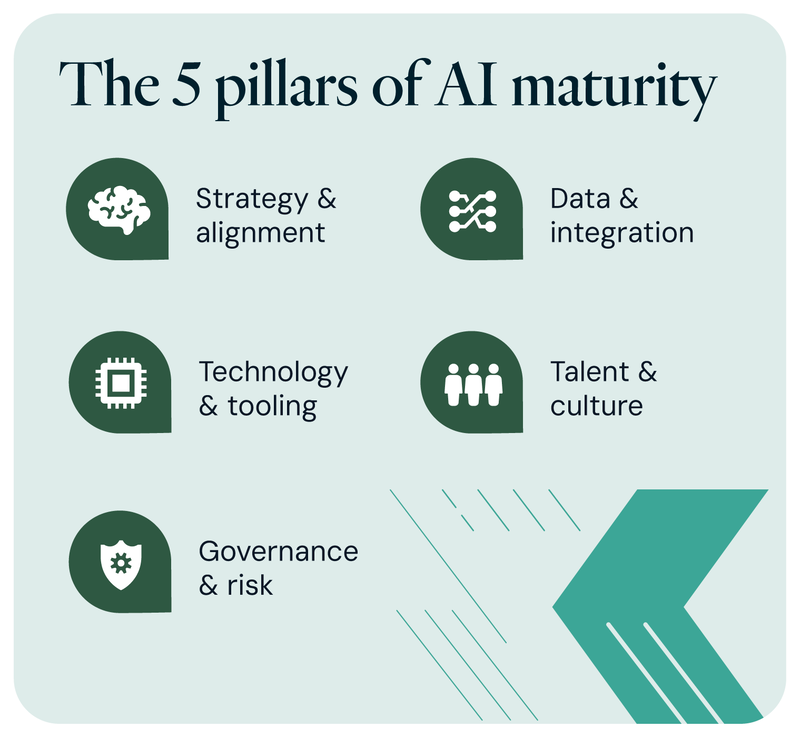
Strategy & alignment: Your AI initiatives must align with clear business objectives and have strong executive sponsorship. This pillar ensures AI investments support strategic priorities rather than becoming technology projects in search of problems to solve.
Data & integration: AI systems require access to quality data across the enterprise. This pillar addresses data governance, integration architecture, and the ability to connect AI to the applications and data assets that power your business.
Technology & tooling: The right platform capabilities enable rapid development and secure deployment. This includes the infrastructure, development tools, and operational capabilities needed to build, run, and manage AI at scale.
Talent & culture: AI maturity requires both technical expertise and organizational readiness. This pillar encompasses skills development, change management, and fostering a culture that embraces AI-augmented work.
Governance & risk: Enterprise AI demands robust frameworks for security, compliance, ethical use, and risk management. This pillar ensures AI systems operate within appropriate boundaries while maintaining audit trails and accountability.
Sema4.ai’s platform directly strengthens each pillar of the AI maturity model. Our SAFE framework (Secure, Accurate, Fast, Extensible) ensures security with deployment in your AWS VPC or Snowflake account, accuracy through leading LLMs, fast deployment with one-click publishing, and extensibility through 100+ pre-built actions. Control Room provides audit-ready governance and complete agent lifecycle management, while our zero-copy data architecture enables secure integration without moving sensitive information outside your security boundaries.
AI maturity vs. AI development: why the confusion hurts
A critical misconception slows many organizations: confusing stages of AI development with organizational AI maturity. AI development refers to the technical process of building custom AI agent solutions—teams assembling DIY frameworks, coding integrations, training prompts, and stitching together various tools and APIs to create agent capabilities. This is a project-focused process centered on individual technical implementations.
The AI capability model for organizations is fundamentally different. Organizational AI maturity measures how effectively your entire enterprise leverages AI across operations—encompassing strategy, governance, security, culture, and systematic value delivery. You can have technically sophisticated custom-built agents while maintaining low organizational maturity if those agents remain siloed, ungoverned, or dependent on scarce developer resources to build and maintain.
This confusion creates dangerous blind spots. Teams celebrate deploying impressive custom-coded agents while ignoring whether business users can actually build and maintain agents themselves, whether developers are freed to focus on strategic integrations rather than repetitive agent construction, or whether the organization can scale AI without creating unsustainable technical dependencies.
The result? Technically impressive DIY projects where business users remain dependent on developers for every agent modification, developers become bottlenecks building one-off solutions, and AI initiatives stall because they can’t scale beyond available technical resources.
Sema4.ai eliminates this gap through clear role separation: business users build and maintain agents using natural language Runbooks without coding, while developers use our comprehensive SDK to create the enterprise integrations those agents need. Control Room provides security, governance, and lifecycle management to ensure both business-created agents and developer-built integrations operate within enterprise standards—accelerating the journey from technical projects to true organizational AI maturity.
The 2026 AI maturity framework: 5 stages
Understanding where your organization sits on the AI maturity model helps you identify specific challenges and chart a clear path forward. The stages of AI adoption follow a predictable progression, each with distinct characteristics, friction points, and advancement requirements:
Stage 1: Ad hoc – At this initial stage, AI projects emerge organically across the organization without central coordination or strategy. Individual teams experiment with AI tools, often using shadow IT and consumer-grade solutions. There’s no standardization, limited knowledge sharing, and no governance framework. Organizations remain stuck here when they lack executive sponsorship or a clear vision for AI’s strategic role.
Stage 2: Opportunistic – Success stories begin to emerge from Stage 1 experiments, creating pockets of proven value. However, these successes remain isolated and difficult to replicate. Different departments pursue AI independently, often duplicating effort or creating incompatible solutions. Technical debt accumulates as teams build one-off integrations without enterprise architecture oversight. Organizations stall at this stage when they fail to establish centralized AI leadership or shared platforms.
Stage 3: Systematic – Leadership recognizes the need for coordination and establishes an AI Center of Excellence (CoE). The organization develops an AI roadmap aligned with business strategy, selects enterprise platforms, and implements governance frameworks. Standards emerge for data access, model choice, and deployment. This stage represents the critical transition from experimentation to enterprise capability. Sema4.ai’s Studio enables systematic agent development using natural-language Runbooks and Evaluations, while Control Room provides the governance and lifecycle management that systematic AI maturity demands.
Stage 4: Integrated – AI becomes embedded across the organization with enterprise-wide alignment. The CoE has matured into a strategic function that enables business units while maintaining standards. AI systems integrate seamlessly with enterprise applications and data sources through semantic understanding that eliminates data silos. Cross-functional collaboration becomes standard, with business users empowered to build and deploy agents for their domains. Sema4.ai’s Semantic Data Models enable agents to understand and query enterprise databases using natural language, automatically building contextual understanding of your data structure and relationships. Combined with MCP connectivity and pre-built integrations, this semantic layer enables true cross-system integration where agents work intelligently with data across your entire technology landscape.
Stage 5: Optimized – AI agents drive autonomous operations and continuous innovation. The organization has achieved true AI maturity with AI systems that learn, adapt, and optimize themselves. Worker Agents handle end-to-end processes 24/7, only escalating exceptions that require human judgment. The organization systematically captures knowledge from agent operations to drive continuous improvement. Sema4.ai’s Worker Agents and comprehensive observability capabilities enable this autonomous operational model while maintaining transparency and control.
Most enterprises today operate between Stages 2 and 3, with pockets of success but lacking the systematic approach and enterprise platforms needed to scale. Moving to Stage 4 and beyond requires deliberate investment in platforms like Sema4.ai that support governance, integration, and business-user empowerment characteristic of mature AI organizations.
Our learnings
Through our work with enterprises building mature AI programs, clear patterns have emerged. Successful organizations treat AI agents as products – building cross-functional teams around prioritized use cases with clearly managed backlogs. The winning formula pairs a business user who deeply understands the process, data, and desired outcomes with a developer who builds custom integrations to enterprise applications. With the right platform, this pair can rapidly create, test, and validate agents using Evaluations to measure behavior, then gradually scale deployment as confidence builds. This product-team approach transforms AI from experimental projects into systematic value delivery.
The most successful use cases share three characteristics: they’ve already failed with traditional RPA or automation tools, they represent significant operational cost or resource consumption, and they have clear SLAs that aren’t being met today. But selecting the right use cases is only half the battle. Mature organizations establish recurring steering committee meetings where teams share learnings, socialize repeatable patterns, and accelerate adoption across business units. This systematic knowledge sharing – documenting what works, what doesn’t, and why – enables organizations to compound their AI maturity gains rather than starting from scratch with each new initiative.
How to benchmark AI maturity
Assessing your current AI maturity provides the foundation for building an effective AI roadmap. Rather than treating maturity as a single score, evaluate your organization across the five pillars we discussed earlier, using a simple low/medium/high framework for each.
- For strategy & alignment, ask: Do we have a clear AI strategy supported by executive leadership? Are AI initiatives tied to measurable business outcomes?
- For data & integration, examine whether you have consistent data governance and whether AI systems can access enterprise data securely.
- Assess technology & tooling by evaluating whether you have enterprise AI platforms or rely on fragmented point solutions.
- For talent & culture, consider both technical AI capabilities and organizational readiness for AI-augmented work.
- Finally, evaluate governance & risk by examining whether you have frameworks for AI security, compliance, and ethical use.
Apply this AI capability model assessment, department by department, to identify maturity gaps across your organization. Marketing might rate high on adoption but low on governance, while IT rates high on security but struggles with business alignment. These gaps reveal where focused investment delivers maximum impact.
Document your assessment and share it with stakeholders to build consensus on current state and priorities. This baseline becomes your starting point for measuring progress as you advance through the stages of ai adoption.
Why you need an AI Center of Excellence (CoE)
Organizations plateau at Stage 2 AI maturity without establishing an AI Center of Excellence. An AI CoE serves as the central hub that coordinates AI governance, establishes standards and guidelines, provides platforms and capabilities, and enables business units to develop and deploy AI solutions aligned with enterprise requirements.
The CoE’s role isn’t to gatekeep or centralize all AI development – that creates bottlenecks that frustrate innovation. Instead, a mature CoE enables federated AI development by providing the platforms, frameworks, and support that allow business units to build solutions independently while maintaining enterprise standards for security, governance, and integration.
Common missteps prevent CoEs from achieving this enabling role. Some organizations staff CoEs exclusively with theoretical AI experts, neglecting the platform engineering and governance expertise needed for enterprise AI strategy. Others grant CoEs insufficient authority or executive support, relegating them to advisory roles without the mandate to establish standards. Still others fail to provide CoEs with enterprise platforms, forcing them into endless custom integration projects that prevent scaling.
Sema4.ai empowers AI CoEs to fulfill their enabling mission by providing a comprehensive platform that enforces best practices while empowering business users. Control Room gives CoEs centralized visibility and governance across all agents while enabling workspace-level autonomy for different business units. Shared configuration management allows CoEs to distribute approved LLM configurations, data connections, and action packages across the organization while maintaining security. The curated Action Gallery ensures teams access approved integrations that meet enterprise standards, while comprehensive audit logs provide the transparency and accountability that AI governance requires.
Read our white paper to learn more about building an AI agent Center of Excellence.
Your roadmap to AI at scale by 2026
Building a practical AI roadmap requires translating the AI maturity model into concrete actions your organization can execute. This roadmap guides your progression through the stages of AI adoption while delivering measurable value at each phase:
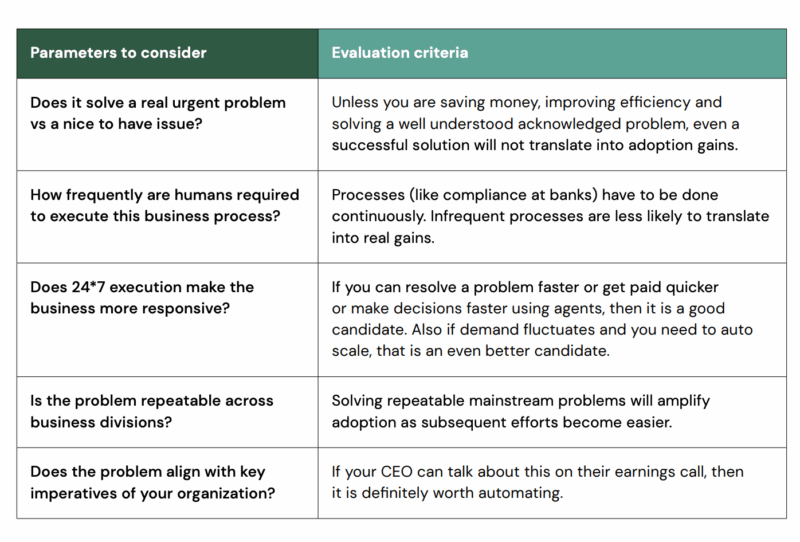
Identify high-impact use cases: Don’t start by trying to transform everything. Identify specific processes where AI agents can deliver clear ROI – complex document processing, multi-system reconciliation, help desk automation, or procurement workflows. Prioritize use cases that combine high business value with feasibility, given your current AI maturity level.
Criteria to consider for identifying high-value use cases
Stand up your AI CoE: Establish central AI leadership with a clear mandate to enable enterprise AI adoption. Staff the CoE with diverse capabilities – not just AI enthusiasts, but platform architects, governance specialists, and change management experts. Give the CoE authority to select enterprise platforms and establish standards while empowering business units to innovate within those guardrails.
Adopt a secure AI agent platform: Select an enterprise AI agent platform that supports your journey to Stage 4-5 maturity. The platform must enable business users to build agents through natural language while providing IT with the security, governance, and integration capabilities that enterprise AI strategy demands. Sema4.ai delivers this balance through Studio for agent development, Control Room for governance and lifecycle management, and Work Room for business-user collaboration – all deployed securely in your AWS VPC or Snowflake environment. Learn more about how we support secure enterprise AI agents by design.
Deploy, measure, and iterate: Launch with focused pilots that prove value and establish patterns. Measure both technical success (accuracy, reliability, performance) and business outcomes (time savings, cost reduction, quality improvement). Use insights from initial deployments to refine your approach and identify the next wave of use cases. Scale systematically rather than trying to transform everything simultaneously.
This AI roadmap accelerates your progression from experimentation to optimization by combining strategic planning with practical execution. Sema4.ai supports this journey by enabling teams to move from idea to production-ready agent rapidly – building with no-code natural language Runbooks in Studio, deploying with one click to your secure environment, and managing with comprehensive lifecycle controls in Control Room.
What’s blocking AI maturity?
Even organizations with clear AI adoption frameworks face persistent barriers that prevent scaling. Understanding these obstacles helps you address them proactively:
Fragmented tools: Many enterprises have accumulated dozens of AI and automation tools through organic adoption and acquisition. This fragmentation creates integration nightmares, duplicated effort, and governance blind spots. Each tool requires separate expertise, creating knowledge silos that slow development and make it impossible to establish consistent standards across the organization.
Siloed data: AI systems require access to data across enterprise applications, but legacy architecture often isolates data in disconnected systems. Traditional approaches that copy data for AI access create security risks, compliance challenges, and synchronization problems. The zero-copy data architecture in Sema4.ai solves this by enabling agents to access enterprise data where it lives – in your Snowflake environment, databases, and applications – without moving sensitive information outside your security boundaries.
Compliance risks: Regulatory requirements for data privacy, model explainability, and algorithmic fairness create legitimate concerns that can stall AI initiatives. Without proper governance frameworks and audit capabilities, organizations face genuine legal and reputational risks from AI deployment. Sema4.ai’s comprehensive audit logs and Transparent Reasoning capabilities provide the accountability and explainability that compliance requires, while deployment in your AWS VPC ensures data never leaves your control.
Talent gaps: The shortage of AI and data science expertise forces organizations to compete for scarce technical talent while business users with deep domain knowledge remain unable to build AI solutions themselves. This talent bottleneck prevents scaling even when platforms and data are ready. Sema4.ai addresses this by empowering business users to build sophisticated agents using natural language Runbooks, eliminating the coding barrier while enabling developers to focus on complex integrations and platform capabilities.
Organizational resistance: Teams fear AI will expose inefficiencies or reduce their value to the organization. This resistance manifests as passive roadblocks—delayed approvals, reluctance to share process knowledge, or insistence that “our work is too complex for AI.” Overcoming this requires demonstrating how AI agents augment rather than replace human expertise, empowering teams to focus on higher-value work while agents handle repetitive tasks.
These challenges aren’t insurmountable, but they require comprehensive solutions rather than point fixes. Sema4.ai Enterprise Edition provides the integrated platform capabilities that address all five barriers simultaneously – consolidating fragmented tools, enabling secure data access, providing built-in governance and explainability, and empowering business users alongside technical teams.
Don’t just do AI. Evolve and operationalize it.
The AI maturity model we’ve explored reveals a fundamental truth: in 2026, competitive advantage won’t come from doing AI – it will come from having matured your AI capability to the point where agents operate autonomously, governance is systematic rather than reactive, and business users drive innovation without technical bottlenecks.
Maturity isn’t about accumulating more AI tools or running more experiments. It’s about building secured, governed, scalable systems that deliver ROI at speed while operating within enterprise compliance and risk frameworks. It’s the difference between impressive demonstrations that never scale and production systems that transform how work gets done across your organization.
The AI capability model framework we’ve outlined—five pillars supporting five stages of progression—provides your roadmap from ad hoc experimentation to optimized operations. But frameworks alone don’t create maturity. You need enterprise platforms that embody these principles, enabling systematic advancement while removing the technical and governance barriers that keep most organizations trapped in pilot purgatory.
Sema4.ai’s SAFE architecture delivers everything enterprises need to move from pilot to platform without compromising control, compliance, or speed. Secure deployment in your AWS VPC or Snowflake environment ensures data sovereignty. Accurate results through Semantic Data Models that enable agents to understand enterprise databases using natural language, combined with DataFrames for mathematically precise analysis at scale—eliminating the errors and hallucinations that plague LLM-only approaches. Fast deployment through natural language Runbooks that empower business users to build and modify agents without coding, accelerating time-to-value from months to days. Extensible integration through 100+ pre-built actions, universal MCP connectivity, and comprehensive SDK capabilities ensures agents can work across your entire technology stack – —from legacy systems to modern SaaS applications.
See how enterprises are scaling with AI agents on Sema4.ai. Move beyond experimentation to true AI maturity with the platform built for Stage 4-5 organizations that demand security, governance, and business user empowerment without sacrificing technical sophistication.
Connect with us to discuss plans for progressing along the AI maturity curve and to see a demo.


 Read more