
 Back to blog

AI agent use cases in the enterprise
AI agents are fundamentally changing how enterprises get work done. These intelligent AI agents, or digital workers, eliminate what we call “undifferentiated toil” – the repetitive, manual tasks that slow teams down and prevent them from focusing on high-value work. Instead of having to complete the work by hand, humans become the supervisors of the work that AI agents do. This shift from manual execution to human-guided, agent-led automation represents the most significant productivity breakthrough of the AI era.
How are organizations using agentic AI? AI agents perform complex work with unprecedented accuracy and efficiency by combining large language models with the ability to see, understand, access enterprise systems, plan, reason, and act autonomously. Unlike traditional automation or simple chatbots, AI agent use cases span entire business processes – from triaging customer support tickets to orchestrating multi-system workflows across departments.
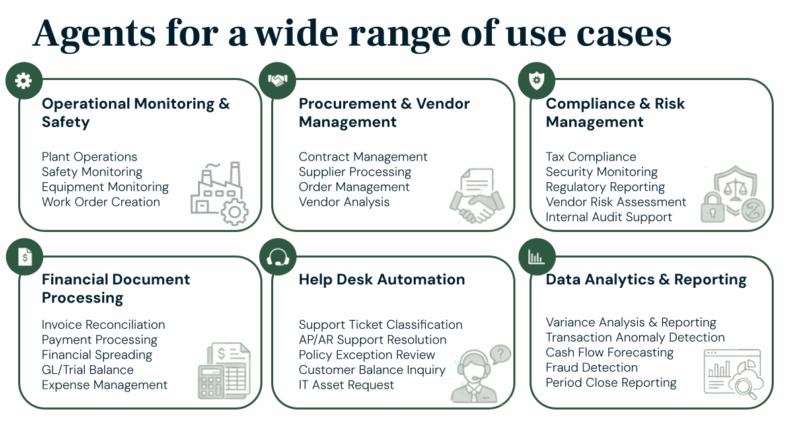
This article explores ten real, functional AI agent use cases transforming business operations including:
- Customer support automation
- Sales and marketing automation
- Finance and banking automation
- Human resources automation
- Legal contract automation
- Supply chain and logistics automation
- Healthcare operations automation
- Manufacturing operations automation
- Data access and natural language queries
- Cross-system workflow orchestration
See how Sema4.ai supports top AI agent use cases with a purpose-built platform for secure, scalable deployments across your systems.
1. Customer support automation
AI agents are revolutionizing customer support by triaging tickets, handling order tracking queries, pulling context from multiple systems, and automating common replies. Instead of forcing human agents to spend hours on routine inquiries, intelligent AI agents handle the high-volume, low-complexity interactions while escalating complex or high-empathy situations to human team members.
These agents can instantly access customer history across CRM systems, order management platforms, and knowledge bases to provide contextual, accurate responses. They work 24/7 without fatigue, ensuring consistent service quality and dramatically reducing response times. For enterprises, this means lower support costs, higher customer satisfaction scores, and human agents who can focus on building relationships and solving complex problems.
The impact is measurable: teams report 60-80% reduction in ticket handling time for routine inquiries, with customer satisfaction remaining high because complex issues still receive the human touch they require.
2. Sales and marketing automation
Sales and marketing teams spend countless hours on administrative tasks that don’t directly generate revenue. AI agents change this equation by qualifying leads, generating high quality content aligned to product and corporate messaging, key differentiators, and brand guidelines, generating personalized outreach, producing campaign performance reports, and surfacing competitive insights from market data.
These AI agent use cases function as revenue accelerants. An agent can analyze inbound leads against ideal customer profiles, score them based on engagement signals across multiple channels, and automatically route qualified prospects to the right sales representative. Marketing agents can create blog, ad copy, and Web content, generate personalized email sequences that adapt based on recipient behavior, create campaign performance summaries that pull data from multiple analytics platforms, and even identify trending topics for content creation.
Learn more about how we use our marketing agent at Sema4.ai to transform content creation.
The transformation is tangible: sales professionals report spending 40% more time in actual customer conversations, and marketing teams can execute more campaigns with the same headcount.
3. Finance and banking automation
What are the use cases of AI agents in banking? The financial sector has embraced AI agents in banking applications for fraud detection, invoice reconciliation, loan risk assessment, quote-to-cash applications and Know Your Customer (KYC) compliance. These enterprise AI agents function as always-on, audit-ready coworkers that reduce errors and speed up decision cycles in highly regulated environments.
In banking specifically, agents monitor transactions in real-time, flagging suspicious patterns that human analysts might miss across millions of daily transactions. They automate the tedious process of reconciling invoices against purchase orders and payment records. This is work that previously took analysts days, which now completes in minutes with mathematical precision. For loan underwriting, agents assess risk by analyzing credit histories, financial statements, and market conditions, providing consistent evaluations that reduce bias.
The business process automation with AI in finance delivers measurable impact: organizations report 70-90% reduction in invoice processing time, faster fraud detection with fewer false positives, and significantly improved compliance audit performance. And, enterprises gain the ability to speed up payments, reduce days sales outstanding, and deliver better accuracy by improving unstructured data match rates.
Learn more about real customer successes in financial services, including invoice processing and remittance matching.
4. Human resources automation
Human resources teams are drowning in administrative work during hiring surges and onboarding cycles. AI agents transform HR operations by screening resumes, scheduling interviews, managing onboarding workflows, and answering employee benefits questions – freeing HR professionals to focus on strategic talent development and culture building.
These AI agent use cases deliver better time-to-hire through consistent, unbiased candidate evaluation. An agent can review hundreds of resumes against job requirements, identify top candidates based on skills and experience patterns, and even conduct initial screening conversations. For onboarding, agents orchestrate complex workflows across IT provisioning, benefits enrollment, training scheduling, and documentation – ensuring no steps are missed and new hires have a smooth first experience.
The always-on nature of HR agents means candidates get immediate responses to questions regardless of time zone, improving the candidate experience and reducing drop-off rates. Organizations report 50% faster time-to-hire and significantly higher new hire satisfaction scores when agents handle routine HR workflows.
5. Legal contract automation
Legal teams face mounting pressure to review more contracts faster without increasing risk exposure. Enterprise AI agents revolutionize legal operations by automating the processes of reviewing contracts, comparing versions, highlighting risky clauses, and flagging non-standard terms that require attorney attention.
These agents understand legal language and can compare incoming contracts against approved templates, standard clauses, and company policies. They catch problematic terms, including unlimited liability clauses, unfavorable payment terms, or missing indemnification language that might slip past overworked legal teams. For contract negotiations, agents can track changes across multiple versions, highlighting exactly what shifted between drafts.
The impact on legal workflow is transformative: contracts that previously took days for initial review now get processed in hours, with agents flagging only the exceptions that truly need legal expertise. Law departments report handling 3-4x more contract volume with the same team size, while reducing legal risk through more consistent contract review.
6. Supply chain and logistics automation
Supply chain disruptions cost enterprises millions in lost productivity and rush shipping. AI agents for supply chains provide resilience by monitoring inventory levels, optimizing delivery routes based on real-time traffic and weather data, and scheduling predictive maintenance before equipment failures occur.
These AI agent use cases reduce bottlenecks, waste, and risk across complex supply chains. An agent can detect when inventory for a critical component is running low, automatically trigger reorder workflows, and even suggest alternative suppliers if the primary vendor has lead time issues. They can also analyze supplier quotes against industry data, published pricing information and known discount structures to help ensure the optimal price is paid. For logistics, agents continuously optimize delivery routes as conditions change, reducing fuel costs and improving on-time delivery rates.
AI for supply chain across industries
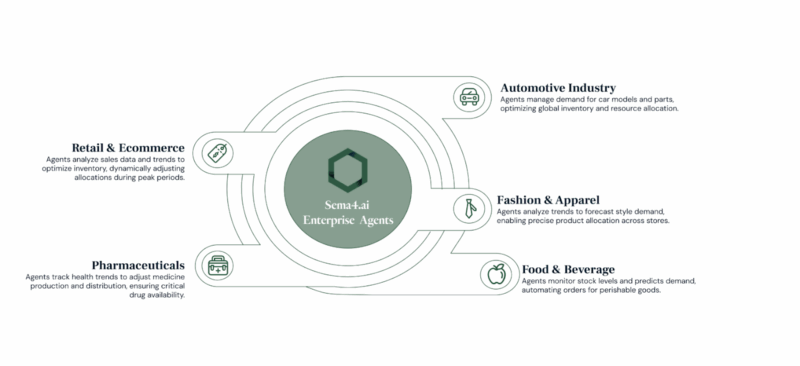
The predictive maintenance capabilities are particularly powerful: by analyzing sensor data from equipment, agents can schedule maintenance during planned downtime rather than responding to unexpected breakdowns. Manufacturers report 30-40% reduction in unplanned downtime and significant savings in emergency repair costs.
Explore in more detail by watching our webinar on revolutionizing supply chain management.
7. Healthcare operations automation
Healthcare organizations face immense administrative burden that pulls resources from patient care. AI agents automate patient scheduling, medical billing, clinical note-taking and summarization, and research data analysis. These are operational tasks that consume significant staff time without requiring clinical judgment.
These AI agent use cases keep focus on operational lift rather than diagnosis, functioning as assistants to busy clinical and administrative teams. Scheduling agents manage appointment bookings, cancellations, and rescheduling across multiple providers and locations, optimizing for patient preferences and clinical capacity. Billing agents verify insurance eligibility, code procedures, and follow up on claims, reducing denials and accelerating payment cycles.
For clinical documentation, agents can generate draft notes from physician-patient conversations, allowing doctors to review and approve rather than typing from scratch. Research agents can analyze clinical trial data, literature reviews, and patient outcomes – accelerating research timelines without compromising accuracy.
Healthcare organizations report administrative staff spending 60% less time on scheduling and billing tasks, with higher accuracy rates and improved patient satisfaction due to reduced wait times and billing errors.
8. Manufacturing operations automation
Manufacturing environments generate constant streams of data from equipment, quality checks, and supply chains. AI agents process equipment damage reports (including image analysis of physical damage), manage inventory across production lines, and surface supply chain risks before they impact production schedules.
These AI agent use cases connect directly to uptime, safety, and production continuity, the metrics that matter most in manufacturing. When equipment shows signs of degradation, agents can analyze historical maintenance records, current sensor readings, and manufacturer guidelines to recommend specific interventions. For quality control, agents can review inspection photos, compare against specifications, and automatically route defective items while alerting supervisors to systematic quality issues.
Inventory management agents ensure production lines never halt for lack of materials by monitoring consumption rates, lead times, and buffer stock levels across complex multi-stage manufacturing processes. The result is smoother operations, fewer emergency interventions, and improved safety through early identification of equipment issues.
9. Data access and natural language queries
One of the most transformative AI agent use cases is democratizing data access. Enterprise AI agents let business users ask questions like “What was last quarter’s churn by region?” and get real-time answers without building dashboards, writing SQL, or waiting for data analyst availability.
This represents analytics democratization, moving insights from a specialized function to an everyday capability. Marketing managers can explore campaign performance across channels, operations leaders can analyze throughput trends, and executives can drill into business metrics through natural conversation. The agents connect to data warehouses, generate appropriate queries, and present results in business-friendly formats.
The business impact is substantial: organizations report a 10x increase in data-driven decisions when employees can access insights through natural language agents rather than traditional BI tools.
10. Cross-system workflow orchestration
The most powerful AI agent use cases involve multi-agent workflows that span multiple systems – employee onboarding that touches HR, IT, facilities, and payroll; procurement that requires approvals, vendor management, and financial systems; or compliance workflows that coordinate across legal, operations, and audit functions.
These enterprise AI agents use automation as code frameworks to orchestrate complex, multi-step processes end-to-end. Rather than requiring employees to manually move information between systems, agents handle the integration work. They extract data from one system, transform it as needed, and update other systems while maintaining complete audit trails.
Below is an example of a multi-agent procurement workflow:
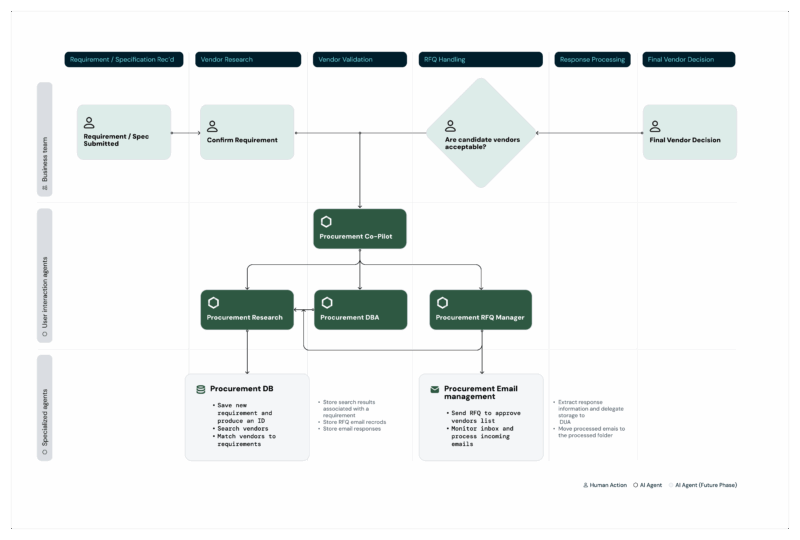
Sema4.ai’s Enterprise AI Agent Platform with its Control Room feature enables orchestration at scale, with enterprise-grade security, observability, and lifecycle management. These agents can handle exceptions intelligently, escalating to humans only when true judgment is required rather than simply encountering a system integration issue.
Organizations implementing workflow orchestration agents report 70-80% reduction in process cycle times and dramatic improvements in compliance audit results because every step is logged and verifiable. The shift from employees manually executing workflows to agents handling orchestration represents the ultimate transformation from manual execution to human-guided automation.
Learn more about how AI agent workflows work.
AI agents let teams work on what matters
These ten AI agent use cases demonstrate a fundamental shift in how enterprises approach work. AI agents aren’t hypothetical future technology – they’re solving real business challenges today across customer support, sales, finance, HR, legal, supply chain, healthcare, manufacturing, analytics, and workflow orchestration.
The common thread across all these applications is the transformation from manual execution to human-guided, agent-led automation. Instead of employees spending hours on repetitive tasks, intelligent AI agents handle the repetitive work while humans focus on judgment, creativity, and relationship building. This isn’t about replacing people – it’s about augmenting human capabilities and freeing teams to work on what matters most.
Sema4.ai enables secure, observable, enterprise-grade deployment of AI agents at scale. Our platform provides the build, run, and manage capabilities enterprises need to transform these use cases from pilots into production systems that deliver measurable business impact.
Read our e-book to see how real teams are scaling with AI agents today and discover how your organization can join the enterprises already transforming operations with intelligent automation.
Learn more about AI agents in deployment and see use case demos.


 Read more