Back to learning center
What is order to cash?


Order to cash (O2C) is the end-to-end business process organizations use to manage customer orders from initial receipt through fulfillment, invoicing, payment collection, and revenue recognition.
The order to cash process is the structured operational workflow that connects sales, operations, and finance teams to manage every stage of the customer revenue lifecycle. From the moment a customer places an order to the point where payment is collected and recorded, the O2C process ensures that organizations maintain control over revenue operations and financial accuracy.
The order to cash cycle spans several critical activities, including customer order receipt and management, credit management and approval, order fulfillment and delivery, invoicing and billing, accounts receivable management, and payment collection and reconciliation.
Organizations rely on a well-managed O2C workflow to maintain accurate customer relationships and order handling, control revenue operations and billing activity, reduce disputes and improve financial accuracy, and improve cash flow visibility while lowering days sales outstanding (DSO).
Today, automation and AI technologies are transforming how enterprises manage order to cash operations. AI-powered platforms help teams process invoices, manage collections, and reduce manual work across every stage of the cycle. In industries like manufacturing and distribution, where invoice volumes are high, or in SaaS environments with complex recurring billing, these challenges make automation especially critical.
The order to cash process is a structured workflow used to manage customer orders from receipt through payment and revenue recognition. It serves as the backbone of an organization’s revenue operations, ensuring every order is accurately captured, fulfilled, invoiced, and collected.
The order management workflow connects two primary groups of stakeholders. Sales and order management teams are responsible for capturing and processing customer orders accurately. Finance and accounts receivable teams handle invoicing, collections, and payment processing to close the revenue cycle.
When these teams operate within a structured O2C workflow, organizations gain better revenue visibility, billing accuracy, and customer satisfaction. Without a clear process, orders can fall through the cracks, invoices may contain errors, and collections can stall, all of which directly impact cash flow and customer trust.
The order to cash workflow follows a structured sequence of stages that guide a customer order from initial receipt through final payment. While the specifics may vary by industry, the core O2C workflow typically includes these major stages:
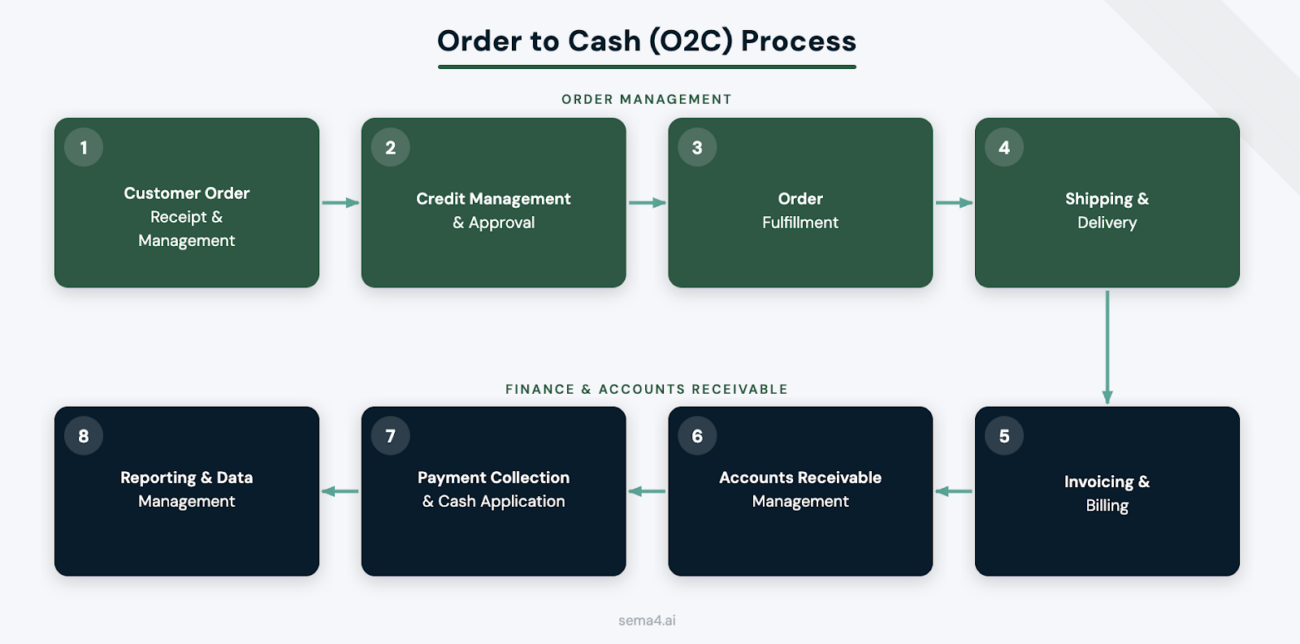
Each stage builds on the previous one, and delays or errors at any point in the cycle can cascade through the entire process.
Customer orders are received through various channels, including email, phone, EDI, or online portals. Order management teams validate order details, confirm product availability, and ensure pricing accuracy before the order moves forward in the O2C process.
Credit management evaluates the customer’s creditworthiness and payment history before approving an order. This step helps organizations minimize financial risk by setting appropriate credit limits and payment terms based on the customer’s profile.
Once an order is approved, fulfillment teams pick, pack, and prepare goods for shipment. This stage requires coordination between warehouse operations and inventory management to ensure accurate and timely order completion.
Shipping and delivery involves transporting goods to the customer according to agreed-upon terms. Logistics teams track shipments, manage carrier relationships, and confirm delivery to ensure the customer receives their order on schedule.
Invoicing is triggered once goods or services are delivered. Accurate invoices are generated and sent to the customer, detailing quantities, pricing, taxes, and payment terms. AI-powered document intelligence can automate invoice processing, reducing manual errors and accelerating the billing cycle.
Accounts receivable teams track outstanding invoices, manage collections follow-up, and resolve billing disputes. Effective AR management is essential for maintaining healthy cash flow and reducing DSO. Organizations looking to streamline this step can explore how automated receivables matching accelerates payment processing and reduces manual reconciliation work.
Payment collection involves receiving and processing customer payments through methods such as ACH, wire transfer, check, or credit card. Timely follow-up on overdue payments and proactive communication with customers help organizations maintain consistent cash flow.
Cash application is the process of matching incoming customer payments to open invoices. Errors or delays in cash application directly impact AR accuracy and DSO. This document-heavy step is prone to manual errors, especially when remittance information arrives in varying formats. Document Intelligence for remittance processing can automate payment matching with near-perfect accuracy, significantly reducing manual effort.
The order to cash process involves multiple teams working in coordination across the organization. Sales teams capture and manage customer orders. Order management teams process and validate orders for fulfillment. Warehouse and logistics teams handle picking, packing, shipping, and delivery. Finance and accounts receivable teams manage invoicing, collections, and payment reconciliation. And of course, customers themselves play a central role by placing orders and submitting payments. Effective O2C operations require clear communication and handoffs between all of these stakeholders.
A well-structured order to cash process is critical for any organization managing complex customer relationships and high-volume revenue operations. The O2C cycle directly impacts an organization’s ability to maintain revenue visibility and financial control, improve cash flow and reduce days sales outstanding (DSO), strengthen customer relationships through accurate and timely billing, ensure compliance with billing and revenue recognition policies, and improve visibility into order status and collections activity.
The complexity of O2C scales significantly across industries. Manufacturing and distribution companies manage high transaction volumes with diverse invoice formats. SaaS businesses navigate recurring billing cycles and usage-based pricing. Retail organizations coordinate multi-location fulfillment and returns processing.
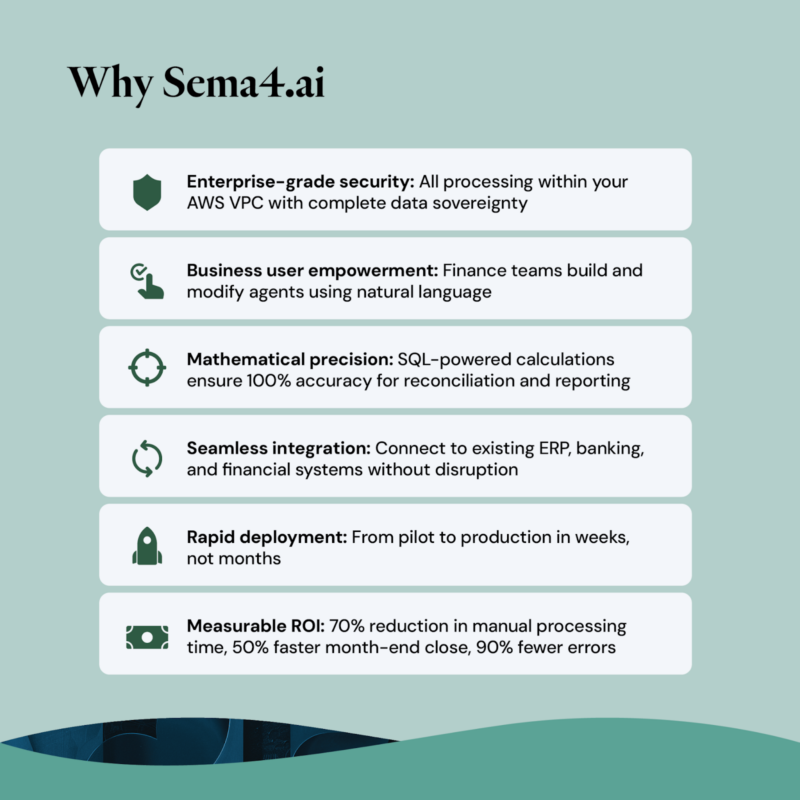
Enterprise automation platforms such as Sema4.ai apply the SAFE framework to support secure and scalable financial automation. This means data remains within your enterprise infrastructure (Secure), SQL-powered DataFrames provide mathematical precision for financial calculations (Accurate), Document Intelligence configuration can be completed in minutes (Fast), and integrations connect to enterprise systems such as SAP, Salesforce, and Workday (Extensible).
Tracking the right metrics is essential for understanding and improving O2C performance. Here are the key KPIs finance and AR teams should monitor:
AI-powered automation platforms such as Sema4.ai help organizations improve each of these metrics by reducing manual errors, accelerating processing, and providing real-time visibility into O2C performance.
Despite its importance, the order to cash process is often plagued by inefficiencies that slow revenue collection and frustrate teams. Common challenges include manual order entry and processing errors that create downstream issues, slow invoice generation and delivery that delay payment timelines, payment disputes and reconciliation issues that consume AR team resources, high days sales outstanding and delayed collections that strain cash flow, limited visibility into accounts receivable and cash flow status, and manual, error-prone cash application processes that create AR inaccuracies.
These challenges compound at enterprise scale, where teams process thousands of invoices monthly across varying formats and customer requirements. Organizations seeking to address these pain points can see how Sema4.ai automatesreceivables matching, invoice reconciliation, procurement sourcing and AP helpdesk to reduce manual work and improve accuracy.
Organizations looking to optimize their O2C process should focus on several key improvement areas. Automating order capture and validation reduces manual entry errors. Streamlining invoice generation and delivery accelerates billing cycles. Improving collections workflows and payment follow-up shortens DSO. Increasing visibility into accounts receivable aging helps prioritize collections activity. Digitizing document-driven processes across the O2C lifecycle eliminates paper-based bottlenecks. And automating cash applications reduces payment matching errors and speeds AR close.
To build an efficient, scalable O2C operation, organizations should follow these best practices:
AI agents eliminate manual bottlenecks and accelerate every stage of the process thereby improving operational efficiency. Automated invoice generation and delivery ensure bills reach customers faster. Faster payment collection and collections follow-up shorten the revenue cycle. Improved financial accuracy reduces billing disputes and credit memo volumes. Reduced manual data entry frees order and AR teams to focus on exceptions and strategic work. And improved visibility into cash flow and outstanding receivables enables better financial planning.
The real-world results speak for themselves. Organizations implementing O2C automation have reduced invoice processing time from hours to minutes, shortened payment collection cycles and reduced DSO, and improved operational efficiency across finance and AR teams.
Autonomous Worker Agents can handle these workflows 24/7, processing invoices, managing collections, and reconciling payments without manual intervention, escalating to humans only when exceptions require review.
Enterprise AI agent platforms such as Sema4.ai are redefining what is possible in O2C automation. Unlike traditional automation tools that follow rigid rules, AI agents can reason, adapt, and collaborate to handle the complexity of real-world financial processes.
Business user empowerment is at the core of this transformation. Sema4.ai enables finance and AR teams to configure automation using natural language runbooks, eliminating the need for extensive coding or developer resources. Business users can build O2C agents using natural language and iterate on workflows as business needs evolve.
Document Intelligence for complex invoices and order documents processes invoices across multiple formats with near-perfect accuracy and can be configured in minutes, not months.
Worker Agents for autonomous processing operate continuously to generate invoices, manage collections, and reconcile customer payments while escalating exceptions only when human review is required.
Real-world results from enterprise deployments include invoice processing time reduced from hours to approximately two minutes per invoice, AR collections follow-up reduced from days to minutes with autonomous resolution, and DSO improvements driven by automated payment reminders and reconciliation.
Traditional automation tools such as RPA rely on rule-based workflows that require developer-heavy configuration and offer limited adaptability when invoice formats or order structures change. These rigid systems break when faced with document variations and require constant maintenance.
Enterprise AI agents take a fundamentally different approach. They use natural language configuration so business users can define and update processes without code. Reasoning models adapt to document variations across formats and suppliers. Transparent decision-making provides full visibility into how agents process each order and invoice. And autonomous processing with human oversight ensures quality while scaling operations.
Sema4.ai is part of the emerging enterprise AI agent platform category, enabling organizations to build, run, and manage agents that handle the full complexity of O2C operations.
Order to cash and procure to pay are complementary financial workflows that operate on opposite sides of the transaction.
Order to cash (O2C) is a customer-facing revenue workflow that manages order fulfillment, invoicing, and payment collection. It focuses on revenue recognition and accounts receivable.
Procure to pay (P2P) is a supplier-facing purchasing workflow that manages procurement, invoice processing, and supplier payments. It focuses on cost management and accounts payable.
While O2C tracks money coming in, P2P tracks money going out. Both processes benefit from automation, particularly in document processing, invoice management, and payment reconciliation. Learn more about how the procure to pay process works and how Sema4.ai automates P2P workflows.
| Order to cash (O2C) | Procure to pay (P2P) | |
| Direction | Revenue coming in | Payments going out |
| Focus | Customer-facing revenue workflow | Supplier-facing purchasing workflow |
| Key activities | Order fulfillment, invoicing, payment collection | Procurement, invoice processing, supplier payments |
| Financial focus | Revenue recognition and accounts receivable | Cost management and accounts payable |
| Stakeholders | Sales, order management, AR, finance | Procurement, purchasing, AP, finance |
| Primary KPI | Days sales outstanding (DSO) | Days payable outstanding (DPO) |
Order to cash and quote to cash are related but distinct workflows that differ in scope and starting point.
Order to cash (O2C) begins when a confirmed customer order is received. It focuses on order fulfillment, invoicing, collections, and cash application, and is typically used in product-based or transactional sales environments.
Quote to cash (Q2C) begins earlier in the sales cycle, at the quoting or proposal stage. It encompasses CPQ (configure, price, quote), contract management, order management, and revenue collection. Q2C is more common in complex, contract-driven, or subscription-based sales environments.
O2C is often considered a subset of the broader Q2C process. Both workflows benefit from automation at the invoicing, AR, and collections stages.
The future of O2C automation is being shaped by several converging trends. AI-driven revenue and collections workflows are replacing manual processes at scale. Intelligent document processing for invoices and order documents is achieving near-perfect accuracy across formats. Autonomous AR and collections agents are handling end-to-end workflows without human intervention. Real-time customer payment analytics and predictive DSO modeling are giving finance leaders unprecedented visibility. And the adoption of agentic AI for end-to-end O2C automation is accelerating across industries.
Modern platforms such as Sema4.ai enable business users to configure automation using natural language runbooks while maintaining enterprise-grade transparency and control. As AI agents become more capable and organizations gain confidence in autonomous operations, the order to cash process will continue to evolve from a manual, error-prone workflow into a fully intelligent, self-optimizing system.
Learn more about how AI agents accelerate order to cash cycles
What is the order to cash process? Order to cash (O2C) is the end-to-end business process that manages customer orders from initial receipt through fulfillment, invoicing, payment collection, and revenue recognition. It connects sales, operations, and finance teams to ensure accurate revenue management.
What are the steps in order to cash? The main steps include order receipt, credit management, order fulfillment, shipping and delivery, invoicing, accounts receivable management, payment collection, and cash application. Each step builds on the previous one to complete the revenue cycle.
What is days sales outstanding (DSO) in order to cash? DSO measures the average number of days it takes an organization to collect payment after a sale. Lower DSO indicates faster collections and healthier cash flow. It is one of the most important KPIs for measuring O2C performance.
What is cash application in order to cash? Cash application is the process of matching incoming customer payments to open invoices in the accounts receivable system. Accurate and timely cash application is essential for maintaining AR accuracy and reducing DSO.
What is the difference between order to cash and procure to pay? Order to cash manages the customer-facing revenue cycle from order to payment collection. Procure to pay manages the supplier-facing purchasing cycle from procurement to supplier payment. O2C focuses on accounts receivable while P2P focuses on accounts payable.
What is the difference between order to cash and quote to cash? Order to cash begins when a customer order is confirmed, while quote to cash starts earlier at the quoting stage. Q2C includes CPQ and contract management in addition to the O2C steps. O2C is often a subset of the broader Q2C process.
What software supports order to cash automation? Enterprise AI agent platforms such as Sema4.ai enable organizations to automate O2C workflows using natural language runbooks, Document Intelligence for invoice processing, and Worker Agents for autonomous operations, all within your existing security infrastructure.
Many organizations are exploring AI-driven automation to improve revenue operations and reduce manual work in accounts receivable. Learn how Sema4.ai enables finance teams to transform operations with AI agents.

 Learn about Agent Studio