Back to learning center
What is an AI Center of Excellence (CoE)? Understanding the definition and benefits
 Back to learning center

An AI Center of Excellence (CoE) is a centralized, cross-functional team or organizational unit responsible for defining AI strategy, establishing governance frameworks, driving adoption, and scaling AI initiatives across the enterprise to deliver measurable business outcomes.
Enterprises across every industry recognize the transformative potential of artificial intelligence. Yet for many organizations, the path from AI experimentation to production-grade deployment remains frustratingly unclear. Teams launch pilots in isolation, adopt inconsistent tools, and struggle to demonstrate ROI, while governance, security, and compliance gaps widen with every new initiative.
This is the challenge an AI Center of Excellence is designed to solve.
An AI Center of Excellence, often called an AI CoE, is a dedicated organizational function that centralizes AI expertise, governance, and best practices to accelerate enterprise AI adoption. Rather than allowing fragmented AI efforts to proliferate across business units, a center of excellence for AI provides the coordination, standards, and strategic direction needed to move from scattered pilots to scalable, production-ready AI.
Common challenges that drive organizations to establish an AI CoE include:
Organizations that build an AI Center of Excellence do so to create a unified AI strategy aligned with business objectives, establish responsible AI practices, accelerate time-to-value, build internal capabilities, and standardize technology platforms across the enterprise.
The emergence of AI agent platforms is further transforming what AI CoEs can achieve. These platforms enable business users to build and deploy AI agents using natural language rather than requiring deep technical expertise for every initiative, dramatically expanding who can participate in AI-driven transformation.
AI CoE structures also vary by industry. Financial services organizations may emphasize regulatory compliance and auditability. Healthcare enterprises often prioritize patient safety and data privacy. Manufacturing companies frequently focus on supply chain optimization and operational efficiency. Regardless of industry, the core purpose remains the same: structured, governed, and scalable AI adoption.
An AI Center of Excellence is a centralized, cross-functional organizational unit that owns AI strategy, governance, best practices, and enablement across the enterprise. Its primary purpose is to bridge the gap between isolated AI experiments and enterprise-wide, production-grade AI deployment.
A typical AI CoE includes professionals from multiple disciplines:
AI Centers of Excellence typically adopt one of three operating models:
The scope of an AI CoE covers:
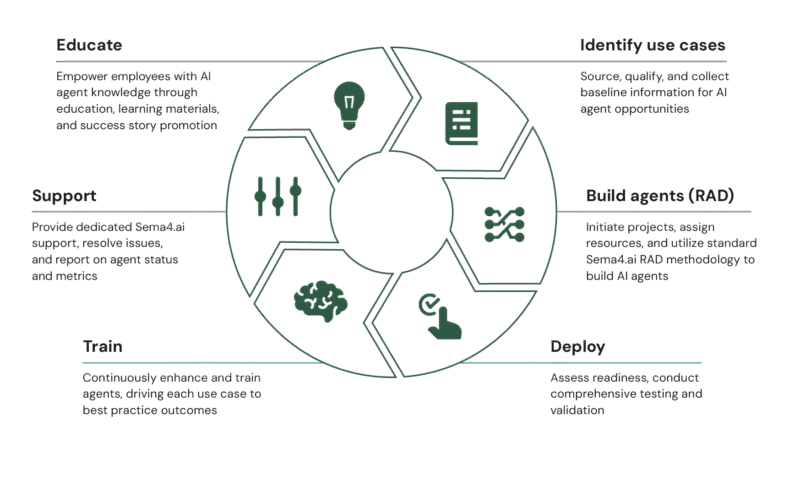
The AI CoE is the organizational answer to a common enterprise challenge: AI potential is widely recognized, pilots are launched across departments, but without centralized coordination, governance, and platform standardization, most initiatives stall before delivering production value.
The AI CoE should help:
An effective AI center of excellence framework includes seven primary functions. Each plays a critical role in moving AI from concept to enterprise-scale impact.
Define the organization’s AI vision, prioritize use cases by business impact, and align AI initiatives with corporate strategy. A clear roadmap ensures resources are directed toward the highest-value opportunities.
Establish policies for data privacy, model transparency, bias mitigation, security, and regulatory compliance. Strong governance builds trust and reduces risk as AI deployments scale.
Select and manage the AI platforms, tools, and infrastructure used across the organization. Standardization reduces complexity, accelerates development, and ensures consistency. An enterprise AI agent platform provides a unified development environment that supports both technical and business users.
Upskill business users, train technical teams, and build a culture of AI literacy. Effective CoEs make AI accessible beyond the data science team.
Evaluate potential AI applications across business units. Score each by feasibility, data readiness, business impact, and alignment with strategic goals.
Move AI solutions from pilot to production, ensuring integration with enterprise systems, monitoring, and lifecycle management.
Track KPIs, measure ROI, and report AI impact to executive stakeholders. Consistent measurement validates investments and informs expansion decisions.
The business case for building an AI Center of Excellence grows stronger as organizations expand their AI ambitions. Without a CoE, several critical challenges emerge:
As enterprises move from AI experimentation to AI at scale, the Center of Excellence becomes the organizational operating system for AI. It ensures every initiative is governed, measured, and aligned with strategic objectives.
Understanding the distinction between an AI Center of Excellence and a traditional IT or analytics team is essential for proper organizational design.
| Dimension | Traditional IT team | AI Center of Excellence |
| Focus | Infrastructure and support | AI strategy, governance, and enablement |
| Scope | Technology operations | Cross-functional business transformation |
| Users | IT staff and developers | Business users, analysts, and technical teams |
| Delivery model | Ticket-based requests | Proactive enablement and use case discovery |
| Success metric | Uptime and incident resolution | AI adoption, ROI, and business impact |
| Governance | Security and compliance | Responsible AI, ethics, bias, and transparency |
The AI CoE is a strategic function, not a support function. It drives business outcomes rather than maintaining systems. While IT teams ensure infrastructure reliability, the AI CoE ensures AI initiatives deliver measurable value across the enterprise.
Organizations that invest in building an AI Center of Excellence gain significant, measurable advantages:
Organizations with mature AI CoEs consistently report faster deployment cycles, higher project success rates, and measurable improvements in operational efficiency across finance, procurement, and customer operations workflows.
Building an AI Center of Excellence requires a structured, phased approach. The following ai center of excellence framework provides a practical roadmap for getting started.
Identify a C-level sponsor, such as a CTO, CDO, or COO, who champions the CoE and secures funding and organizational buy-in. Executive support is non-negotiable for long-term success.
Choose between centralized, federated, or hub-and-spoke models based on organizational size, AI maturity, and business unit structure.
Recruit a cross-functional team that includes AI/ML engineers, data scientists, business analysts, change management leads, and domain experts from priority business units.
Define policies for data privacy, result accuracy, model transparency, responsible AI, security, and regulatory compliance before scaling any deployments.
Choose AI platforms that enable both technical and business users. Prioritize platforms with natural language configuration, enterprise-grade security, and robust system integration capabilities. Sema4.ai Studio provides a standardized AI development environment that supports this requirement.
Score potential AI applications by business impact, feasibility, data readiness, and alignment with strategic goals. Start with well-defined processes that offer clear, measurable returns.
Launch initial use cases, track KPIs, report results to stakeholders, and expand the CoE’s scope based on demonstrated value. Early wins build organizational confidence and momentum.
Modern AI agent platforms are transforming how AI Centers of Excellence operate, accelerating every phase from development to deployment and governance.
Here is how AI agent platforms support core CoE objectives:
AI agent platforms effectively multiply the capacity of the CoE, enabling a small central team to support AI adoption across dozens of business units and hundreds of use cases.
AI Centers of Excellence deploy AI agents across a wide range of business functions. It is important to first identify areas where agents can add value. Here are criteria to help identify where to start:
| Parameters to consider | Evaluation criteria |
| Does it solve a real urgent problem vs a nice to have issue? | Unless you are saving money, improving efficiency, and solving a well understood acknowledged problem, even a successful solution will not translate into adoption gains. |
| How frequently are humans required to execute this business process? | Processes (like compliance at banks) have to be done continuously. Infrequent processes are less likely to translate into real gains. |
| Does 24×7 execution make the business more responsive? | If you can resolve a problem faster or get paid quicker or make decisions faster using agents, then it is a good candidate. Also if demand fluctuates and you need to auto scale, that is an even better candidate. |
| Is the problem repeatable across business divisions? | Solving repeatable mainstream problems will amplify adoption as subsequent efforts become easier. |
| Does the problem align with key imperatives of your organization? | If your CEO can talk about this on their earnings call, then it is definitely worth automating. |
Sophisticated back office and operational functions represent the highest-value targets for AI agent deployment. These areas share critical characteristics that make them exceptionally well-suited for intelligent automation:
High-volume repetitive work: Back office teams process thousands of similar transactions, invoices, purchase orders, support tickets, and contracts, creating significant opportunities for automation at scale.
Multi-system complexity: Operational work typically requires accessing multiple enterprise systems to complete a single task. AI agents excel at orchestrating these cross-system workflows, eliminating the manual switching and data re-entry that consumes employee time.
Document-intensive processes: Finance, HR, legal, and supply chain operations revolve around processing unstructured documents. Modern AI agents can read, understand, and extract data from PDFs, emails, and images with near-human accuracy.
Clear success metrics: Unlike some strategic initiatives, back office automation delivers measurable impact through reduced processing time, improved accuracy rates, and quantifiable cost savings that justify continued investment.
Lower risk testing ground: Operational use cases allow organizations to deploy AI agents in controlled environments, validate performance, and build confidence before expanding to customer-facing or revenue-critical applications.
The result: organizations implementing back office AI agents report 70-90% reduction in invoice processing time, 50% faster time-to-hire in HR, and dramatic improvements in compliance audit performance.
Here are some of the most impactful use cases organized by department.
Learn more about how AI agents transform finance and accounting workflows.
Following proven AI CoE best practices increases the likelihood of long-term success and organizational adoption.
The AI Center of Excellence model is evolving rapidly. Several key trends are shaping the next generation of enterprise AI governance and deployment.
Platforms like Sema4.ai are purpose-built for this future, enabling CoE teams to build, run, and manage AI agents across the enterprise using natural language configuration and enterprise-grade infrastructure. Read more about building an AI agent center of excellence.
An AI Center of Excellence is a centralized, cross-functional team responsible for defining AI strategy, establishing governance frameworks, standardizing technology platforms, and scaling AI initiatives across the enterprise. It serves as the organizational hub for coordinating all AI-related efforts.
A traditional analytics team focuses on reporting and data analysis within specific departments. An AI CoE operates cross-functionally, owning AI strategy, governance, platform standardization, and enablement. It drives business transformation rather than providing analytical support.
Core functions include AI strategy and roadmap development, governance and responsible AI, technology platform standardization, talent development, use case identification and prioritization, deployment and scaling, and performance measurement across the organization.
Start by securing executive sponsorship, then define an operating model, assemble a cross-functional team, establish governance frameworks, standardize technology platforms, prioritize use cases, and deploy with measurement and iteration built into the process.
Key benefits include faster AI deployment, consistent governance, higher ROI on AI investments, reduced duplication of effort, broader AI adoption across business units, proactive risk mitigation, and clear executive visibility into AI impact.
AI agents enable CoE teams to automate complex business processes at scale. Platforms like Sema4.ai allow business users to build agents using natural language, while Worker Agents handle tasks autonomously 24/7 and Document Intelligence processes unstructured documents.
Prioritize platforms that offer natural language agent configuration, enterprise-grade security, pre-built integrations with business systems, autonomous agent capabilities, document intelligence, and comprehensive lifecycle management from development through production.
AI CoEs track metrics including deployment velocity, user adoption rates, processing accuracy, time-to-value for new use cases, cost savings, ROI per initiative, and the number of business units actively leveraging AI solutions.
Enterprise leaders are building AI Centers of Excellence to move beyond fragmented pilots and deliver AI at scale. Learn how Sema4.ai enables AI CoE teams to deploy enterprise AI agents across finance, procurement, and operations using natural language configuration, enterprise-grade Document Intelligence, and autonomous Worker Agents.

 Learn about Agent Studio