 Back to learning center
Agentic software vs generative AI

Sema4.ai Announces Semantic Layer Capabilities at the Gartner® Data & Analytics Summit 2026 → Read now


The AI landscape is undergoing a fundamental shift. While generative AI has captured attention with its ability to create content, a new paradigm is emerging that goes far beyond content generation. Agentic software represents the evolution of AI from tools that respond to prompts into intelligent systems that autonomously act on goals within secure enterprise environments.
This shift addresses a critical gap in enterprise AI adoption. Organizations need more than chatbots that answer questions. They require AI automation that executes complex workflows, integrates with existing systems, and operates within governance frameworks. The rising demand for agent-based solutions reflects this reality, as enterprises seek reliable, auditable systems that can handle mission-critical operations at scale.
According to The GenAI Divide: State of AI in Business 2025
Sema4.ai is leading this evolution by delivering an industry leading platform for building, running, and managing enterprise AI agents. Unlike generative AI tools designed for individual productivity, agentic software from Sema4.ai empowers organizations to automate end-to-end business processes with complete transparency and control.
Agentic software refers to intelligent software agents powered by AI that possess autonomy, decision-making capabilities, persistent memory, and secure access to enterprise systems. Unlike traditional automation that follows rigid if-then rules, or generative AI that simply responds to prompts, agentic software actively pursues goals through multi-step reasoning and coordinated actions.
The fundamental distinction lies in the difference between tools that react and systems that act. A chatbot reacts to your question with a response. An intelligent agent acts on your behalf, analyzing data across multiple systems, making informed decisions, executing workflows, and adapting based on outcomes. This context awareness and goal orientation enables agents to understand business processes, not just generate text.
Agentic software integrates seamlessly across APIs, databases, and enterprise workflows. These autonomous agents can read documents, access structured data, trigger actions in business applications, and collaborate with both humans and other agents. They maintain memory of past interactions and learn from feedback, enabling continuous improvement over time.
Virtual agent definition in the enterprise context means software that doesn’t just assist. It operates independently within defined parameters, handling complex tasks that previously required human judgment and coordination across multiple systems.
Understanding the difference between agentic AI and generative AI is critical for enterprise leaders evaluating AI architectures. While both leverage large language models, their purposes and capabilities differ fundamentally.
Generative AI focuses on content creation. These systems excel at producing text, images, and code based on prompts, but they operate in a stateless manner, meaning each interaction is independent with no persistent memory. Generative AI has no ability to take actions, access live data, or integrate into enterprise workflows. It responds to questions but cannot execute tasks or coordinate multi-step processes. Most importantly, generative AI limitations include lack of governance controls, making it unsuitable for business-critical operations.
Agentic AI is designed for execution and orchestration. Autonomous agents understand goals, break them into actionable steps, access enterprise systems securely, make decisions based on real-time data, and execute complex workflows that span multiple applications. They maintain context across interactions, support enterprise governance requirements, and provide complete auditability of actions taken.
Our architecture delivers unprecedented precision for complex workflows—enabling agents to execute sophisticated business processes with mathematical accuracy and consistent, verifiable outcomes that drive real business value.
| Capability | Generative AI | Agentic AI |
| Primary function | Content generation | Goal execution |
| Memory | Stateless | Persistent context |
| System access | None | Secure API integration |
| Workflow integration | External only | Native enterprise integration |
| Governance | Limited | Built-in compliance |
| Use case | Individual productivity | Enterprise automation |
This contrast explains why agents work better for real operational needs. When enterprises require AI to perform actual work, not just provide suggestions, agentic AI becomes the only viable architecture.
The question “why are AI agents reliable software?” reveals a critical advantage: agentic software aligns with established enterprise software engineering principles in ways that prompt-based generative AI cannot.
Enterprise AI agents fit naturally into enterprise AI architecture through comprehensive lifecycle management. Like any mission-critical software, agents support versioning, allowing organizations to manage updates, roll back changes, and maintain multiple environments for development, testing, and production. This structured approach ensures reliability and predictability.
Observability is built into agent platforms, providing real-time insights into agent performance, decision-making processes, and system interactions. Organizations can monitor agent behavior, identify issues proactively, and optimize performance using familiar enterprise monitoring tools like Splunk, Datadog, and LangSmith.
Auditability addresses compliance requirements that generative AI cannot meet. Every agent action generates detailed logs showing what was executed, when, by whom, and why. This transparency supports regulatory compliance, security reviews, and operational intelligence – critical capabilities for regulated industries and enterprise governance.
Unlike unpredictable LLM prompts that can produce inconsistent results, agents are structured, testable components. Development teams can write unit tests, validate edge cases, and ensure agents behave consistently across scenarios. This testability enables continuous integration and deployment practices that enterprises depend on.
Agents also support scalability and integration at the enterprise level. They connect securely to existing systems through APIs, respect role-based access controls, and operate within established security boundaries. This makes them governed components of enterprise architecture, not shadow IT experiments.
When evaluating AI agent frameworks for enterprise deployment, specific capabilities separate true agentic platforms from basic automation tools or LLM wrappers.
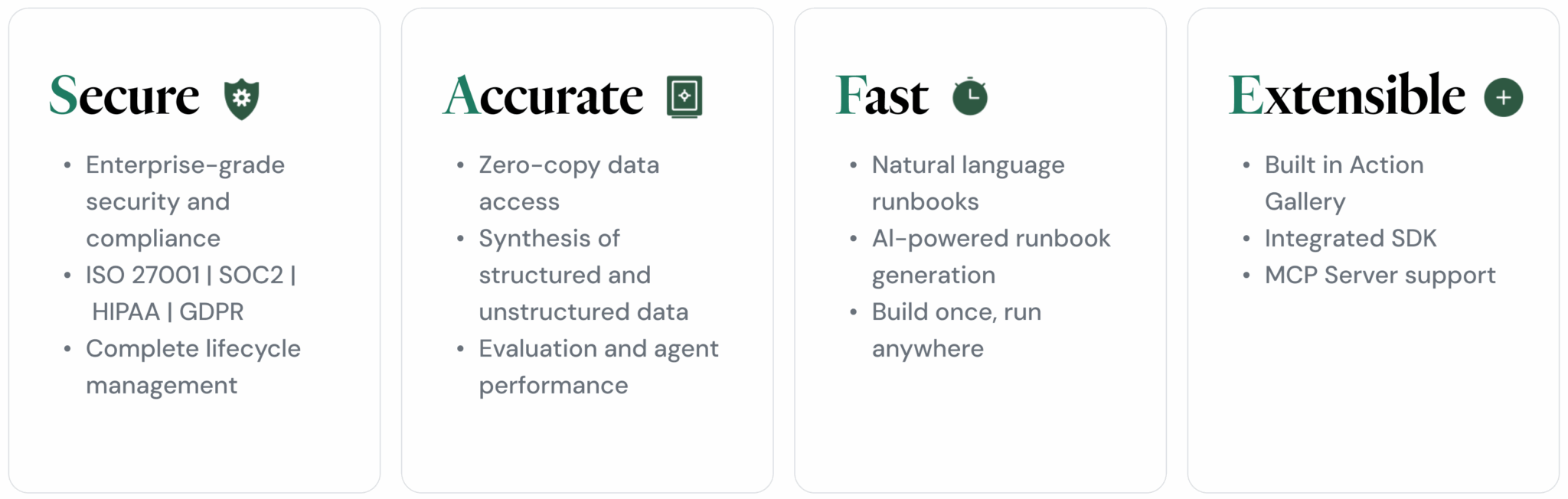
Secure access to enterprise systems forms the foundation. Effective agentic AI requires native integration with SaaS applications, databases, and APIs while maintaining zero-copy data access that keeps sensitive information within existing security boundaries. The platform should support OAuth and enterprise SSO, ensuring agents operate with appropriate permissions.
Role-based access control enables governance at scale. Organizations need granular control over which users can build agents, which agents can access specific systems, and what actions agents are authorized to perform. Enterprise AI platforms must map to existing identity management systems and support workspace-level isolation for different business units.
Built-in observability provides transparency into agent operations. Comprehensive monitoring should integrate with enterprise tools through OpenTelemetry, offering real-time insights into agent performance, decision-making processes, and system interactions. This visibility builds trust and enables rapid troubleshooting.
Natural language agent building democratizes automation by empowering business users to create agents using plain English runbooks rather than complex code. This capability accelerates time-to-value and ensures agents are built by those who understand business processes best.
Sema4.ai delivers all these capabilities through our SAFE framework and a comprehensive platform that provides full-stack control and governance. Organizations can build agents in Studio, deploy them securely in their own AWS VPC or Snowflake environment, and manage the entire lifecycle through Control Room. This architecture ensures enterprise AI agents operate with the security, scalability, and reliability that mission-critical operations demand.
Sema4.ai meets the highest industry standards for data protection and privacy, including certification for SOC2 and ISO27001 and HIPAA compliance for healthcare data protection. We are GDPR adherent for EU data privacy regulations.
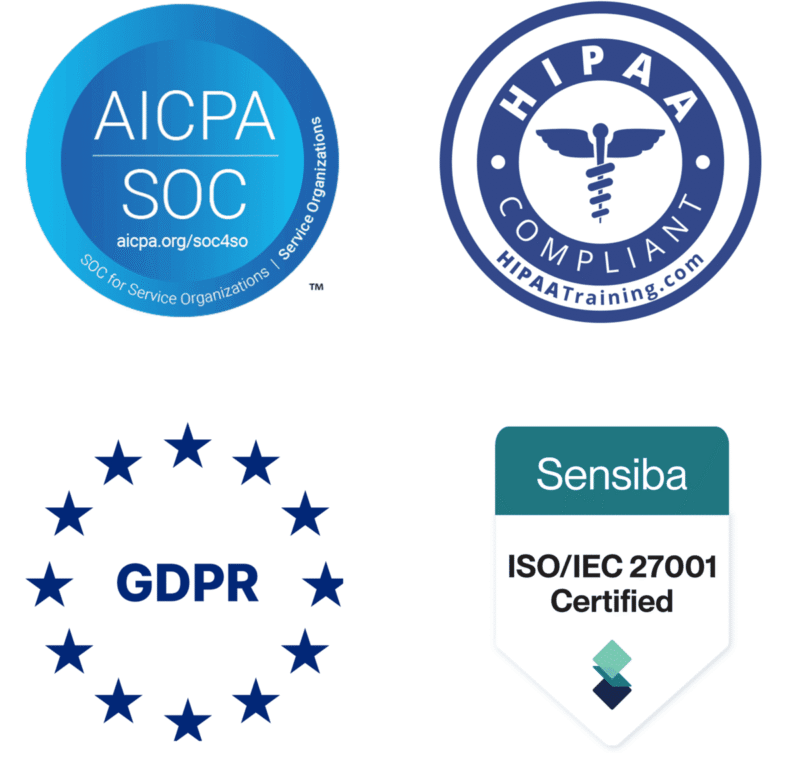
Sema4.ai meets the highest industry standards for data protection and privacy, including certification for SOC2 and ISO27001 and HIPAA compliance for healthcare data protection. We are GDPR adherent for EU data privacy regulations.
The practical difference between generative AI and intelligent software agents becomes clear when examining scenarios where content generation fails but autonomous execution succeeds.
Multi-system coordination represents a classic use case where agentic software excels. Consider an approval workflow that requires pulling data from a financial system, validating against compliance rules, routing for management approval, and sending notifications via email and Slack. Generative AI can draft the email, but only autonomous agents can orchestrate the entire process end-to-end, handling exceptions and adapting based on responses.
Compliance-driven workflows demand the auditability and governance that enterprise AI automation provides. Fraud review processes, for example, require agents that can access transaction data, cross-reference with risk databases, apply regulatory rules, escalate suspicious cases, and maintain detailed logs of all decisions. This level of sophistication and oversight is impossible with basic chatbots or content-generation tools.
Reusable automation at scale showcases the software advantages of agent-based systems. Organizations can build agents for IT ticket routing, HR onboarding, invoice reconciliation, or customer support that operate consistently across thousands of transactions. These agents learn from feedback, adapt to variations, and maintain performance standards that generative AI cannot match.
Real enterprise deployments demonstrate this advantage. Organizations use intelligent software agents to process hundreds of complex invoices monthly with 90%+ accuracy, handle employee onboarding workflows that span multiple systems, and manage IT support tickets that previously required manual review – all with complete transparency and audit trails.
Learn more about agentic use cases.
Agentic software represents the natural evolution beyond content generation, from AI that helps write to AI that actually works. For enterprise leaders navigating AI adoption, this distinction is crucial. While generative AI enhances individual productivity, agentic AI transforms organizational capability.
The enterprises succeeding with AI aren’t just deploying chatbots or content generators. They’re implementing agent-first platforms that deliver secure, governed automation at scale. These organizations recognize that the true value of AI lies not in generating more content, but in executing complex workflows, coordinating across systems, and continuously improving through learning.
As AI technology matures, the question isn’t whether to adopt agentic software – it’s how quickly organizations can implement agent-based architectures before competitors gain an insurmountable advantage. The platforms that enable business users to build, deploy, and manage enterprise AI agents will define the next decade of organizational productivity.
Sema4.ai provides the comprehensive platform that enterprise leaders need to realize this vision. With capabilities spanning agent development, secure deployment, and lifecycle management, organizations can confidently build the intelligent automation that drives competitive advantage.
Explore our platform or schedule a demo today.



 Learn more about Studio