Back to learning center
What is payment remittance?


Payment remittance is the act of sending a payment from one party to another to settle an obligation, accompanied by remittance advice. It is a document that details which invoices or accounts the payment covers, enabling the recipient to accurately apply the payment and reconcile their records.
Every time a business sends funds to a supplier, vendor, or creditor, the money alone doesn’t tell the whole story. The recipient needs to know which invoices are being paid, what deductions were taken, and how to apply the funds correctly. That context is what payment remittance provides.
Payment remittance is central to accounts payable (AP), where the paying organization sends remittance advice with or after payment. It’s equally critical in accounts receivable (AR), where the receiving organization uses remittance data to match payments to open invoices. In cash application, remittance details enable accurate posting of payments to the correct accounts. And in bank reconciliation, remittance information helps finance teams match bank transactions to internal records.
The challenge? Remittance advice arrives in wildly different formats: PDF attachments, email body text, EDI transactions, paper documents, and payment portals. For finance teams processing hundreds or thousands of payments each month, manually extracting and matching this data is time-consuming, error-prone, and a major bottleneck in the financial close process.
AI-powered document intelligence and AI agents are changing this fast. They automatically extract remittance data from any format, match it to open invoices, and accelerate cash application without manual intervention.
Payment remittance refers to the process of sending money from a buyer (payer) to a seller (payee) to settle outstanding invoices, bills, or other financial obligations. In remittance accounting, it’s a fundamental concept that keeps the financial engine of business relationships running.
It’s important to understand the distinction. While “payment” refers to the transfer of funds itself, “remittance” encompasses both the payment and the accompanying documentation, called remittance advice, that explains what the payment covers.
In B2B finance, this distinction matters because a single remittance payment often covers multiple invoices, includes deductions such as discounts, credits, or disputes, and may involve partial payments. Without that remittance context, the recipient has no clear way to process the payment correctly.
Remittance data flows through the entire financial lifecycle, from AP and AR to cash application and reconciliation, making it a critical data point across both the order-to-cash and procure-to-pay processes.
Remittance advice is a document sent by the payer to the payee that itemizes which invoices a payment is intended to cover. The remittance advice meaning is straightforward: it’s the explanation that accompanies the money, listing invoice numbers, amounts paid, deductions taken, and credits applied.
Payment remittance advice enables the receiving party’s AR team to match the incoming payment to the correct open invoices and post it accurately in their accounting system.
A typical remittance advice document includes:
Remittance advice is typically generated by the payer’s AP department and sent to the payee’s AR department. Without it, finance teams must manually investigate each payment to determine which invoices it covers, a process that delays cash application, increases errors, and ties up valuable resources.
Remittance advice comes in several formats, each with different implications for remittance processing speed and automation readiness.
Basic remittance advice is a simple document listing invoice numbers and amounts paid – often a paper stub attached to a check.
Scannable remittance advice includes barcodes or OCR-friendly formatting designed for automated processing.
Electronic remittance advice (ERA) is sent electronically via EDI (such as EDI 820), EFT addenda records, or AP/AR portals, enabling straight-through processing when systems are integrated.
Email remittance advice arrives as PDF attachments or embedded in email body text – increasingly common but highly variable in format.
| Type | Delivery method | Processing speed | Automation readiness |
| Paper/check stub | Physical mail | Slowest | Low, requires manual entry |
| Email/PDF | Email attachment | Moderate | Medium, variable formats |
| EDI (820) | Electronic/system | Fast | High, structured data |
| Portal-based | Supplier/AP portal | Moderate–fast | Medium, portal-dependent |
Most enterprises receive remittance advice across all of these formats simultaneously, creating a significant data extraction challenge. Unlike rule-based systems requiring custom templates for each format, AI-powered document intelligence extracts data from PDFs, emails, EDI files, and scanned documents automatically – eliminating per-payer configuration.
Remittance processing follows a structured workflow from payment initiation to final reconciliation.
Step 1: Payment initiation. The payer’s AP team initiates payment via check, ACH, wire transfer, or EFT based on approved invoices.
Step 2: Remittance advice generation. The payer generates remittance advice documenting which invoices the payment covers, along with amounts, deductions, and credits.
Step 3: Remittance delivery. Remittance advice is sent to the payee via email, EDI, postal mail, or supplier portal – often arriving separately from the payment itself.
Step 4: Remittance receipt and data extraction. The payee’s AR team receives the remittance, identifies the format, and extracts relevant data including invoice numbers, amounts, and deductions.
Step 5: Payment-to-invoice matching. AR associates the payment with the corresponding open invoices in the ERP or accounting system, resolving any discrepancies.
Step 6: Cash application. The payment is posted to the correct customer account and invoices are marked as paid, fully or partially.
Step 7: Reconciliation. Finance teams reconcile applied payments against bank statements to ensure all transactions are accounted for.
Steps 4 and 5, data extraction and matching, are the most labor-intensive and error-prone parts of this process, and the primary targets for AI-powered automation.
Finance teams face several persistent pain points when handling payment remittance manually.
These aren’t process problems, they’re data problems. The core issue is extracting structured data from unstructured documents at speed and scale, which is exactly what AI-powered Document Intelligence is designed to solve.
AI agents and Document Intelligence are transforming remittance workflows across every stage of the process.
Document Intelligence extracts remittance data, invoice numbers, amounts, deductions, payment references, from any format. Whether it’s a PDF attachment, email body text, EDI file, or scanned document, AI reads and understands the content automatically.
Intelligent matching enables AI agents to match extracted remittance data against open invoices in the ERP, handling partial payments, deductions, and multi-invoice payments without manual intervention.
Exception handling allows agents to reason through discrepancies, amount mismatches, missing invoice numbers, unauthorized deductions. Agents either resolve them autonomously or escalate to a human with full context.
Autonomous cash application is powered by Worker Agents that post matched payments to customer accounts around the clock, accelerating cash application from days to minutes.
Enterprise system integration through pre-built connectors to ERP systems (SAP, Oracle, NetSuite), banking platforms, and AR tools ensures remittance data flows directly into existing workflows.
Continuous learning means agents improve over time as they process more remittance documents from each payer, increasing accuracy and reducing exceptions with every cycle.
See how enterprises are automating receivables matching and cash application with AI agents.
Automating remittance processing delivers measurable outcomes across the finance function.
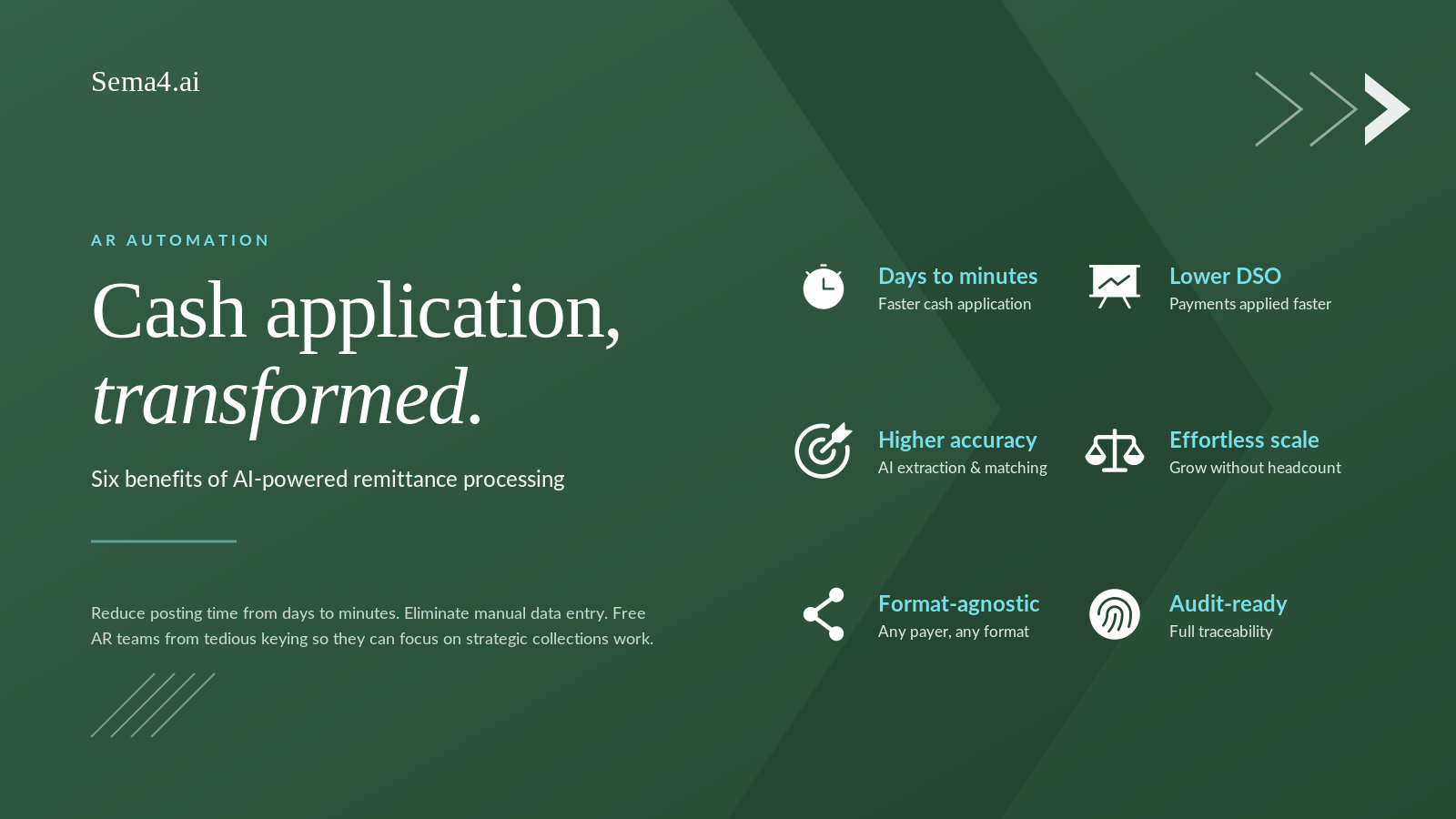
Enterprises using AI-powered remittance processing report cash application time reduced from days to minutes, significant reductions in unapplied cash, and AR teams reallocated from data entry to strategic collections work.
| Term | Definition |
| Payment | The transfer of funds from payer to payee |
| Remittance | The act of sending payment, often used interchangeably with payment in B2B contexts |
| Remittance advice | The document accompanying a payment that details which invoices are being paid |
| Cash application | The process of matching incoming payments to open invoices using remittance data |
| Electronic remittance advice (ERA) | Remittance advice delivered electronically via EDI, EFT addenda, or integrated systems |
The remittance landscape is evolving rapidly, driven by AI and real-time payment infrastructure.
End-to-end autonomous processing. AI agents are moving toward managing the entire remittance lifecycle,from receipt to cash application to reconciliation, without human intervention.
Real-time remittance. As networks like FedNow and RTP expand, remittance advice will increasingly be embedded in the payment itself, enabling instant cash application.
Predictive cash application. AI will predict which invoices a payment covers before remittance advice arrives, based on historical payer behavior.
Multi-agent orchestration. Specialized AI agents will collaborate across extraction, matching, exception resolution, and reconciliation.
Platforms like Sema4.ai are purpose-built for this future – enabling finance teams to deploy AI agents that process remittance data from any format, match payments intelligently, and apply cash autonomously at enterprise scale. Explore how Sema4.ai’s AI agent platform automates remittance workflows.
What is payment remittance? Payment remittance is sending funds from a buyer to a seller to settle invoices or financial obligations. It includes both the payment and the remittance advice that details which invoices the payment covers.
What is remittance advice? Remittance advice is a document sent by the payer listing the invoices a payment covers, including amounts, deductions, and credits. It enables the recipient’s AR team to match payments to the correct accounts.
What is the difference between a payment and a remittance? A payment is the transfer of funds. A remittance includes the payment plus the documentation explaining which invoices are being paid, what deductions were taken, and how to apply the funds.
What information is included in remittance advice? Typically: payer name, payment date and amount, invoice numbers being paid, individual amounts per invoice, deductions or adjustments, and the payment method used.
What is electronic remittance advice (ERA)? ERA is remittance information delivered digitally via EDI (such as EDI 820), EFT addenda records, or integrated AP/AR portals. It enables faster, more automation-ready processing than paper-based formats.
How does remittance processing work? It involves receiving remittance advice, extracting data, matching payment details to open invoices, applying cash to the correct accounts, and reconciling against bank statements.
What is a cash application? Cash application is matching incoming payments to open invoices using remittance data and posting those payments to the correct customer accounts in the accounting system.
How can AI automate remittance processing? AI agents extract data from any document format using Document Intelligence, match payments to invoices intelligently, resolve exceptions autonomously, and apply cash around the clock through Worker Agents.
Finance teams processing hundreds of remittance advices per day are replacing manual data entry and matching with AI agents that extract, match, and apply payments automatically – across any document format. Learn how Document Intelligence and Worker Agents accelerate cash application and eliminate unapplied cash at enterprise scale.

 Learn about Agent Studio