Back to learning center
What is finance automation?


Finance automation is the use of technology to streamline and execute financial operational processes – such as accounts payable, accounts receivable, reconciliation, and reporting – reducing manual effort, errors, and processing time across the finance function.
For years, finance teams have relied on spreadsheets, manual data entry, and rule-based bots to keep operations running. These approaches worked when processes were simple and volumes were low. But as transaction complexity has grown and document formats have multiplied, the limitations of legacy automation in finance have become impossible to ignore.
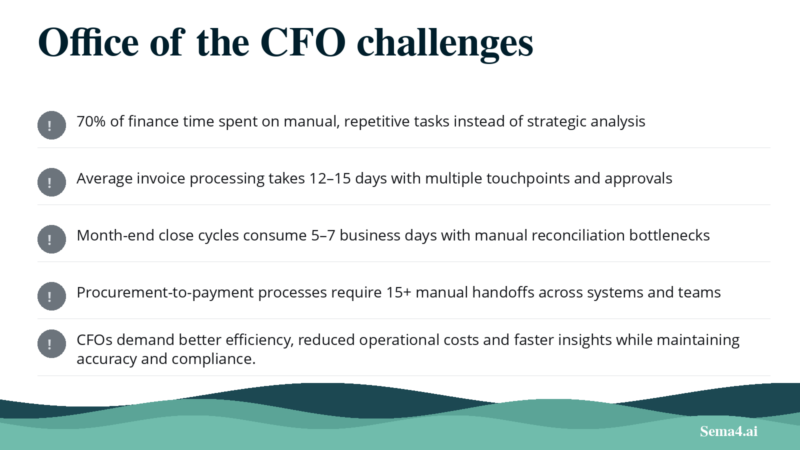
Today, process automation in finance is undergoing a fundamental shift. Organizations are moving beyond rigid, developer-dependent RPA workflows toward intelligent AI agents that can reason, adapt, and operate autonomously. This new generation of back-office finance automation software doesn’t just follow predefined rules – it understands documents, makes decisions, and handles exceptions with minimal human intervention.
The finance function typically automates activities such as:
Organizations invest in finance automation to:
Whether you operate in manufacturing with high invoice volumes, financial services with complex multi-entity consolidation, or healthcare with strict regulatory reporting, the shift from RPA to agentic AI is redefining what automation in finance can achieve – moving beyond rule-based bots to intelligent agents that handle document variations, make decisions, and operate autonomously with human oversight.
Process automation in finance delivers the most value in high-volume, document and data-heavy workflows where manual effort creates bottlenecks and introduces errors. Here are the core areas where automation of finance processes are transforming operations:
Accounts payable (AP) – From invoice receipt and data extraction to coding, approval routing, and payment execution, AP automation eliminates the most labor-intensive steps in finance. AI agents process invoices across any supplier format without requiring template configuration for each vendor.
Accounts receivable (AR) – Automation streamlines invoice generation, collections follow-up, receivables matching, and cash application. Agents manage the full order-to-cash workflow, reducing days sales outstanding and improving cash flow predictability.
Bank reconciliation – Matching transactions across bank statements, ERP systems, and sub-ledgers is a time-consuming, error-prone process when done manually. AI agents handle partial matches, missing references, and multi-currency complexities automatically.
Financial close and reporting – Automating journal entries, intercompany eliminations, variance analysis, and regulatory reporting accelerates close cycles from weeks to days.
Expense management – Receipt processing, policy compliance checks, and reimbursement workflows benefit from intelligent automation that understands document formats and enforces rules consistently.
Procurement and procure-to-pay – Purchase order matching, supplier onboarding, and payment processing become seamless when agents manage the end-to-end workflow.
Finance function automation is no longer limited to simple, repetitive tasks. Modern AI agents handle the complexity that RPA could never reach.
The history of finance automation follows three distinct waves, each representing a step change in what technology can handle.
Wave 1: Spreadsheets and manual processes
For decades, finance teams relied on Excel, email, and manual data entry to manage core workflows. Analysts spent hours copying data between systems, reconciling numbers by hand, and chasing approvals through email chains. Error rates were high, scalability was limited, and there was no reliable audit trail. This approach worked when transaction volumes were modest, but it could never scale with the business.
Wave 2: RPA and rule-based automation
Robotic process automation brought relief for structured, repetitive tasks. RPA bots could copy data between systems, run scheduled reports, and execute predefined workflows. But RPA required developer-heavy configuration and constant maintenance. When invoice formats changed, processes varied, or exceptions appeared, bots broke and were costly to fix. RPA was fundamentally limited to structured data and could not handle the unstructured documents – PDFs, scanned images, email attachments – that dominate finance operations.
Wave 3: AI agents and intelligent automation
AI agents represent the current frontier of finance automation. Powered by reasoning models, these agents adapt to document variations and process complexity without requiring reprogramming. Business users configure agent behavior through natural language runbooks instead of developer-heavy scripting. Agents process transactions autonomously around the clock, escalating to humans only when genuine exceptions arise. And critically, they handle unstructured documents – invoices, remittance advices, contracts – with near-perfect accuracy using AI-powered document intelligence. Agents can be easily improved over time with additional clarifications from business users, learning as they go.
RPA was a necessary step in the evolution of automation in finance. But the finance function now requires automation that can reason, adapt, and scale – which is exactly what AI agents deliver.
Finance leaders who invested heavily in RPA are confronting a difficult reality: the technology that was supposed to transform their operations is now creating as many problems as it solves. Here’s why automation finance strategies built entirely on RPA are falling short:
Brittle workflows – RPA bots follow rigid rules and break when invoice layouts, field positions, or data formats change. A single supplier switching PDF templates can halt an entire AP workflow.
High maintenance burden – Finance teams spend significant resources and costs keeping bots running as systems and processes evolve. Every ERP update, format change, or process modification requires bot reconfiguration.
Cannot handle unstructured data – RPA struggles with the variety of document formats common in finance – PDFs, scanned images, email text, and attachments. This limits automation to only the most structured, predictable tasks.
Developer dependency – Business users cannot configure or modify RPA workflows without engineering support, creating bottlenecks and slowing time-to-value.
Limited decision-making – RPA executes predefined steps but cannot reason through exceptions, escalations, or edge cases. When something unexpected happens, the bot stops and waits for human intervention.
Poor ROI at scale – The cost of maintaining large RPA deployments often exceeds the value they deliver, especially as document variety and process complexity increase.
Finance leaders are recognizing that RPA was built for a structured, predictable world. Modern finance operations are anything but – and that’s why the shift to AI-powered process automation in finance is accelerating. Learn more about enterprise AI agents vs. RPA and their key differences.
AI agents for finance are intelligent software systems that go far beyond what traditional RPA bots can accomplish. Rather than following rigid, predefined scripts, AI agents use reasoning models to understand context, make decisions, and adapt to complexity – fundamentally changing how finance automation software works.
Here are the core capabilities that set AI agents apart:
Document intelligence – AI agents extract, classify, and validate data from invoices, purchase orders, remittance advice, and contracts across any format. AI-powered document intelligence uses multi-pass parsing with agentic OCR to achieve near-perfect accuracy, even on complex, multi-page documents.
Reasoning and decision-making – Instead of following predefined rules, agents evaluate exceptions, route approvals, and resolve discrepancies using advanced reasoning models. They handle the edge cases that cause RPA bots to fail.
Natural language configuration – Business users define how agents work using runbooks written in plain English, not code. Finance teams can create and modify automation without developer dependency, using tools like Sema4.ai Studio to build agents in minutes.
Autonomous execution with oversight – Autonomous Worker Agents process transactions 24/7, handling high-volume workflows like AP and AR without supervision. They escalate to humans only when genuine exceptions require judgment.
Enterprise system integration – Agents connect to ERPs like SAP, Oracle, and NetSuite, as well as banking platforms, payment systems, and financial tools through pre-built actions and universal MCP connectivity.
The result is finance function automation that operates continuously, adapts to change, and improves over time – delivering the intelligence and autonomy that modern finance operations demand.
Modern finance automation software delivers tangible, measurable outcomes that directly impact the bottom line. Here are the benefits that are driving adoption across enterprise finance teams:
Reduced processing costs – Automating high-volume, low-value tasks like invoice data entry and payment matching dramatically reduces the cost per transaction. Organizations processing hundreds of invoices monthly can redirect significant resources to higher-value work.
Faster financial close – Automating reconciliation, journal entries, and variance analysis accelerates month-end and quarter-end close cycles. Teams that once spent weeks closing the books can compress that timeline to days.
Improved accuracy – Manual errors in AP, AR, and reporting carry real financial risk. AI agents eliminate data entry mistakes and ensure consistent processing across every transaction.
Better cash flow visibility – Real-time tracking of payables, receivables, and cash positions gives finance leaders the clarity they need for strategic decision-making and accurate forecasting.
Scalability without headcount – Growing transaction volumes no longer require proportional staff increases. AI agents handle increased workloads seamlessly, from processing 350+ invoices per month to managing thousands of AR transactions.
Audit readiness – Full traceability of every automated decision and transaction creates a complete audit trail, simplifying compliance and regulatory reporting.
Strategic focus – By automating the automation of finance processes that consume the most time, finance professionals can redirect their expertise toward analysis, planning, and business partnering.
The real-world impact speaks for itself: invoice processing time reduced from up to three hours to approximately two minutes, AR follow-up reduced from days to minutes, and DSO improvements through automated reminders and reconciliation.
Understanding the difference between RPA and AI agents is critical for finance leaders evaluating their automation strategy. Here’s a direct comparison:
| Capability | Traditional RPA | AI agents (e.g., Sema4.ai) |
| Configuration | Developer-coded scripts | Natural language runbooks |
| Document handling | Structured data only | Any format with Document Intelligence |
| Adaptability | Breaks when formats change | Adapts with reasoning models |
| Decision-making | Follows predefined rules | Reasons through exceptions |
| Maintenance | High – constant bot repairs | Low – agents self-adapt |
| Oversight | Manual monitoring required | Autonomous with human escalation |
The distinction is clear: RPA automates tasks, while AI agents automate work. Finance automation powered by AI agents handles the complexity, variability, and judgment that RPA was never designed to address.
Selecting the right finance automation software requires evaluating platforms against the criteria that matter most for enterprise finance. The SAFE framework provides a clear structure for this evaluation:
Secure – Financial data is among the most sensitive in any organization. Choose a platform where data remains within your enterprise infrastructure. No sensitive financial data should leave your environment.
Accurate – In finance, precision is non-negotiable. Look for platforms with SQL-powered DataFrames that provide mathematical precision for financial calculations and Document Intelligence that achieves near-perfect extraction accuracy across document types.
Fast – Time-to-value matters. Platforms should enable Document Intelligence configuration in minutes, not months, and agents should deploy rapidly without lengthy implementation cycles.
Extensible – Your finance tech stack is complex. Ensure the platform integrates with enterprise systems such as SAP, Oracle, Salesforce, Workday, and banking platforms through pre-built actions and universal connectivity.
Beyond the SAFE framework, finance leaders should also ask:
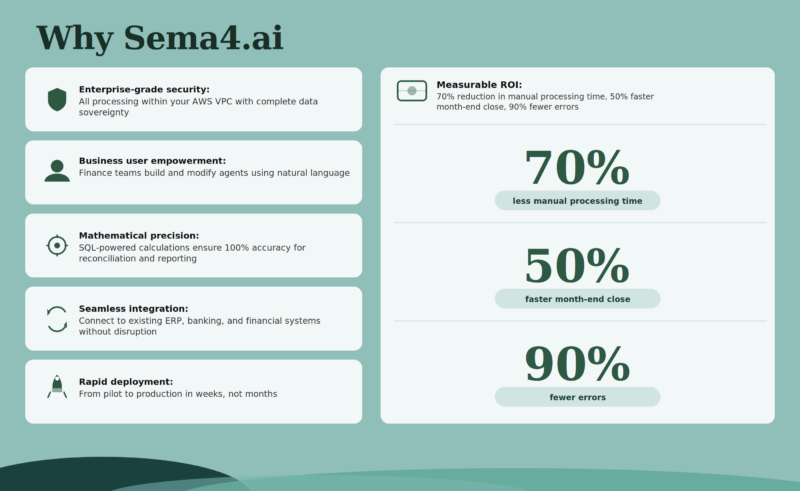
Platforms like Sema4.ai enable finance teams to build finance automation agents with natural language, putting control directly in the hands of the people who understand the processes best.
Across industries, finance teams are deploying AI agents to automate real workflows and deliver measurable results. Here are practical examples of process automation in finance in action:
Accounts payable automation
AI agents extract invoice data across formats, validate against purchase orders, route for approval, and execute payments. Document Intelligence processes invoices from any supplier in any format – eliminating the template-by-template configuration that RPA requires. One large manufacturer reduced invoice processing time from up to three hours to approximately two minutes per invoice, with agents processing 350+ invoices per month and handling 90%+ of PDFs autonomously across varying formats.
Accounts receivable and collections
Automated invoice generation, payment reminders, collections follow-up, and accounts receivable matching transform AR operations. Worker Agents manage AR workflows around the clock, escalating only exceptions. One enterprise increased receivables matching accuracy from approximately 20% to over 80%, ensuring end-of-month, quarter, and year processing is always completed on time.
Bank and payment reconciliation
AI agents match transactions across bank statements, ERP records, and sub-ledgers. They handle partial matches, missing references, and multi-currency complexities that would take analysts hours to resolve manually.
Financial close acceleration
Automating journal entry preparation, intercompany eliminations, and variance analysis compresses close cycles from weeks to days, giving finance leaders faster access to accurate financial data for decision-making.
These are not theoretical use cases. Enterprises are achieving these results today with automation of finance processes powered by AI agents.
Successful finance automation initiatives share common patterns. Here are the best practices that deliver the strongest results:
Measure and iterate – Track KPIs like invoice processing time, days sales outstanding, close cycle length, and error rates to quantify automation impact and identify opportunities for continuous improvement.
The evolution of automation in finance is accelerating, and several trends are shaping what comes next:
End-to-end agentic automation – AI agents are moving beyond automating individual tasks to managing entire workflows autonomously. Rather than automating just invoice data extraction, agents will handle the full AP lifecycle from receipt to payment.
Predictive financial intelligence – AI-driven cash flow forecasting, spend analysis, and anomaly detection will give finance leaders forward-looking insights, not just backward-looking reports.
Multi-agent orchestration – Specialized agents will collaborate across finance function automation workflows. An AP agent and a reconciliation agent, for example, will work together seamlessly to process and validate transactions end to end.
Natural language as the interface – Finance professionals will configure, query, and manage automation systems in plain language. The technical barriers that have limited finance automation adoption will continue to disappear.
Continuous compliance – Real-time regulatory monitoring and automated audit trail generation will make compliance a byproduct of automation rather than a separate workstream.
Platforms like Sema4.ai are already enabling this future, empowering business users to configure automation using natural language runbooks while maintaining enterprise-grade transparency and control.
What is finance automation? Finance automation is the use of technology to streamline financial processes such as accounts payable, accounts receivable, reconciliation, and reporting. Modern finance automation uses AI agents that can reason, adapt, and process documents autonomously, reducing manual effort and errors.
What is the difference between RPA and AI in finance? RPA follows rigid, predefined rules and requires developer coding. AI agents use reasoning models to adapt to document variations, make decisions, and handle exceptions autonomously. AI agents can process unstructured documents that RPA cannot.
What finance processes can be automated? Core automatable processes include accounts payable, accounts receivable, bank reconciliation, financial close and reporting, expense management, and procure-to-pay workflows. AI agents handle both structured and unstructured data across these areas.
How does AI improve accounts payable automation? AI agents extract data from invoices in any format using Document Intelligence, validate against purchase orders, route approvals, and execute payments. They process hundreds of invoices monthly with near-perfect accuracy, reducing processing time from hours to minutes.
How does AI improve accounts receivable and collections? AI agents automate invoice generation, payment reminders, collections follow-up, and receivables matching. Worker Agents manage AR workflows continuously, improving cash application accuracy and reducing days sales outstanding.
What is the SAFE framework for finance automation? SAFE stands for secure, accurate, fast, and extensible. It provides evaluation criteria for finance automation platforms: data stays in your infrastructure, calculations are mathematically precise, deployment is rapid, and integrations connect to your enterprise systems.
What should CFOs look for in finance automation software? CFOs should prioritize platforms that are secure within existing infrastructure, accurate with document processing and calculations, fast to deploy, and extensible across enterprise systems. Business user empowerment and transparent agent reasoning are essential.
How do AI agents handle document processing in finance? AI agents use multi-pass document intelligence with agentic OCR to extract structured data from invoices, contracts, and remittance advices in any format. The system adapts to document variations automatically and achieves near-perfect accuracy across 100+ languages.
Finance leaders across industries are replacing fragile RPA workflows with AI agents that adapt, reason, and deliver results at scale. Learn how Sema4.ai enables finance teams to automate AP, AR, reconciliation, and reporting using natural language runbooks and enterprise-grade AI agents.
Contact us to see demos of finance use cases, like invoice reconciliation, remittance matching, AP help desk, procurement sourcing, and more, or explore our finance e-book, “5 finance use cases transformed by enterprise AI agents”.

 Learn about Agent Studio