 Back to learning center
Cognitive architecture in AI: How agents learn, reason, and adapt

Sema4.ai Announces Semantic Layer Capabilities at the Gartner® Data & Analytics Summit 2026 → Read now


The artificial intelligence landscape is evolving beyond systems that simply generate content or respond to prompts. Today’s most capable AI systems are built on cognitive architecture—a structured model that enables agents to learn, reason, and adapt over time, not just react. This represents a fundamental shift from generative output to genuine cognition and action.
What is cognitive architecture? At its core, it’s the blueprint for building intelligent systems that can operate with memory, logic, and decision-making capabilities. While generative AI has captured public attention with its ability to create text and images, cognitive architecture powers the next generation of AI agents capable of autonomous, goal-directed behavior in complex, changing environments. These architectures enable agents to perceive their surroundings, learn from experience, recall relevant information, and make reasoned decisions, mirroring the cognitive processes that drive human intelligence.
Cognitive architecture is a structured framework that simulates how intelligent agents perceive, remember, reason, and act. Rather than simply executing predefined tasks or generating responses based on pattern recognition, cognitive architecture provides a comprehensive blueprint for modeling cognition itself—the underlying processes that enable intelligent behavior.
Think of cognitive architecture as the operating system for artificial intelligence. Just as an operating system manages a computer’s hardware and software resources, a cognitive architecture orchestrates the components of intelligence: sensory perception, memory systems, learning mechanisms, and reasoning processes. This structured approach enables agents to operate autonomously in dynamic environments, making decisions based on goals, past experiences, and current context.
The power of cognitive architecture lies in its ability to support both reasoning and learning over time. Unlike static rule-based systems or pure neural networks, cognitive architectures integrate multiple cognitive functions into a cohesive framework. They enable agents to:
This comprehensive approach distinguishes cognitive architectures from simpler AI systems. Where a chatbot might generate contextually appropriate responses, an agent built on cognitive architecture can pursue long-term goals, learn from failures, adapt strategies, and explain its reasoning. This is essential for enterprise applications where reliability, transparency, and continuous improvement are non-negotiable.
Understanding cognitive architecture requires examining its fundamental building blocks, the core modules that work together to create intelligent behavior. These components form the cognitive model and architecture that defines how agents process information and make decisions.
The perception module serves as the agent’s sensory interface with its environment. It processes inputs from various sources, including text, images, structured data, API responses, or user interactions. It then transforms raw data into meaningful representations that the agent can work with. In enterprise AI agents, perception might involve parsing documents, interpreting database queries, or understanding natural language requests.
Memory is crucial for enabling agents to learn from experience and maintain context over time. Cognitive architectures typically incorporate three types of memory:
These memory systems work together to give agents the context they need for intelligent action. An agent processing an invoice, for example, might use working memory to track current validation steps, procedural memory to apply learned reconciliation patterns, and declarative memory to recall similar past transactions.
The learning component enables agents to improve their performance through experience. Rather than requiring manual reprogramming, agents with learning capabilities can adapt their behavior based on outcomes, feedback, and new information. This experience-based behavior change is what transforms reactive systems into truly adaptive intelligence.
The reasoning module handles goal selection, planning, and rule-based decision-making. It evaluates available information, considers multiple action paths, and selects approaches aligned with the agent’s objectives. This component provides the logical foundation for transparent, explainable AI, a critical requirement in regulated industries and enterprise applications.
These structures aren’t just theoretical constructs. They’re foundational to research on architecture for learning agents and are extensively studied in academic programs focused on artificial intelligence and cognitive psychology. By organizing intelligence into these modular components, cognitive architectures provide both the flexibility to adapt to different domains and the structure needed for reliable, predictable behavior.
Here is a simple example that illustrates how these components work together.
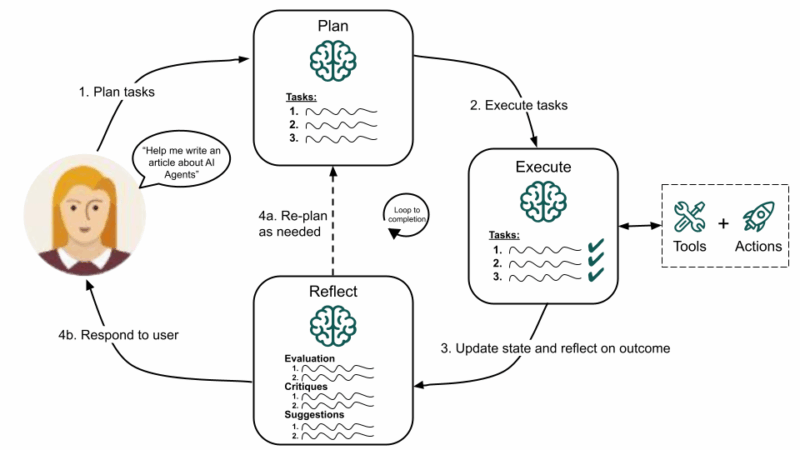
Not all cognitive architectures are created equal. The field has evolved along two distinct approaches, each with unique strengths and limitations: symbolic and subsymbolic architectures.
Symbolic cognitive architecture represents intelligence through explicit rules, logical relationships, and structured knowledge representations. Classic frameworks like SOAR and ACT-R exemplify this approach, using symbols to represent concepts and rules to define how those concepts interact.
The strengths of symbolic architectures include:
These characteristics make symbolic architectures particularly valuable in regulated industries where auditability and logic transparency are essential. Financial services, healthcare, and legal applications often require agents that can explain their reasoning in human-understandable terms, precisely what symbolic architectures provide.
Subsymbolic approaches, primarily based on neural networks, represent intelligence through distributed patterns of activation rather than explicit symbols. These architectures excel at pattern recognition, handling noisy data, and generalizing from examples.
However, they come with trade-offs:
Recognizing that both approaches offer valuable capabilities, modern cognitive architectures increasingly adopt hybrid models that combine symbolic reasoning with subsymbolic learning. These integrated systems leverage neural networks for perception and pattern recognition while using symbolic reasoning for high-level planning and decision-making.
This hybrid approach represents the future of enterprise AI, providing the flexibility of learning systems with the transparency and reliability that businesses require. Agents can learn from experience while maintaining the explainability and logical consistency that enterprise applications demand.
Several major cognitive architecture frameworks have emerged from decades of research, each offering distinct approaches to modeling intelligence. Understanding these frameworks provides insight into how different cognitive principles translate into practical agent design.
SOAR (State, Operator, And Result) operates through a continuous decision cycle, working through a goal stack to solve problems. It represents one of the longest-running cognitive architecture projects, with applications ranging from military simulations to video game AI. SOAR’s strength lies in its unified approach to learning and problem-solving, where all knowledge is represented as production rules that fire based on current context.
ACT-R (Adaptive Control of Thought—Rational) takes a psychology-informed approach, modeling human cognitive processes with exceptional fidelity. Developed through decades of cognitive psychology research, ACT-R has been validated against human behavioral data across numerous domains. It excels at predicting how long tasks will take, what errors humans might make, and how learning occurs over time, making it valuable for designing human-AI collaboration systems.
CLARION introduces a dual-level cognitive architecture that distinguishes between explicit (conscious, rule-based) and implicit (unconscious, associative) cognition. This framework recognizes that intelligence involves both deliberate reasoning and intuitive pattern recognition, integrating these processes into a unified architecture. CLARION has been applied to skill learning, social simulation, and decision-making research.
Sigma represents a newer generation of hybrid cognitive architectures, using graph-based reasoning to integrate symbolic and subsymbolic approaches. It aims to provide a unified framework that handles everything from perception and action to language and problem-solving within a single computational model. Sigma’s flexibility makes it particularly relevant for complex, multi-faceted intelligent agent design.
These frameworks demonstrate that cognitive architecture isn’t a single approach but a rich field of research with multiple viable implementations. Each framework makes different trade-offs between psychological fidelity, computational efficiency, domain generality, and practical applicability. These are choices that matter when designing real-world AI agents.
While cognitive architectures originated in academic research, their principles now power modern AI agents deployed in enterprise environments. Today’s most capable agents embody cognitive architecture concepts to deliver multi-step reasoning, memory recall, real-time planning, and goal tracking.
Enterprise AI agents built on cognitive principles can:
These capabilities transform AI from a tool that generates responses into an autonomous system that can handle sophisticated business processes.
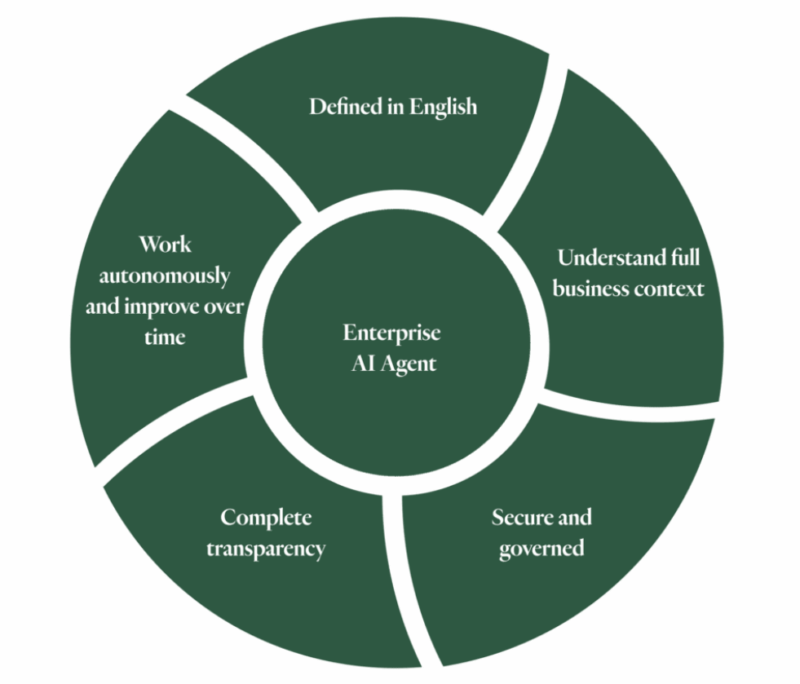
At Sema4.ai, we’ve built an enterprise AI agent platform that embodies many of these cognitive architecture principles. Our agents support observable, secure, and adaptive operations through:
This represents the practical application of cognitive architecture concepts to real-world business challenges. Rather than remaining theoretical constructs, cognitive architectures now provide the foundation for AI agents that can truly reimagine how work gets done.
To learn more about how these principles translate into practical agent capabilities, explore our detailed analysis of what makes an AI agent and visit our AI Agent Learning Center..
Cognitive architecture is not a theoretical concept confined to academic research—it’s foundational to how AI agents can scale, adapt, and think in real-world enterprise environments. As we move beyond simple chatbots and generative AI tools, cognitive architectures provide the structured intelligence needed for agents to handle complex, multi-step processes with reliability and transparency.
The next evolution of enterprise AI isn’t about bigger language models or more sophisticated generation capabilities. It’s about agents with genuine cognitive abilities: memory systems that maintain context, learning mechanisms that improve performance, reasoning frameworks that provide explainable decisions, and adaptive behaviors that respond intelligently to changing conditions.
Organizations that understand and leverage cognitive architecture principles will build AI agents capable of transforming their operations—not just automating simple tasks but reimagining entire business processes with intelligent, autonomous systems that work alongside humans.
See how Sema4.ai supports reasoning and real-world agent tasks. Our enterprise AI agent platform enables you to build, run, and manage AI agents that embody cognitive architecture concepts—from natural language runbooks to transparent reasoning to unlimited memory systems.
Talk to our team about building intelligent agents with memory and goals. Discover how cognitive architecture principles translate into practical business value through agents that can handle your most complex processes.



 Learn more about Studio