 Back to learning center
Understanding AI virtual agents

Sema4.ai Announces Semantic Layer Capabilities at the Gartner® Data & Analytics Summit 2026 → Read now


The era of rigid, script-based automation is over. Today’s enterprises face increasingly complex challenges that demand more than simple chatbots or predefined workflows. They need AI virtual agents – intelligent systems that can act autonomously, reason through problems, and integrate securely across your entire technology stack.
The stakes are clear: businesses that rely on legacy automation tools will struggle to keep pace with organizations deploying intelligent agent technology. These next-generation systems don’t just respond to queries. They execute complete business processes, make informed decisions, and adapt to changing conditions without constant human oversight.
AI agents are the “killer app” of the AI era, where AI virtual agents transform how work gets done across every department and industry. Sema4.ai leads this movement by empowering organizations to build, run, and manage enterprise AI agents at scale – securely, efficiently, and with complete transparency.
A virtual AI agent is an autonomous software system that performs complex work by combining advanced reasoning capabilities with the ability to act across enterprise applications and data sources. Unlike traditional automation scripts or simple service bots, AI virtual agents can understand context, make decisions, and execute multi-step processes with minimal human intervention.
The virtual agent definition extends far beyond basic automation. These intelligent agents leverage large language models (LLMs) for natural language understanding while integrating structured knowledge, real-time data access, and programmable actions to complete sophisticated business tasks. They function as digital workers capable of decision-making automation across your organization.
What distinguishes modern AI virtual agents from legacy virtual agents is their ability to reason, learn, and adapt. Traditional service bots follow rigid decision trees and can only handle predefined scenarios. In contrast, today’s intelligent agents understand business context, navigate ambiguous situations, and improve their performance over time through feedback and training.
These software agents operate with transparency, providing complete visibility into their reasoning process and actions. This explainability is critical for enterprise adoption, ensuring teams can trust agent decisions and maintain governance standards across all automated workflows.
Intelligent agent systems combine three critical components to deliver autonomous automation: advanced AI models, structured enterprise knowledge, and secure integrations with your technology stack.
At their core,AI virtual agents use large language models to understand natural language instructions and generate human-like responses. However, the real power comes from how these LLMs connect to your enterprise ecosystem. Agents access structured data through direct database connections, understand documents and images through advanced vision capabilities, and execute actions through APIs and enterprise application integrations.
Enabling agents to understand business context and connect to the enterprise
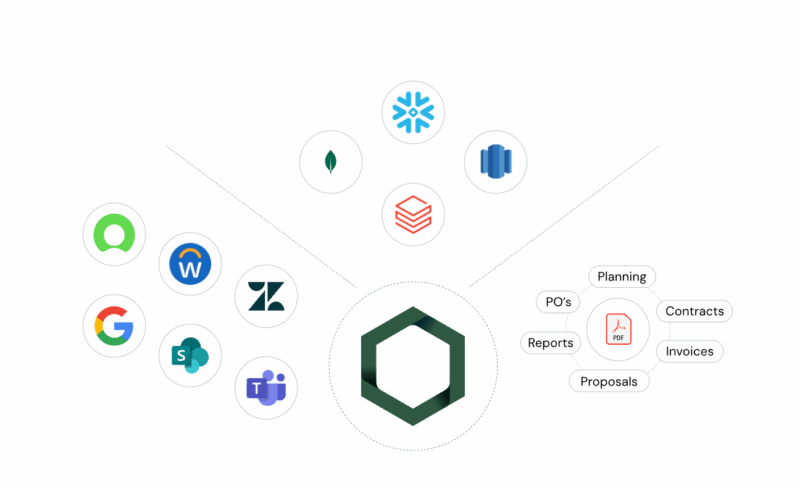
An autonomous agent architecture enables sophisticated reasoning and planning. When assigned a task, an agent breaks down complex goals into actionable steps, determines which data sources and systems to access, executes those actions in the correct sequence, and validates results before proceeding. This orchestration happens dynamically based on the specific scenario rather than following rigid scripts.
AI automation through virtual agents includes enterprise-grade capabilities essential for production deployment. Role-based permissions ensure agents only access authorized data and systems. Comprehensive observability provides real-time visibility into agent activities, performance metrics, and decision-making processes. Complete lifecycle management covers everything from initial development through deployment, monitoring, and continuous improvement.
Unlike reactive chatbots that simply respond to queries, AI virtual agents proactively monitor for triggers like incoming emails, system events, or scheduled tasks, and respond to business events by executing complete workflows autonomously. This “brain plus wiring” approach combines intelligent reasoning with reliable execution across your entire enterprise infrastructure.

See our AI agent platform in action.
Learn more about Sema4.ai Agents.
Understanding the differences between these technologies is essential for choosing the right solution for your enterprise needs.
Chatbots function primarily as a user interface layer with limited logic. They excel at answering frequently asked questions and routing requests but lack the ability to execute complex actions across systems. Chatbots follow predefined conversation flows and cannot reason through novel situations or perform sophisticated decision-making automation.
Virtual assistants like Siri or Alexa represent generalized consumer tools designed for broad, everyday tasks. While more capable than basic chatbots, virtual assistants prioritize consumer convenience over enterprise security, governance, and integration requirements. The virtual assistant vs chatbot distinction lies mainly in scope. Assistants handle more diverse requests but still operate within consumer-focused limitations.
Virtual AI agents deliver purpose-built, secure enterprise automation that goes far beyond both chatbots and consumer virtual assistants. The virtual agent vs chatbot difference is fundamental: agents don’t just converse, they act. They can read complex documents, access multiple enterprise systems, execute sophisticated workflows, and make informed decisions based on complete business context.
The chatbot vs virtual assistant comparison highlights user experience differences, but neither technology addresses enterprise requirements for security, compliance, auditability, and cross-system orchestration. Virtual AI agents fill this gap by providing:
Sema4.ai specializes in enterprise AI agents – systems designed from inception to meet the rigorous demands of modern business operations while empowering business users to define agent behavior through natural language.
Enterprise AI agents transform how organizations handle complex, high-value work across departments. Here are real-world applications where AI automation delivers measurable impact:
Invoice reconciliation: Virtual agents read complex invoices across varying formats, extract structured data, access financial systems to reconcile discrepancies, and flag exceptions for human review. One manufacturer reduced invoice processing time from 3 hours to 2 minutes per document while handling 350+ invoices monthly with 90%+ accuracy across diverse formats.
Help desk and ticket resolution: Agents automatically pull ticket metadata and attachments, parse documents for context, perform system lookups with fuzzy matching, collect status information, and respond to users – all autonomously. Organizations have reduced response times from 24-48 hours to approximately 10 minutes while handling 200+ tickets daily.
CRM data enrichment: Virtual agents monitor for new customer records, research company information across multiple sources, validate and standardize data formats, and update CRM systems automatically. This ensures sales teams always work with current, accurate information without manual data entry.
Compliance verification and reporting: Agents review documents against regulatory requirements, identify potential compliance issues, generate detailed reports with citations, and escalate concerns to appropriate teams. This continuous monitoring reduces compliance risk while freeing legal teams from repetitive review tasks.
HR onboarding automation: Virtual agents orchestrate complete onboarding workflows – provisioning system access, scheduling training sessions, collecting required documentation, and tracking completion across multiple systems. New employees experience consistent, efficient onboarding while HR teams focus on strategic relationship building.
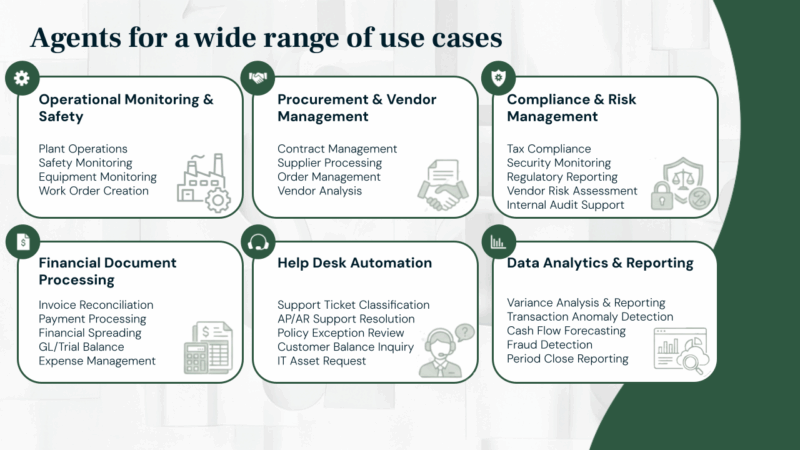
These use cases represent just a fraction of what’s possible. Explore additional enterprise AI agent use cases and real-world success stories to discover how organizations across industries are deploying virtual agents to reimagine work.
Deploying intelligent agent technology delivers transformative benefits across your enterprise operations:
Reduce manual overhead dramatically: Virtual agents handle repetitive, time-consuming tasks that previously required hours of human effort. Organizations report processing times reduced from days or hours to minutes while maintaining or improving accuracy. This efficiency gain allows teams to focus on strategic, high-value work that requires human judgment and creativity.
Enable cross-system orchestration: AI automation through virtual agents seamlessly coordinates actions across disparate enterprise systems without custom integration development. Agents can pull data from your CRM, validate information against your ERP, update records in your database, and send notifications through collaboration platforms – all as part of a single automated workflow.
Improve decision outcomes: Autonomous agents access complete business context before taking action. They analyze data from multiple sources, apply business rules consistently, and identify patterns humans might miss. This comprehensive analysis leads to better decisions while eliminating the inconsistency that comes from manual processes performed by multiple team members.
Maintain governance and observability: Unlike black-box automation, enterprise AI agents provide complete transparency into their reasoning and actions. Comprehensive audit trails track every decision and system interaction. Role-based access controls ensure agents operate within appropriate boundaries. Real-time monitoring identifies issues before they impact operations.
For example, a large manufacturer deployed virtual agents for gas invoice reconciliation across eight analysts handling 350 invoices monthly. The agents now autonomously process 90%+ of invoices with human intervention only on complex exceptions – transforming a process prone to errors and delays into reliable, predictable automation.
What distinguishes virtual AI agents from other automation approaches is how they’re built, deployed, and managed throughout their entire operational lifecycle. Most tools stop at “deploy and hope” . Sema4.ai handles the complete journey.
Build with natural language: Business users who understand processes best can define agent behavior using plain English instructions rather than code. This natural language approach eliminates months-long development cycles and ensures agents align perfectly with actual business requirements. Domain experts create and refine agents without technical dependencies, accelerating time-to-value from months to days.
Secure integrations: Autonomous agents connect to your enterprise applications, databases, and documents through pre-built actions and standardized protocols like MCP (Model Context Protocol). OAuth integration ensures agents access systems securely on behalf of authorized users while maintaining complete audit trails. All data processing occurs within your security boundary, whether in your AWS VPC or Snowflake environment.
Role-based access and workspace management: Granular permission controls ensure each agent and user can only access appropriate data and systems. Workspace isolation enables separate environments for development, testing, and production while maintaining centralized governance. Enterprise SSO integration leverages your existing identity management infrastructure.
Observability and monitoring: Comprehensive observability provides real-time visibility into agent performance, decision-making processes, and system interactions. Integration with enterprise monitoring tools like Datadog, Splunk, and LangSmith ensures agents fit seamlessly into your existing operational framework. Detailed metrics support continuous improvement and optimization.
This end-to-end lifecycle management represents Sema4.ai’s fundamental differentiator. While other platforms focus solely on agent development or deployment, Sema4.ai ensures your AI virtual agents remain secure, compliant, and effective throughout their entire operational lifespan – from initial concept through production deployment and ongoing optimization.
AI virtual agents represent the future of enterprise automation., and that future is already here. Organizations deploying intelligent agents gain unprecedented advantages in efficiency, accuracy, and scalability while their competitors struggle with legacy automation approaches.
The question isn’t whether enterprise AI agents will transform your industry – it’s whether you’ll lead that transformation or follow others. Sema4.ai provides everything you need to build, run, and manage virtual agents securely at enterprise scale, with complete governance and transparency that IT leaders demand and the business-user accessibility that accelerates adoption.
Unlike chatbots that simply respond or consumer virtual assistants with limited enterprise capabilities, Sema4.ai Agents execute complete business processes with human-like reasoning and judgment. They operate within your security boundaries, integrate with your existing systems, and provide the observability and control that enterprise operations require.
Ready to see how AI virtual agents can reimagine work in your organization? You can learn more about AI for business use cases in our e-book: AI agents: top 8 practical use cases. Learn how Sema4.ai can help you build secure, scalable virtual agents that empower your teams, protect your data, and accelerate your digital transformation journey. The AI revolution is here – and it’s powered by intelligent agents that truly understand your business.



 Learn more about Studio