 Back to learning center
What exactly is an AI agent platform?

Sema4.ai Announces Semantic Layer Capabilities at the Gartner® Data & Analytics Summit 2026 → Read now

An AI agent platform is enterprise software that allows organizations to build, deploy, and manage intelligent AI agents that can perform tasks, make decisions, and interact with business systems. Unlike traditional automation tools, AI agent platforms support reasoning, cross-system workflows, and human oversight, enabling enterprises to scale AI-driven automation safely across complex environments.
AI agents are rapidly moving from experimental technology to enterprise reality. While powerful language models like GPT-4 and Claude can understand and generate human-like responses, they cannot execute real work within enterprise systems on their own. They lack the infrastructure to safely access data, trigger workflows, and integrate with business applications.
This is where AI agent platforms become essential. They provide the orchestration layer that transforms AI models into practical enterprise tools – enabling intelligent AI agents to work across systems, make context-aware decisions, and operate under proper governance. Organizations are discovering AI agent use cases across the enterprise, from automating invoice processing to orchestrating complex IT operations, all requiring platforms that can manage these capabilities at scale.
The difference between experimenting with AI and deploying enterprise AI agents comes down to infrastructure. AI agent platforms provide that infrastructure, allowing organizations to move from proof-of-concept to production with confidence.
When evaluating AI agent platforms, enterprises need to look beyond basic AI capabilities and focus on the features that enable safe, scalable deployment across their organization.
Unlike traditional automation that follows rigid, predefined steps, intelligent AI agents can interpret high-level goals and determine the best path to achieve them. They analyze context, consider multiple options, and adapt their approach based on real-time information. This goal-driven execution allows agents to handle complex scenarios that would require dozens or hundreds of rules in traditional automation systems.
Enterprise AI agents must safely interact with critical business systems while maintaining strict security standards. Top AI agent platforms provide robust authentication mechanisms, granular permission controls, and secure system access protocols. Agents can connect to CRM systems like Salesforce, ERP platforms like SAP, data warehouses such as Snowflake, and countless APIs – all while respecting existing access controls and maintaining audit trails of every interaction.
Real enterprise work rarely happens in a single system. An AI agent platform must enable agents to retrieve data from one system, analyze it using another, and trigger actions across multiple platforms. This orchestration capability is what separates enterprise-grade platforms from simple chatbot tools. For organizations scaling enterprise AI agent deployment, this cross-system capability proves essential.
Despite their intelligence, enterprise AI agents should not operate without oversight. Top platforms provide human-in-the-loop controls that allow people to supervise agent decisions through approval checkpoints, review workflows, and escalation procedures. This ensures agents augment human judgment rather than replace it, maintaining accountability while delivering efficiency gains.
Enterprise requirements demand complete visibility into agent operations. AI agent platforms must provide comprehensive logging of agent decisions, detailed monitoring of system interactions, and complete audit trails for compliance purposes. This observability builds trust and enables organizations to refine agent behavior based on real-world performance data.
As organizations deploy more agents across more teams, platforms must support enterprise-scale management. This includes version control for agent updates, environment management for testing and production deployments, and governance policies that ensure consistency across the organization. Without proper lifecycle management, AI agent platforms cannot scale beyond pilot projects.
Understanding how AI agent platforms differ from traditional automation is critical for enterprise decision-makers. Here’s a clear comparison:
| Feature | Traditional automation | AI agent platforms |
| Logic | Rule-based | Goal-driven reasoning |
| Workflows | Static | Adaptive |
| System scope | Single system | Cross-system |
| Decision making | Predefined | Context-aware |
| Oversight | Limited | Governed autonomy |
Key takeaways:
Governance concerns are often the biggest barrier to enterprise AI agents adoption. Organizations need assurance that agents will operate within established security, compliance, and business rules.
Effective governance starts with role-based access control, ensuring agents can only access systems and data appropriate to their function. Approval workflows create checkpoints where human judgment is required before high-stakes actions. Comprehensive monitoring and logging provide visibility into agent decisions, while auditability ensures every action can be traced and explained for compliance purposes.
One emerging approach is automation as code, which treats agent definitions as code that can be versioned, reviewed, and tested before deployment. This brings software engineering discipline to AI automation, enabling teams to govern agents with the same rigor they apply to critical applications.
The goal isn’t to eliminate agent autonomy – it’s to ensure that autonomy operates within well-defined boundaries that protect the organization while delivering business value.
The AI agent platform landscape includes several distinct categories, each suited to different enterprise needs.
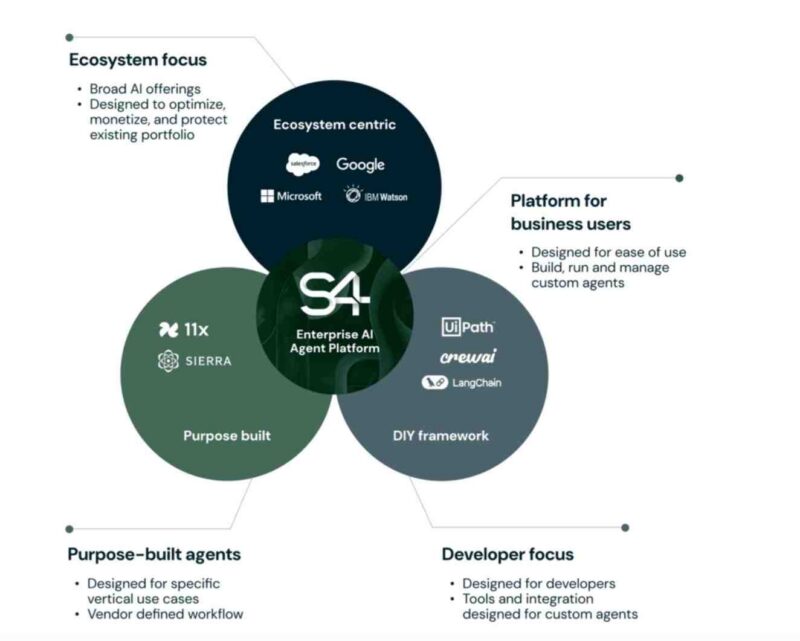
Developer-first agent frameworks offer maximum flexibility for technical teams building custom solutions. These platforms provide powerful capabilities but typically lack the enterprise governance, scalability features, and business user accessibility that large organizations require. They work well for technical teams with specific use cases but struggle to scale across diverse business units.
Task-specific agent tools focus on narrow use cases like code generation agents that help developers write software, or research agents that gather and synthesize information. While useful for their specific domains, these tools lack the orchestration capabilities needed for complex, cross-system enterprise workflows. They represent point solutions rather than comprehensive platforms.
Enterprise AI agent platforms combine the intelligence of AI with the governance, scalability, and orchestration capabilities that large organizations require. These platforms enable business users to define agent behavior, provide comprehensive lifecycle management, support cross-system workflows, and enforce enterprise security standards. For organizations moving beyond experimentation to production-scale deployment, enterprise-focused AI agent platforms are essential infrastructure.
Selecting the right AI agent platform requires looking beyond impressive demos and considering your organization’s actual deployment needs.
Common mistakes to avoid:
Evaluation checklist:
Read our blog, Top AI Platforms: The Best AI Platforms of 2026, to learn what matters most in selecting an AI agent platform.
Yes. In fact, integration capability is more critical than AI intelligence when evaluating AI agent platform options for enterprise workflows.
The value of intelligent AI agents comes from their ability to work across your existing technology landscape – CRM systems like Salesforce and HubSpot, ERP platforms like SAP and Oracle, HRIS systems like Workday, and data warehouses like Snowflake and Databricks. Without deep integration capabilities, agents remain isolated from the systems where real work happens.
Modern AI agent platforms provide cross-system orchestration rather than simple point integrations. This means agents can retrieve customer data from your CRM, analyze it against inventory information in your ERP, check financial records in your data warehouse, and trigger notifications through your collaboration platform – all within a single workflow. This orchestration capability transforms agents from smart assistants into true business process automation tools.
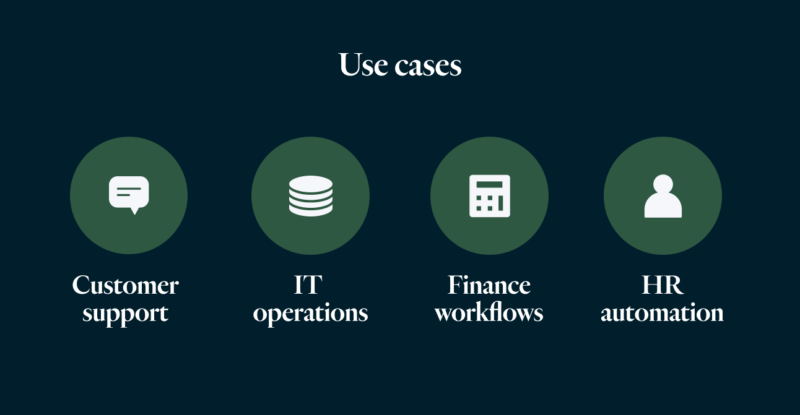
Organizations are deploying enterprise AI agents across virtually every business function, with AI agent use cases spanning customer-facing and back-office operations.
Customer support automation: Agents handle tier-1 support inquiries, access customer records across systems, resolve common issues, and escalate complex cases to human agents with complete context.
IT operations: Agents monitor system health, diagnose issues by analyzing logs across multiple systems, trigger remediation workflows, and keep stakeholders informed throughout incident resolution.
Finance workflows: From invoice processing and reconciliation to expense approval and financial reporting, agents automate document-heavy processes that traditionally required significant manual effort. Learn more about agents for the office of the CFO.
HR automation: Agents streamline employee onboarding, answer policy questions by accessing HR systems and documentation, route approval workflows, and ensure consistent policy application.
The evolution of AI agent platforms is accelerating as enterprises move from experimentation to production deployment.
Multi-agent systems are emerging where specialized agents collaborate on complex tasks, each contributing unique capabilities while orchestrated by the platform. Advanced agent orchestration will enable more sophisticated workflows that adapt dynamically to changing business conditions. Enhanced enterprise AI governance frameworks will provide even finer-grained control over agent behavior while maintaining the autonomy that makes them valuable.
As AI models become more capable and AI agent platforms mature, the boundary between human and agent work will continue to evolve. The platform that connects intelligence with enterprise reality – providing governance, integration, and orchestration – will determine which organizations can scale AI-driven automation successfully.
AI agents are moving from experimental technology to mainstream enterprise infrastructure. The difference between organizations that successfully deploy enterprise AI agents at scale and those stuck in pilot purgatory comes down to platform choice.
An AI agent platform provides the orchestration, governance, integration, and lifecycle management capabilities that transform intelligent models into practical automation tools. It ensures agents can work safely across your enterprise systems while humans maintain appropriate oversight. As enterprises discover the transformative potential of agent-driven automation, the platform foundation becomes the critical success factor.
The future of enterprise work is collaborative – humans defining goals and providing judgment, intelligent AI agents executing complex workflows across systems, all orchestrated by platforms that make this collaboration safe, scalable, and governable.
Explore how enterprises deploy AI agents securely and at scale with the Sema4.ai platform.



 Learn more about Studio