Back to learning center
How AI agents cut days from spreadsheet-heavy finance operations


AI agent deployment for finance operations means transitioning from manual, spreadsheet-based data stitching to autonomous, continuous orchestration directly across core ERP and banking systems.
Research consistently finds that a significant majority of complex financial workbooks contain material errors, many of which go undetected until they surface during audits or month-end reviews. Meanwhile, finance teams routinely lose multiple days per close cycle to manual copy-paste workflows, VLOOKUP chains, and ad hoc exception triage spread across dozens of disconnected files.
These are not minor inefficiencies. They are structural time drains baked into the process.
AI agent deployment for finance operations offers a permanent fix, not another spreadsheet layer or macro add-in, but autonomous agents that connect directly to ERPs, banking portals, and data warehouses to execute the work. Automation in finance operations shifts from stitching exported files together to orchestrating live, cross-system workflows with deterministic accuracy and full audit trails. The result is cycle times measured in minutes rather than days, and a team freed to focus on analysis and judgment instead of data wrangling.
AI agent deployment means agents operate directly across enterprise systems, not inside a spreadsheet. They read, reconcile, and write back to ERPs and databases autonomously. Spreadsheet “glue” breaks at scale. Manual VLOOKUPs, copy-paste handoffs, and emailed workbooks create compounding error risk and time loss as transaction volume grows. Agents go beyond read-only. Production-grade finance AI agents don’t just surface insights. They draft journal entries, post GL adjustments, and settle intercompany balances with secure, governed write access.
Deterministic accuracy, not AI-guessed numbers. All calculations run through SQL-powered engines, guaranteeing mathematical precision and same-input, same-output reproducibility. Safe deployment follows a phased path. A four-phase framework, from read-only audit through continuous observability, gives risk and compliance stakeholders a clear, trust-building maturity model.
The core issue is not Excel itself. Spreadsheets remain useful for ad hoc modeling and analysis, and agents can produce Excel as an output format or incorporate spreadsheet data as an input. The problem is dependence on manual Excel edits as the connective tissue between enterprise systems.
When finance teams use workbooks as system-to-system middleware, several risks compound.
These are symptoms of disconnected enterprise systems, not a tooling problem that a better spreadsheet add-in can solve. Replacing Excel in finance starts with connecting the systems directly, and that is precisely what AI agent deployment delivers.
Finance teams evaluating automation in finance operations typically encounter three approaches that fall short of genuine enterprise AI deployment. Understanding the gaps saves months of wasted effort.
The spreadsheet add-in trap
A growing category of spreadsheet AI add-in tools promises to make Excel smarter by embedding AI capabilities directly in the sheet. These tools can summarize data, suggest formulas, or auto-fill columns, but they operate within the boundaries of a single file. They cannot query your ERP in real time, post a journal entry, or maintain state across a multi-day close cycle. The data stays siloed in the workbook. The audit trail remains nonexistent. And the moment the workbook is emailed to the next person in the chain, version control collapses.
A production AI agent is fundamentally different. Agents operate natively across ERPs, banking systems, and data warehouses with cross-system write access. They do not live inside a spreadsheet. They orchestrate the workflow that spreadsheets were never designed to handle. They also work continuously, accelerating the business operations.
The IT/infrastructure trap
Some IT/infrastructure vendors approach the problem from the opposite direction: container orchestration, developer APIs, and infrastructure tooling that technical teams can assemble into agent-like systems. These platforms provide compute and connectivity, but they do not address financial logic, controller approval gates, or the audit requirements that compliance teams demand before anything writes to a production ledger. Infrastructure alone does not equate to enterprise AI deployment in finance.
The DIY agent-chain trap
A third pattern is increasingly common: finance or IT teams stitching together open frameworks, custom scripts, and general-purpose coding agents into a homegrown multi-agent system. This is not hypothetical. These ungoverned agent chains are actively running in enterprises today, and they tend to fail quietly. Writes silently drop data. Verification steps are skipped. Context is lost on large volumes. There is no formal governance layer catching it, no centralized audit trail, and no vendor accountability when a silent failure corrupts a close package.
This is the pattern that makes the strongest case for a purpose-built governance layer. Without platform-level safeguards, observability, permission controls, and reasoning logs, the speed gains from chaining agents together come with risks that finance leaders cannot accept.
| Legacy Excel operations | Enterprise AI agent deployment | Strategic impact |
| Manual VLOOKUPs and copy-paste | Native API and cross-system write access | Eliminates manual data-stitching; reduces processing time from days to minutes. |
| Hidden formula errors and override risk | Deterministic calculation engine (SQL logic) | Guarantees calculation accuracy with complete auditability. |
| Version control chaos (“vFinal_v2”) | Automated, detailed versioning with rollback options | Single source of truth with real-time process visibility in Control Room. |
| Manual re-keying of PDF invoices and receipts | Multimodal unstructured data extraction | Automates data processing with accuracy and repeatability |
The following workflows represent the highest-impact opportunities for finance AI agents. Each is document-heavy, multi-step, and currently consuming hours or days of analyst time that AI agents for finance operations can reclaim.
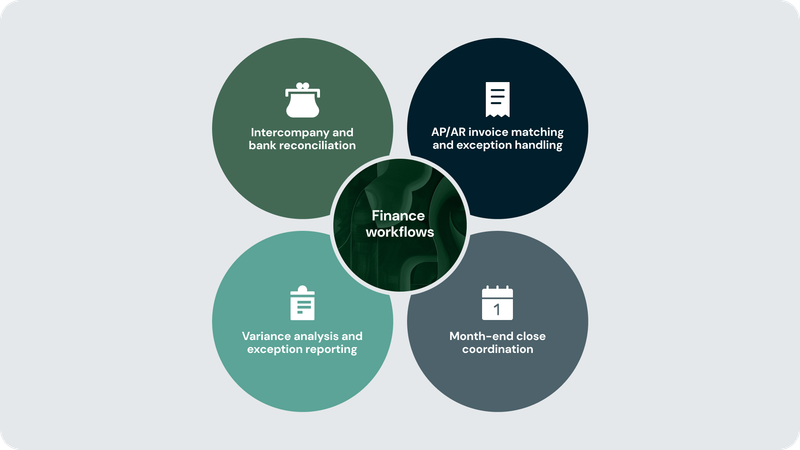
Intercompany and bank reconciliation: cross-system matching without manual file exports
Intercompany reconciliation requires matching balances across multiple entities, often running on different ERPs or GL systems, then netting positions, flagging mismatches, and closing with an audit trail. Today, analysts export data from each system into separate workbooks, align the formats manually, and run VLOOKUP chains to identify breaks.
Finance AI agents handle this as intelligent reconciliation. The agent connects directly to each ledger and banking portal, pulls balances in real time, identifies and categorizes reconciling items across systems, and proposes adjusting entries, all without a single file export. Cross-system ID mappings, currency conversion rules, and timing windows are captured in the agent’s semantic layer, so the knowledge compounds rather than living in one analyst’s head.
For bank reconciliation specifically, agents match ERP cash transactions against bank statement line items, flag discrepancies by category (timing differences, missing entries, amount variances), and prepare the reconciliation workpaper automatically. Processing time drops from hours of manual cross-referencing to minutes of exception review.
AP/AR invoice matching and exception handling: unstructured parsing with human-in-the-loop escalation
Invoice processing is where spreadsheet dependency hits hardest. Invoices arrive in dozens of formats: PDFs, scanned images, email attachments, and supplier portal exports. Analysts manually rekey data into spreadsheets, then cross-reference against purchase orders and goods receipts for the three-way match.
Deployed agents parse unstructured invoices using multi-pass document intelligence, extract structured data regardless of format, and execute the three-way match against live ERP records with SQL-powered mathematical precision. When a genuine exception surfaces, the agent does not force-automate it. It routes the exception to a human reviewer with full context: the original document, the matched PO, the specific discrepancy, and the agent’s reasoning. Humans touch only the cases that genuinely require judgment.
| Capability | Traditional AP automation | RPA | AI agents |
| Handle missing fields | Weak | Weak | Strong |
| Interpret remittance emails | Weak | Weak | Strong |
| Resolve exceptions | Manual | Manual | Assisted |
| Learn workflow patterns | No | No | Yes |
Organizations using this approach have reduced invoice processing time from up to 3 hours per invoice to roughly 2 minutes, with autonomous processing rates above 90%. Learn more about AP/AR invoice matching in production.
Variance analysis and narrative reporting: from manual aggregation to generated commentary
Every close cycle, FP&A teams pull actuals from the ERP, compare them against budgets and prior-period figures, identify the material variances, and write narrative commentary explaining the drivers. The analysis itself is time-consuming, but the narrative writing is what consumes the most hours, because it requires translating numbers into plain-language explanations for leadership.
Finance AI agents automate the full sequence. The agent queries actuals and budgets directly from the data warehouse, computes variances with deterministic accuracy through SQL-powered DataFrames, identifies the most significant drivers, and drafts narrative commentary grounded in the underlying data. The finance team reviews, refines, and approves rather than building from scratch.
This is where time savings compound most visibly. What once took an analyst a full day of data assembly and writing can be reduced to an hour of review and judgment.
Month-end close coordination: stateful orchestration across multi-day tasks
The close is not a single task. It is a multi-day orchestration of dependent steps, reconciliations, journal entries, intercompany settlements, variance analysis, and management reporting, executed by multiple people across multiple systems. Today, tracking close status typically lives in a shared spreadsheet or email thread that resets context with every re-open.
AI agents maintain state across the entire close cycle. An agent tracks which tasks are complete, which are blocked, and which are ready to begin. It executes the steps it can handle autonomously (reconciliations, standard journal entries, routine variance calculations), escalates the steps that need human judgment, and maintains a real-time view of close progress that any stakeholder can access.
The shift is fundamental: instead of the close being a series of disconnected file-based tasks, it becomes a single, continuous workflow with real-time visibility and a complete audit trail.
Finance and IT leaders need a risk-management path they can present to internal stakeholders. The following framework provides that structure, a maturity model for AI agent deployment that builds trust incrementally with compliance, audit, and executive teams. To learn more about building and deploying SAFE agents, read our blog, “Are Your Enterprise AI Agents SAFE? A Framework for Trusted AI“
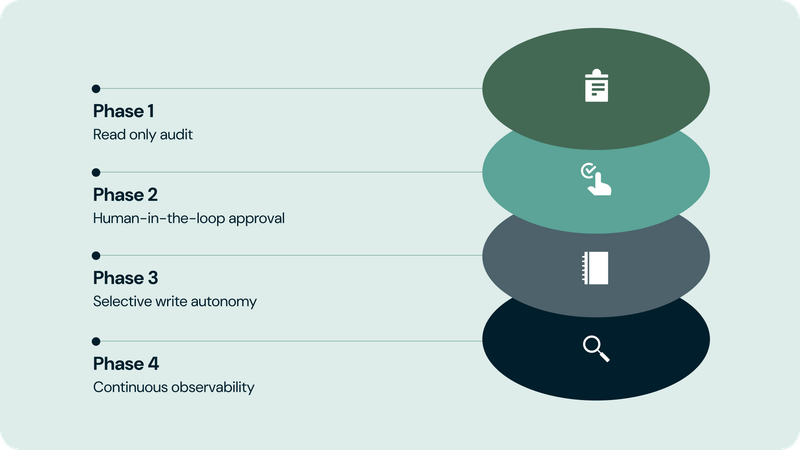
Phase 1: Read-only audit. Agents connect to enterprise systems and observe live workflows without write access. They flag discrepancies, surface exceptions, and generate reports. The goal is to validate that the agent understands the data and the process correctly before it takes any action. This phase builds confidence with minimal risk.
Phase 2: Human-in-the-loop approval. Agents begin drafting actions: proposed journal entries, reconciliation adjustments, exception classifications. Every action requires explicit human approval before execution. Governance infrastructure like Work Room enforces programmable approval gates, so no write reaches a production system without a designated reviewer signing off. This phase proves the agent’s judgment while keeping humans in full control.
Phase 3: Selective write autonomy. Based on the track record established in Phase 2, agents receive governed write access for low-risk, high-confidence actions, standard journal entries, routine reconciliation postings, and automated payment matching within defined tolerance thresholds. Ambiguous or high-value cases still escalate to a human. Permission boundaries are enforced at the platform level, not left to individual agent configuration.
Phase 4: Continuous observability. At scale, every agent decision across every workflow is captured in a full audit trail with complete reasoning logs. Work Room provides three-lens visibility: analysts see plain-language summaries, auditors see compliance certificates with method classifications, and engineers see raw execution traces. This is not a one-time audit. It is continuous, real-time observability that satisfies SOX requirements and gives the compliance team the evidence they need to move from gatekeeper to champion.
Sema4.ai’s enterprise AI agent architecture maps directly to the phased framework above. Here is how each platform component delivers enterprise AI deployment for finance.
Production agents handle autonomous execution. They operate 24/7, responding to business events such as incoming invoices, reconciliation triggers, or close-cycle task dependencies. Worker Agents maintain state across multi-day workflows like the month-end close, execute cross-system writes through governed API access, and escalate genuine exceptions to humans with full context. They do not reset with every interaction. They carry the work forward. Learn more about Agents.
Work Room provides the governance layer. It manages the draft-to-live agent lifecycle, enforces role-based permission inheritance, and delivers programmable human-in-the-loop approval gates that map to Phase 2 and Phase 3 of the deployment framework. Every agent action, every decision, every tool call is logged with full reasoning trails for audit.
The platform is a collaborative building environment where finance process owners and IT teams work together. Business users define agent behavior through natural language runbooks, upload SOPs, set exception thresholds, and describe vendor-specific handling in plain English. IT configures data connections, LLM providers, and security policies. Both collaborate in the browser without desktop software dependencies.

Accuracy architecture. LLMs handle document parsing, workflow reasoning, and natural language understanding. All calculations, reconciliations, and aggregations are performed by a deterministic SQL-powered engine. Results are fully auditable and mathematically precise rather than AI-guessed. The same input produces the same output on every run.
See how Agents execute cross-system finance workflows →
How does AI agent deployment in finance differ from traditional RPA?
RPA follows rigid scripts that break when formats change. AI agents reason across unstructured documents and structured data, adapt to variations, learn from corrections, and orchestrate multi-step workflows with full audit trails. Learn about the core differences between AI agents and RPA.
Can deployed AI agents write directly back to enterprise ERP systems?
Yes. Enterprise agents connect through native APIs with OAuth-secured, role-based write access. Every write is logged, governed by programmable approval gates, and fully traceable through the platform’s audit infrastructure.
How do enterprise AI agents maintain calculation accuracy without guessing?
Agents separate reasoning from arithmetic. LLMs parse documents and manage workflow logic; all math runs through a deterministic SQL-powered engine, guaranteeing same-input, same-output precision on every run.
What security controls are required for finance AI agent deployment?
Production deployments require VPC-based hosting, zero-copy data access, enterprise SSO, role-based access control, encrypted secrets management, and comprehensive audit logs capturing every decision for SOX and regulatory compliance.
The 4-phase framework for SAFE AI agent deployment is designed to be shared with your own risk, compliance, and executive stakeholders. It provides the trust-building structure that moves AI agent deployment from concept to production without skipping the governance steps that finance demands.
To see how Sema4.ai’s platform is purpose-built for the workflows, accuracy requirements, and audit standards that define modern finance, explore our solutions for the Office of the CFO and read our e-book, “5 finance use cases transformed by enterprise AI agents.”

 Learn about Agent Studio