Back to learning center
How AI agent workflows work


An AI agent workflow represents the next evolution in enterprise automation – moving beyond rigid, rule-based systems to intelligent, adaptive processes that can reason, learn, and execute complex tasks autonomously. Unlike traditional automation that follows predetermined scripts, AI agent workflows leverage advanced AI models to understand context, make decisions, and adapt to changing business conditions in real-time.
As enterprises accelerate their digital transformation initiatives, understanding how AI agents work within orchestrated workflows becomes critical for leaders evaluating automation solutions. These intelligent systems don’t just execute tasks – they plan, reason, and collaborate to deliver outcomes that were previously impossible with conventional automation tools.
This comprehensive guide will demystify AI agent workflows, explore their architecture and execution patterns, and demonstrate how Sema4.ai makes enterprise level agent orchestration accessible, secure, and scalable across your organization.
An AI agent workflow is a sophisticated automation process where intelligent agents autonomously execute multi-step business tasks through coordinated planning, reasoning, and action. Think of it as having a highly capable digital employee who can understand complex instructions, access multiple systems, make informed decisions, and complete entire processes without constant human oversight.
What is the workflow of an AI agent? At its core, an AI agent workflow consists of interconnected tasks that are triggered by business events, processed through intelligent reasoning, and executed across enterprise systems. Unlike traditional workflows that follow rigid if-then logic, these intelligent processes adapt dynamically to changing conditions, handle exceptions gracefully, and learn from each interaction.
For example, when a new invoice arrives via email, an AI agent workflow doesn’t just extract data – it understands the document context, validates information against existing records, routes approvals based on business rules, updates multiple systems, and handles exceptions by escalating to appropriate stakeholders. This end-to-end orchestration happens autonomously, with the agent making contextual decisions at each step.
The power of AI agent workflows lies in their ability to combine the reliability of automated processes with the flexibility and judgment traditionally requiring human intervention, creating truly autonomous business operations.
The foundation of effective AI agent workflows rests on a sophisticated AI agent architecture designed for enterprise-scale operations. This architecture consists of three critical layers that work together to enable intelligent workflow execution.
The reasoning layer serves as the agent’s cognitive engine, powered by advanced language models that provide natural language understanding, contextual reasoning, and decision-making capabilities. This layer enables agents to interpret complex business scenarios, understand nuanced requirements, and adapt their approach based on changing conditions – capabilities that distinguish intelligent agents from traditional automation tools.
The orchestration layer manages workflow execution, task coordination, and system integration. This is where how AI agents work becomes apparent – the orchestration layer breaks down complex business processes into manageable tasks, coordinates their execution across multiple systems, and ensures proper sequencing and error handling. Sema4.ai’s orchestration platform provides enterprise-grade capabilities including secure API integration, governance controls, and real-time monitoring.
The integration layer connects agents to enterprise systems, data sources, and external services through secure APIs and pre-built connectors. This layer ensures agents can access the information and systems they need while maintaining enterprise security standards and compliance requirements.
This modular architecture enables AI agent workflows to scale across enterprise environments while maintaining the flexibility to adapt to unique business requirements and integrate with existing technology stacks.
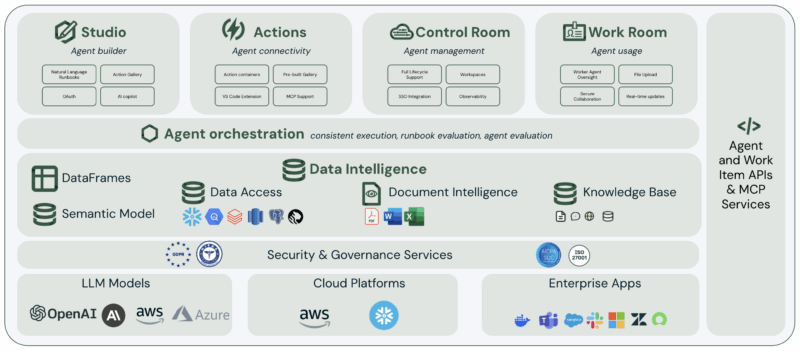
Understanding task orchestration in practice reveals how enterprise AI automation transforms business operations. An AI agent workflow execution follows a sophisticated lifecycle that mirrors human problem-solving while operating at machine scale and speed.
The process begins with trigger recognition, where agents continuously monitor for business events – incoming emails, system alerts, scheduled tasks, or API calls. Unlike traditional automation that requires explicit triggers, intelligent agents can recognize patterns and context, understanding when action is needed even in ambiguous situations.
Contextual analysis follows, where agents gather relevant information from multiple sources, analyze the current business context, and determine the appropriate response strategy. This might involve accessing customer records, checking inventory levels, reviewing policy documents, or consulting real-time data feeds – all happening automatically within seconds.
Dynamic planning represents where AI agent workflows truly excel. Rather than following predetermined paths, agents create execution plans tailored to specific situations. They consider available resources, business constraints, stakeholder preferences, and potential risks to develop optimal approaches for each unique scenario.
Coordinated execution involves agents performing tasks across multiple systems while maintaining awareness of dependencies, handling exceptions, and adapting to changing conditions. Sema4.ai’s platform provides the orchestration infrastructure that ensures reliable execution while maintaining enterprise security and governance standards.
Throughout this process, agents provide transparent reasoning, showing exactly how decisions are made and actions are taken, ensuring accountability and enabling continuous improvement of workflow performance.
The distinction between intelligent agent automation and conventional automation tools represents a fundamental shift in how enterprises approach process optimization. Traditional automation, including RPA and scripted workflows, operates through predetermined rules and rigid decision trees that break down when encountering unexpected scenarios.
How AI agents work differently becomes clear when examining their adaptive capabilities. While traditional automation requires extensive programming for each possible scenario, AI agent workflows use contextual understanding to handle variations and exceptions dynamically. They can interpret natural language instructions, understand business intent, and make reasoned decisions without explicit programming for every contingency.
Traditional automation excels at high-volume, repetitive tasks with predictable inputs and outputs. However, it struggles with complex business processes that require judgment, contextual understanding, or adaptation to changing conditions. Ai agent workflows bridge this gap by combining the reliability of automated execution with the flexibility and reasoning capabilities previously requiring human intervention.
The collaborative aspect represents another key differentiator. While traditional automation operates in isolation, AI agent workflows can communicate with humans and other agents, sharing context, requesting clarification, and coordinating complex multi-agent processes. This collaborative intelligence enables enterprises to automate sophisticated business processes that span multiple departments and systems.
Sema4.ai’s platform makes this advanced capability accessible to business users through natural language runbooks, eliminating the technical complexity that has historically limited intelligent automation to organizations with extensive development resources.
Sema4.ai transforms the complexity of building AI agent workflows into an accessible, enterprise-ready platform that empowers both business users and technical teams. Our comprehensive approach to task orchestration eliminates traditional barriers while providing the security, scalability, and governance that enterprises require.
Natural language runbooks represent our breakthrough approach to workflow creation. Business users can define complex AI agent workflows using plain English instructions, describing processes the same way they would explain them to a new employee. This eliminates the technical bottleneck that has historically limited automation to IT departments, enabling domain experts to directly create and maintain intelligent workflows.
Pre-built enterprise integrations provide immediate connectivity to essential business systems including SharePoint, Salesforce, ServiceNow, and hundreds of other applications. Our action gallery enables rapid workflow development while our comprehensive SDK supports custom integrations for unique enterprise requirements.
Enterprise-level orchestration ensures AI agent workflows operate reliably at scale within your security boundaries. Whether deployed in your AWS VPC through our Enterprise Edition or running natively in Snowflake through our Team Edition, Sema4.ai maintains complete data sovereignty while providing the performance and reliability that business-critical processes demand.
Transparent reasoning and governance provide complete visibility into agent decision-making, enabling organizations to understand, validate, and continuously improve workflow performance. Combined with comprehensive audit trails and role-based access controls, enterprises can deploy intelligent automation with confidence.
Enterprise AI automation through AI agent workflows delivers transformative value across diverse business functions, with organizations reporting significant efficiency gains and improved accuracy in complex processes.
Invoice processing and accounts payable represents a compelling use case where AI agent workflows excel beyond traditional automation. Agents can process invoices in multiple formats, validate information against purchase orders and contracts, route approvals based on complex business rules, handle exceptions through intelligent escalation, and update multiple financial systems – all while adapting to vendor-specific requirements and handling edge cases that would break conventional automation.
Employee onboarding and HR processes showcase how AI agent workflows can orchestrate complex, multi-stakeholder processes. From initial offer acceptance through first-day preparation, agents coordinate with multiple departments, provision accounts and access, schedule training sessions, and ensure compliance requirements are met while adapting to role-specific requirements and organizational changes.
Customer service and support automation demonstrates the collaborative potential of AI agent workflows. Agents can analyze customer inquiries, access relevant account information, coordinate with multiple support systems, and either resolve issues autonomously or seamlessly hand off to human agents with complete context and recommended solutions.
Compliance monitoring and reporting illustrates how AI agent workflows can handle sophisticated analytical tasks, continuously monitoring business activities against regulatory requirements, identifying potential issues, generating detailed reports, and coordinating remediation efforts across multiple departments and systems.
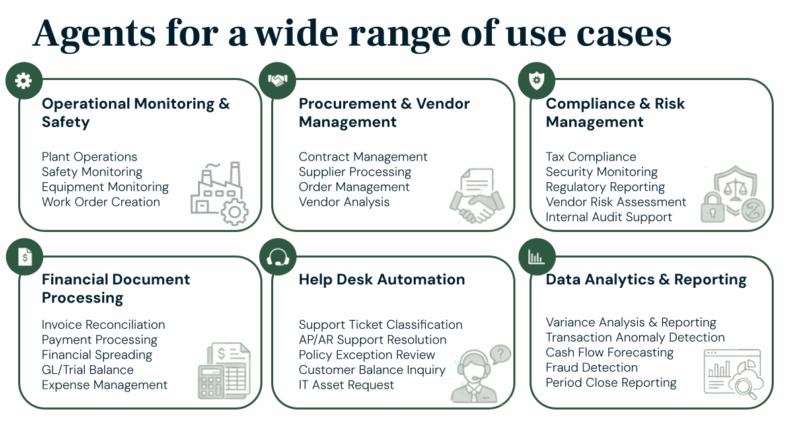
These use cases highlight how AI agent workflows adapt to different organizational needs while maintaining consistency, accuracy, and compliance across diverse business environments.
Read our e-book to learn more about top use cases for enterprise AI agents.
Understanding what are the 5 steps of workflow execution provides insight into how AI agent workflows deliver reliable, intelligent automation. These steps represent the systematic approach that ensures consistent performance across diverse business scenarios.
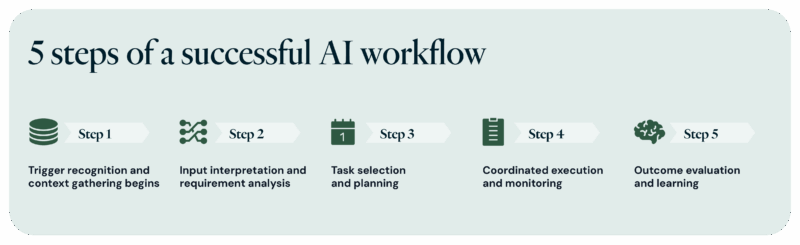
Step 1: Trigger recognition and context gathering begins when agents detect business events requiring action. This might be an incoming email, a scheduled task, a system alert, or an API call. Agents immediately gather relevant context from multiple sources, understanding not just what happened, but the broader business situation requiring response.
Step 2: Input interpretation and requirement analysis involves agents processing available information to understand what needs to be accomplished. Using natural language processing and contextual reasoning, agents interpret complex requirements, identify stakeholders, and determine success criteria for the workflow execution.
Step 3: Task selection and planning represents where intelligent agents demonstrate their adaptive capabilities. Rather than following predetermined paths, agents analyze the specific situation and create tailored execution plans, selecting appropriate tasks, determining optimal sequencing, and identifying potential risks or dependencies.
Step 4: Coordinated execution and monitoring involves agents performing planned tasks while continuously monitoring progress, handling exceptions, and adapting to changing conditions. This includes accessing multiple systems, processing data, making decisions, and coordinating with other agents or human stakeholders as needed.
Step 5: Outcome evaluation and learning ensures continuous improvement through systematic assessment of results against intended outcomes. Agents document what worked well, identify areas for improvement, and incorporate learnings into future workflow executions.
Sema4.ai’s platform supports this complete lifecycle through integrated tools for workflow design, execution monitoring, and performance optimization.
The evolution of AI agent workflows points toward increasingly sophisticated intelligent agent automation that will fundamentally transform enterprise operations. Emerging trends indicate a future where autonomous agents collaborate seamlessly across organizational boundaries, creating federated workflows that span multiple companies and ecosystems.
Multi-agent collaboration represents the next frontier, where specialized agents work together on complex projects, sharing context and coordinating activities much like human teams. These collaborative workflows will enable enterprises to tackle challenges that require diverse expertise and capabilities, from complex financial analysis to comprehensive compliance management.
Adaptive learning and optimization will enable AI agent workflows to continuously improve their performance based on outcomes and feedback. Rather than requiring manual updates, workflows will evolve automatically, becoming more efficient and effective over time while maintaining alignment with business objectives and compliance requirements.
Industry-specific intelligence will emerge as agents develop deep understanding of sector-specific processes, regulations, and best practices. This specialization will enable more sophisticated automation in complex domains like healthcare, financial services, and manufacturing.
Sema4.ai continues to lead this evolution by making advanced AI agent workflows accessible to enterprises today while building the foundation for tomorrow’s autonomous business operations. Our platform’s emphasis on security, governance, and business user empowerment ensures organizations can confidently adopt intelligent automation while preparing for an increasingly autonomous future.
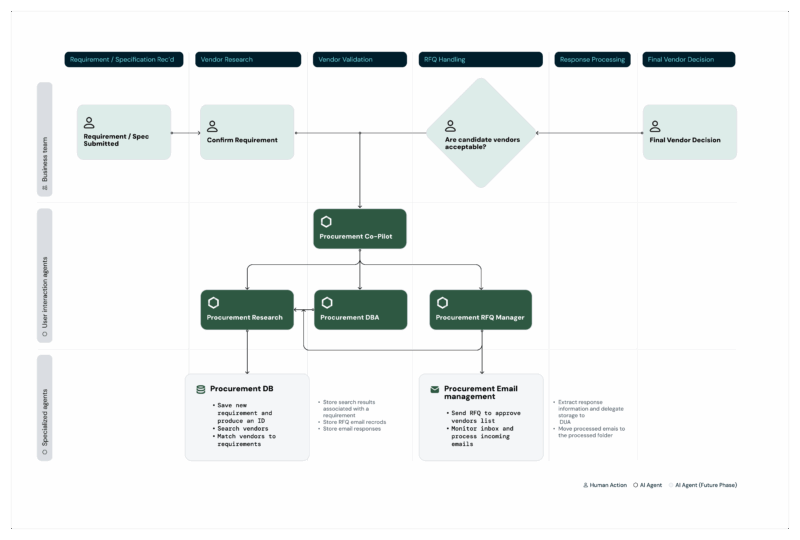
Example agentic workflow: procurement use case
AI agent workflows represent a transformative approach to enterprise automation, moving beyond the limitations of traditional rule-based systems to deliver intelligent, adaptive processes that can handle complex business scenarios with human-like reasoning and judgment. Through sophisticated orchestration, these workflows enable organizations to automate end-to-end processes while maintaining the flexibility to adapt to changing conditions and handle exceptions gracefully.
Sema4.ai makes this advanced capability accessible through our comprehensive platform that combines natural language workflow creation, enterprise-grade security, and transparent governance. Whether you’re looking to automate invoice processing, streamline employee onboarding, or orchestrate complex compliance workflows, our AI agent workflows provide the reliability, scalability, and intelligence that modern enterprises require.
The future of business operations lies in intelligent automation that augments human capabilities while handling routine tasks autonomously. By understanding and implementing AI agent workflows today, organizations position themselves at the forefront of this transformation, gaining competitive advantages through improved efficiency, accuracy, and scalability.
Start building your first autonomous workflow today.
Master AI Agents: AI Agent Learning Center
On demand: How to build your first enterprise AI agent
See how you can build your first agent in minutes: Get a demo

 Learn about Agent Studio