Back to learning center
Natural language access to enterprise data


Natural language access to enterprise data allows users and AI agents to query business information using everyday language instead of SQL or system-specific query languages.
Enterprise information lives everywhere. Critical business data is distributed across databases, ERP systems, CRM platforms, documents, spreadsheets, knowledge bases, and dozens of other applications. For most organizations, getting answers means knowing which system to open, which table to query, and how to write the right syntax to pull what you need.
Natural language access to enterprise data changes this dynamic. Instead of requiring users to understand schemas, table structures, or query languages, natural language interfaces let people ask business questions in everyday language and receive answers drawn from authorized enterprise sources.
However, connecting a large language model (LLM) to a database is not enough. Reliable natural language enterprise data access requires a layered architecture that includes semantic context, enterprise metadata, governance controls, and cross-system reasoning. Without these layers, natural language interfaces risk returning inaccurate results, bypassing security controls, or missing the business context that makes an answer meaningful.
This article explains how natural language data access works at the enterprise level, what architecture it requires, and why semantic layers, governance, and contextual reasoning are essential to making it trustworthy.
Natural language access to enterprise data is the ability for users or AI systems to retrieve, query, interpret, and reason over enterprise information using everyday language. Rather than writing SQL, navigating BI tools, or searching individual systems, users describe what they need in plain words and the system translates that intent into the right queries and retrieval actions across authorized data sources.
This capability is distinct from several related concepts. Enterprise search indexes content and returns matching documents, but it does not generate computed answers from structured data. A generic chatbot can answer general questions, but it lacks connection to enterprise systems and business context. Standalone text-to-SQL converts a question into a database query, but it does not account for business definitions, governance, or unstructured knowledge.
True natural language enterprise data access connects user intent to enterprise meaning, authorized sources, and business context. It bridges structured data, such as records in databases and warehouses, with unstructured data, such as policies, contracts, and operational documents. The interface must understand not just what the user asked, but what the question means within the organization’s specific terminology, metrics, and data landscape.
When these elements work together, natural language data access removes the technical barrier between business users and the information they need to make decisions.
Natural language data access follows an architecture that moves from a user’s question to a contextual, governed answer. The general flow proceeds through several stages: a natural language question is interpreted for intent and context, mapped through a semantic layer and enterprise metadata, translated into governed queries or retrieval actions, reasoned across systems where needed, and returned as a contextual answer.
Each stage plays a specific role in producing reliable enterprise results.
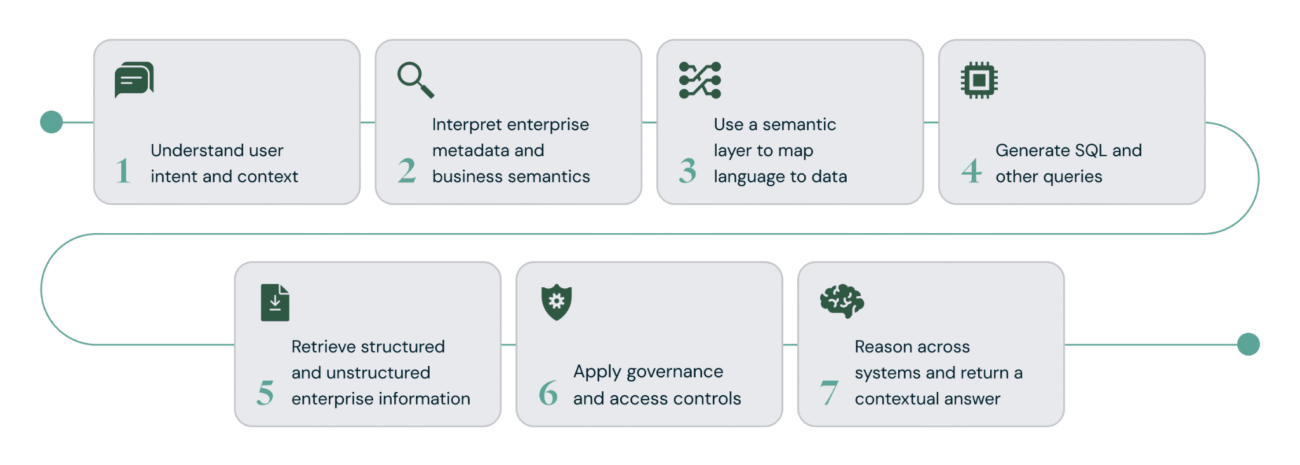
The process starts with interpreting what the user is actually asking. This means identifying the business entities, metrics, timeframes, and conditions embedded in the question. A question like “What were our top-performing regions last quarter?” requires the system to understand “top-performing” as a metric, “regions” as an entity, and “last quarter” as a time filter.
Contextual querying adds another dimension. The same question can carry different meanings depending on who asks it, which business domain they work in, or what they asked previously in a conversation. An accounts receivable analyst asking about “outstanding balances” means something different from a supply chain manager using the same words. The system must interpret intent within the user’s context, not just parse the syntax of the question.
Once intent is understood, the system uses enterprise metadata to connect the question to the right data. Metadata describes schemas, fields, entities, relationships, definitions, and source context. It tells the system that a column labeled “cust_id” represents a customer identifier, that “rev_net” maps to net revenue, and that a particular table contains quarterly summaries rather than daily transactions.
Business semantics go further. They represent the shared meaning behind terms the organization uses every day. “Customer” might mean an active account in one system and any entity with a record in another. “Revenue” might include or exclude certain categories depending on the reporting context. Business semantics ensure that the system interprets terms the way the organization defines them, not the way a general-purpose language model might assume.
A semantic layer sits between natural language and the underlying data models. It maps business terminology, such as “margin,” “customer lifetime value,” or “open orders,” to the specific tables, columns, calculations, and relationships that produce the correct answer.
Without a semantic layer, a natural language system must interpret raw database schemas directly. Column names like “amt_01” or “flg_active” carry no inherent business meaning. A semantic layer resolves this ambiguity by providing a consistent translation between business vocabulary and technical data structures. This mapping reduces errors, improves consistency, and ensures that different users asking similar questions receive comparable answers.
For structured data sources, natural language-to-SQL generation translates the interpreted question into an executable database query. The system maps recognized entities and metrics to the appropriate schema elements, constructs the SQL statement, and executes it against the authorized data source.
However, generated SQL should not operate in isolation. It needs to be grounded in the semantic layer and schema context to ensure accuracy. It must respect access controls so that users only query data they are authorized to see. And it should be subject to validation, verifying that the generated query aligns with the user’s actual intent before returning results.
Enterprise questions often require information from more than one type of source. Structured data, including databases, data warehouses, operational system tables, and APIs, provides quantitative records and transactional history. Unstructured data, including documents, policies, PDFs, knowledge bases, and approved enterprise content, provides qualitative context, rules, and institutional knowledge.
A complete natural language data access architecture retrieves from both categories when the question demands it, rather than limiting answers to a single data type or system.
Every query and retrieval action must respect the organization’s existing governance framework. This includes identity verification, role-based access controls, data policies, and source-system permissions. A natural language interface should never create a new, ungoverned path to sensitive data.
Governance at this layer ensures that the convenience of natural language does not compromise the security and compliance controls the enterprise has established. Users see only the data they are authorized to access, regardless of how they phrase their question.
Many business questions cannot be answered by a single data source. Investigating an invoice exception might require data from the ERP, payment records from the AP system, and contract terms from a document repository. Understanding a supply disruption could involve inventory data, shipment records, and supplier communications.
Cross-system reasoning combines relevant information from multiple authorized sources to construct a complete answer. Where the architecture supports it, the system preserves provenance, explaining where each piece of information originated so users can evaluate and verify the response.
Raw database schemas were designed for systems, not for people. Column names like “vndr_cd,” “amt_tot,” or “dt_mod” carry meaning to a database administrator, but they do not represent how the business talks about vendors, total amounts, or modification dates.
A semantic layer bridges this gap by creating an abstraction that maps technical data structures to consistent business concepts and metrics. When a user asks about “supplier spend by category,” the semantic layer translates “supplier” to the correct vendor entity, “spend” to the appropriate amount fields, and “category” to the relevant classification hierarchy, regardless of how these elements are labeled in the underlying database.
Enterprise metadata enriches this mapping further. Descriptions, ownership tags, data classifications, relationship definitions, and contextual notes all help the system understand not just where data lives, but what it means, who owns it, and how it should be used.
Semantic grounding also helps resolve ambiguity. When “revenue” could refer to gross revenue, net revenue, or recognized revenue depending on the context, the semantic layer and associated metadata help the system select the correct definition. This consistency is critical for organizations where different teams may use the same terms to describe different measures.
Without semantic layers and business semantics, natural language systems must guess at meaning, a pattern that introduces errors, inconsistencies, and eroded trust over time.
Enterprise questions rarely fit neatly into a single data category. A revenue question might require warehouse data for the numbers, but also contract terms from a PDF, a policy document that defines recognition rules, or product context from an operational system. Answering accurately means accessing both structured records and unstructured knowledge.
Structured data access involves executing queries against databases, warehouses, and operational systems. The data is organized in rows and columns, and results are computed through SQL or similar query languages. This is where natural language-to-SQL generation plays its primary role.
Unstructured data access involves retrieving and interpreting information from documents, knowledge bases, policies, emails, and other text-based or file-based sources. These sources do not follow tabular schemas, so the system must parse, extract, and reason over their content to find relevant information.
The most effective natural language data access architectures unify reasoning across both types. Rather than forcing users to search structured and unstructured systems separately, the system combines information from approved sources into a single, contextual response. This unified approach reflects how business questions actually arise, spanning data types, systems, and formats.
Text-to-SQL, also called natural language-to-SQL, is the process of converting a natural language question into an executable SQL query. The system interprets the user’s intent, maps the referenced entities and metrics to the appropriate schema elements using semantic context, generates the SQL statement, executes it against the authorized data source, and interprets the results.
SQL generation is a critical component of natural language data access for structured sources. It eliminates the need for users to know database schemas, table relationships, or SQL syntax. When grounded in a semantic layer, it can produce accurate, consistent queries that reflect business definitions rather than raw column names.
However, SQL generation addresses only one part of the enterprise data access challenge. It works with structured, queryable data sources, but it does not handle unstructured documents, cross-system reasoning, or the contextual interpretation that complex business questions require. Schema awareness, semantic grounding, validation, and permission enforcement all play essential roles in making generated SQL trustworthy for enterprise use.
Positioning SQL generation as the complete solution for natural language data access understates the complexity of what enterprises actually need.
Governed data access means that every interaction with enterprise data respects the organization’s identity, authorization, role-based access, policy, and source-system permission controls. When a user asks a question through a natural language interface, the system must verify who they are, what data they are authorized to access, and whether the requested information falls within their permitted scope.
This matters because natural language interfaces have the potential to make data access significantly easier and faster. That efficiency becomes a risk if it creates an unrestricted abstraction layer that bypasses the controls organizations have spent years building. A well-architected natural language system preserves and applies every existing governance control, treating the natural language interface as a new access method, not a new permission model.
As AI systems gain the ability to query across more data sources and data types, governance becomes even more critical. Cross-system access multiplies the potential exposure if controls are not enforced consistently at every layer. Organizations evaluating natural language data access should verify that governance is built into the architecture, not added as an afterthought.
Governed access is also foundational to trust. When users and compliance teams know that AI-generated answers respect the same controls as direct database access, adoption accelerates and audit concerns diminish.
Data lineage, sometimes called data provenance, refers to understanding the origin and path of the data used in an answer. When an AI system returns a response, lineage shows where the underlying information came from, which sources were queried, and how the data was combined to produce the result.
Lineage matters because AI-generated answers are only as trustworthy as the data behind them. When a finance analyst receives a natural language response about quarterly revenue, they need to know whether the number came from the general ledger, a forecast model, or an aggregated report table. If the answer seems unexpected, lineage provides the trail to investigate and verify.
Data lineage connects directly to metadata and governance. Metadata describes what data means and where it lives. Governance controls who can access it. Lineage completes the picture by showing how data moved from source to answer. Together, these elements create the transparency that enterprise AI deployments require.
Transparent reasoning, where users can see how the system arrived at an answer, reinforces this trust. Rather than presenting results as opaque outputs, architectures that support lineage and reasoning visibility let users evaluate the quality and relevance of every response.
Enterprise business questions frequently span multiple systems. A procurement team investigating a supplier issue might need vendor performance data from the ERP, payment history from the AP system, contract terms from a document repository, and communication records from email. No single system holds the complete picture.
Cross-system reasoning is the ability to combine context and data from multiple authorized sources to answer a business question or support a task. Rather than returning partial results from individual systems, the architecture retrieves relevant information from each source, connects it through shared entities and relationships, and assembles a comprehensive response.
Contextual querying builds on this foundation in several ways. It interprets follow-up questions in light of what was previously asked, so users can refine their analysis without restating context. It applies business definitions consistently, so “overdue” means the same thing whether the data comes from the AR system or a policy document. And it considers the user’s role and domain, so a CFO and a warehouse manager asking the same question receive appropriately scoped answers.
Consider an example: an analyst asks, “Why was this invoice flagged as an exception?” Answering requires the invoice data from the ERP, the matching purchase order, the goods receipt record, the tolerance rules from finance policy, and potentially the vendor’s historical exception rate. Cross-system reasoning connects these sources. Contextual querying ensures the answer addresses the analyst’s specific investigation, not a generic explanation of exception handling.
The distinction between retrieval and reasoning is important here. Retrieval finds relevant information across systems. Reasoning connects that information to the business question and context, producing an answer that reflects the full picture rather than fragments from isolated queries.
To clarify what natural language enterprise data access offers, it helps to compare it with traditional approaches.
| Dimension | Traditional querying | Natural language enterprise data access |
| User interface | SQL, BI tools, system-specific search | Conversational or natural language questions |
| Technical knowledge | Often requires schema and query knowledge | Abstracts much of the technical syntax |
| Business semantics | May depend on analyst knowledge or modeling | Uses semantic layers and metadata to interpret business meaning |
| Data types | Often optimized for structured sources | Can combine structured and unstructured sources |
| Cross-system context | Often requires manual joins or work across tools | Can reason across authorized systems when architecture supports it |
| Governance | Enforced through data and platform controls | Must preserve and apply enterprise access controls |
| Context | Often query-specific | Can incorporate conversational and business context |
Traditional querying remains valuable and widely used. Natural language data access does not replace SQL or BI tools. Instead, it adds an accessible layer that lets more people interact with enterprise data directly, while preserving the governance, accuracy, and context that organizations require.
Sema4.ai builds enterprise AI agents for the complex, data-intensive work that keeps organizations running. Agents need access to the right data, knowledge, applications, and tools to complete complex business tasks with the correct context, and Sema4.ai’s platform is designed to deliver that access with enterprise-grade governance and transparency.
Sema4.ai’s enterprise AI agents connect to enterprise data sources through Semantic Data Models that provide the semantic layer and business context described throughout this article. AI-powered data profiling automatically understands data structures, identifies business entities and relationships, and builds the contextual understanding that enables accurate natural language querying.
Agents access both structured and unstructured enterprise information. They query databases through natural language with SQL, power mathematical precision using calculations within the Sema4 DataFrames, and they process documents through Document Intelligence, extracting structured data from invoices, contracts, policies, and other business documents. These capabilities support the unified reasoning across data types that enterprise questions demand.
Governance and transparency are built into the architecture. Agents run within the customer’s own infrastructure, with zero-copy data access, enterprise SSO, role-based access controls, and comprehensive audit logs. Transparent Reasoning shows users how agents interpret questions, access data, and arrive at answers, building the trust and traceability that enterprise deployments require.
The Sema4.ai platform supports the full agent lifecycle, from building agents with natural language Runbooks to deploying them in production with complete observability,control and auditing.
Explore Sema4.ai Agents for enterprise AI use cases, or request a demo to discuss governed enterprise AI and data access requirements for your organization.
What is natural language access to enterprise data?
Natural language access to enterprise data is the ability for users or AI systems to query, retrieve, and reason over business information using everyday language instead of SQL or system-specific query syntax. It connects user intent to enterprise data sources through semantic layers, metadata, and governance controls.
What is the difference between natural language querying and text-to-SQL?
Text-to-SQL converts a natural language question into an executable SQL query for structured databases. Natural language querying is broader. It includes SQL generation but also encompasses unstructured data retrieval, cross-system reasoning, contextual interpretation, and governed access across multiple enterprise sources.
What is a semantic layer and why does it matter for AI?
A semantic layer maps business terminology to underlying data models, calculations, and relationships. It matters for AI because it ensures that natural language queries are interpreted using consistent business definitions rather than raw database schemas, reducing errors and improving answer quality.
How do LLMs understand enterprise metadata and business semantics?
LLMs use enterprise metadata, including field descriptions, entity relationships, data classifications, and business definitions, to ground their interpretation of questions in organizational context. This grounding helps the model distinguish between ambiguous terms and select the correct data sources and definitions.
Can AI query structured and unstructured enterprise data?
Yes. Natural language data access architectures can retrieve from structured sources like databases and warehouses, as well as unstructured sources like documents, policies, and knowledge bases. Combining both data types enables more complete answers to complex business questions.
How is natural language data access governed?
Governed natural language data access enforces the organization’s existing identity, authorization, role-based access, and policy controls on every query. The natural language interface serves as an access method, not a bypass of enterprise security and compliance frameworks.
What is contextual querying?
Contextual querying interprets questions based on surrounding context, including prior questions in a conversation, the user’s role and business domain, and established business definitions. It ensures that follow-up questions build on previous results and that ambiguous terms are resolved appropriately.
Why is data lineage important for AI-generated answers?
Data lineage shows where the data behind an answer originated and how it was combined. This traceability helps users verify results, investigate discrepancies, and maintain the audit trails that enterprise compliance requires.
How does cross-system reasoning work?
Cross-system reasoning retrieves relevant information from multiple authorized enterprise sources, connects it through shared entities and relationships, and assembles a comprehensive answer. It enables AI to address business questions that span CRM, ERP, finance, supply chain, and document systems.
Natural language access to enterprise data is most valuable when language is grounded in enterprise semantics, metadata, governance, and context. A reliable architecture follows a clear path: understand user intent, map business meaning through a semantic layer, access authorized sources with enforced governance, reason across systems where needed, and return contextual, traceable answers.
This approach moves beyond simple text-to-SQL or conversational search. It represents a shift toward AI that understands business context, respects enterprise controls, and provides the transparency organizations need to trust AI-generated results.
For organizations evaluating how enterprise AI agents can connect teams to the data, knowledge, and systems they need, learn how the Sema4.ai Enterprise AI Agent Platform helps enterprises build, deploy, and manage governed AI agents for real business work.

 Learn about Agent Studio