Back to learning center
Invoice reconciliation: what it is and how it works


Invoice reconciliation is the process of comparing invoices against supporting documents, such as purchase orders, goods receipts, and contracts, to verify accuracy before payment is approved, ensuring that what was ordered, delivered, and billed all match.
Every time a business receives an invoice, it must answer a deceptively simple question: does this bill match what we actually ordered and received? That verification process, known as invoice reconciliation, is one of the most foundational controls in business finance.
Invoice reconciliation sits at the center of several critical functions within reconciliation in accounting:
The challenge is that the invoice reconciliation process rarely runs smoothly in practice. Invoices arrive in different formats: PDFs, emails, EDI transmissions, supplier portals, and even paper. They frequently contain discrepancies against POs and receipts, from line-item mismatches and quantity variances to pricing errors and missing references. For finance teams processing hundreds or thousands of invoices per month, manually comparing these documents is slow, error-prone, and a major bottleneck in the financial close.
We have all seen automation that promised to save time but ended up creating more exception work. AI agents represent a fundamentally different approach. Rather than rigid rule-matching that breaks when a vendor changes a field, agents understand the intent behind a contract and reason through the paperwork intelligently, extracting invoice data, matching it against POs and receipts, and accelerating the close without manual intervention.
Invoice reconciliation is the process of comparing a vendor’s invoice against internal records, including purchase orders, delivery receipts, and contracts, to confirm that amounts, quantities, and terms are correct before approving payment. It is a core control within reconciliation in accounting that protects organizations from financial risk.
Without reconciliation, organizations face overpayments, duplicate payments, fraudulent invoices, and inaccurate financial statements. A single undetected pricing error on a recurring invoice can compound into significant cash leakage over time.
It is worth clarifying a common point of confusion: invoice matching is a step within invoice reconciliation. Matching refers specifically to comparing documents (such as an invoice against a PO). Invoice reconciliation is the broader end-to-end process that includes matching, exception resolution, approval routing, and posting to the ledger.
In the context of the financial close, reconciliation ensures the AP subledger ties out to the general ledger and that period-end balances accurately reflect the organization’s real obligations. When reconciliation breaks down, the close slows down, and finance teams face the kind of last-minute pressure that leads to errors.
For a deeper look at how accounts payable fits into the broader financial workflow, visit our Learning Center. You can also explore how finance automation is transforming back-office operations.
Invoice matching is the specific comparison step within reconciliation. Enterprises use several methods depending on the transaction type, each adding a layer of verification.
Two-way matching compares the invoice against the purchase order. It verifies that prices and quantities billed match what was ordered. This method works well for simple purchases and services where delivery confirmation is not required.
Three-way matching adds the goods receipt (or delivery note) to the comparison. It verifies that what was ordered, delivered, and billed all align. This is the most widely used method in enterprise AP and the standard for goods-based procurement.
Four-way matching adds an inspection or quality acceptance step. It confirms that goods have met quality standards before payment is released. This is common in manufacturing, pharmaceuticals, and other regulated industries.
| Matching type | Documents compared | Use case | Complexity |
| Two-way | Invoice + PO | Simple purchases, services | Low |
| Three-way | Invoice + PO + Receipt | Standard goods procurement | Medium |
| Four-way | Invoice + PO + Receipt + Inspection | Manufacturing, regulated | High |
Most enterprises use three-way matching as their standard, but handle a mix of all three depending on the transaction type. This variability creates complexity that rigid rule-based systems struggle with, but AI agents handle naturally by reasoning through each transaction’s context.
Explore how procurement and sourcing automation connects matching to the broader procure-to-pay workflow.
The invoice reconciliation process follows a consistent workflow from receipt through posting. Here is how it works step by step:
Step 1: Invoice receipt – The AP team receives invoices via email, EDI, supplier portal, or physical mail in various formats.
Step 2: Data extraction – Key fields are extracted from the invoice: vendor name, invoice number, line items, quantities, unit prices, tax, total amount, and PO reference.
Step 3: Document matching – The invoice is compared against the corresponding PO and goods receipt (three-way match) to verify quantities, pricing, and terms.
Step 4: Discrepancy identification – Any mismatches, including quantity variances, price differences, tax errors, and missing PO references, are flagged for review.
Step 5: Exception resolution – AP staff investigate discrepancies, contact vendors for corrections, obtain approvals for variances within tolerance, or reject invoices.
Step 6: Approval and posting – Once reconciled, the invoice is approved for payment and posted to the AP subledger and general ledger.
Step 7: Reconciliation to GL – Finance teams reconcile the AP subledger against the general ledger and bank statements at period end to ensure all invoices and payments are accounted for.
Steps 2 through 5, data extraction, matching, discrepancy identification, and exception resolution, are the most labor-intensive parts of the process. They are also the primary targets for automated invoice reconciliation, where AI agents deliver the greatest impact.
Finance teams encounter several recurring types of invoice discrepancies during reconciliation. Understanding these patterns helps explain why manual processes break down at scale.
These are not problems that AI should guess at. The right approach uses AI to reason through the paperwork, read messy documents, and identify the relevant data, then applies your company’s exact accounting rules to validate the math with 100% accuracy. The intelligence reads the document; the deterministic logic enforces the standard.
Manual invoice reconciliation creates compounding problems as organizations grow. Here are the most common pain points finance teams face:
The evolution of technology in this space is instructive. Traditional ERP and RPA systems use rigid if-then rules that break when a vendor changes a font or layout. Basic AI and OCR tools can read data but leave the thinking to humans. Agentic AI represents a fundamentally different model: goal-oriented reasoning that does not just flag a mismatch but investigates the PO, cross-references the contract, and proposes the correction with full context.
AI agents transform the invoice reconciliation process by handling the complex, document-heavy logic that previously required entire teams of analysts. Here is how they work:
Document Intelligence – AI extracts invoice data, including line items, quantities, prices, tax, and PO references, from any format: PDFs, email attachments, EDI files, scanned documents, and portal exports. The system adapts to new invoice formats automatically without custom templates.
Intelligent three-way matching – AI agents compare extracted invoice data against POs and goods receipts, handling partial deliveries, unit-of-measure conversions, and tolerance thresholds automatically. All calculations use SQL-powered processing for mathematical precision.
Exception reasoning – Agents do not just flag mismatches. They investigate: checking PO history, cross-referencing contract terms, identifying probable causes, and either resolving autonomously or escalating with full context so humans focus only on genuine judgment calls.
Continuous reconciliation – Instead of batch processing at month-end, AI agents reconcile invoices as they arrive. By day 30, the close is a final review, not a multi-day sprint.
Leakage prevention – Agents proactively spot duplicate invoices, missed early-payment discounts, and pricing errors that traditional systems overlook because of slight description differences.
Audit-ready trails – Every agent decision is logged with full reasoning. The trail is cleaner and more consistent than manual human notes, with deterministic execution ensuring the same input produces the same output on every run.
Enterprise system integration – Pre-built connectors to ERP systems (SAP, Oracle, NetSuite) ensure invoice and PO data flows seamlessly without custom development.
See how Sema4.ai automates invoice reconciliation from data extraction to three-way matching to exception resolution. You can also explore how Worker Agents and Document Intelligence work together to streamline AP workflows, or learn about receivables matching on the AR side.
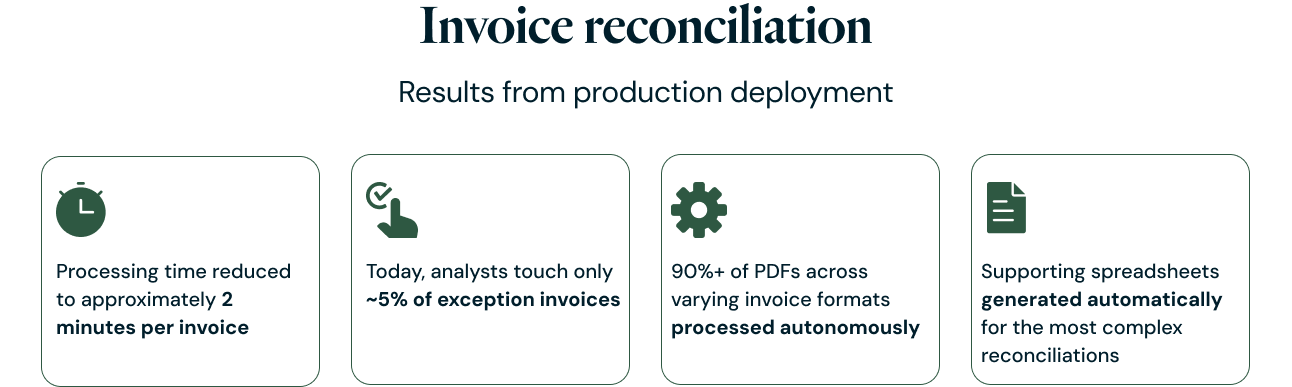
Automated invoice reconciliation delivers measurable outcomes across cost, speed, accuracy, and compliance:
Learn how Sema4.ai streamlines AP workflows and accelerates the financial close.
Several terms in accounts payable and reconciliation in accounting are frequently confused. Here is how they relate:
| Term | Definition |
| Invoice reconciliation | The full process of verifying invoices against POs, receipts, and contracts, resolving discrepancies, and approving for payment |
| Invoice matching | The specific step of comparing an invoice to supporting documents (two-way, three-way, or four-way match) |
| AP reconciliation | Reconciling the accounts payable subledger to the general ledger at period end |
| Bank reconciliation | Matching bank transactions to internal payment records to ensure all disbursements are accounted for |
| Payment remittance | The act of sending payment with remittance advice detailing which invoices are covered |
| Three-way matching | Comparing an invoice against both the PO and the goods receipt to verify quantities, pricing, and delivery |
For more on how cash application works on the receivables side, explore our use case library.
These best practices help finance teams modernize their invoice reconciliation process while building confidence in AI-powered automation:
This phased approach, from shadow mode through exception handling to full autonomous operation, lets organizations realize value quickly while maintaining control at every stage.
Several trends are reshaping how enterprises approach invoice reconciliation:
Platforms like Sema4.ai are purpose-built for this future, enabling finance teams to deploy AI agents that extract invoice data in any format, intelligently match against POs and receipts, and reconcile autonomously at enterprise scale.
Explore the top 5 finance use cases that address critical steps within the larger financial processes your teams execute every day, from procure-to-pay through order-to-cash. Learn how AI agents transform operational bottlenecks within these end-to-end cycles and deliver measurable improvements in speed, accuracy, and cost.
What is invoice reconciliation? Invoice reconciliation is the process of comparing a vendor’s invoice against purchase orders, goods receipts, and contracts to verify that amounts, quantities, and terms are correct before approving payment. It protects organizations from overpayments, duplicates, and inaccurate financial records.
Why is invoice reconciliation important? Without reconciliation, organizations risk paying incorrect amounts, processing duplicate invoices, and reporting inaccurate financials. It is a critical internal control for AP accuracy, cash flow management, and audit readiness across the financial close.
What is three-way matching? Three-way matching compares three documents: the invoice, the purchase order, and the goods receipt. It verifies that what was ordered, what was delivered, and what was billed all align before payment is released. It is the most common method in enterprise AP.
What is the difference between invoice matching and invoice reconciliation? Invoice matching is the specific step of comparing an invoice to supporting documents like POs and receipts. Invoice reconciliation is the broader process that includes matching plus exception resolution, approval routing, posting, and GL reconciliation.
What are common invoice discrepancies? Common discrepancies include quantity variances, unit price mismatches, tax and freight differences, missing PO references, duplicate submissions, partial delivery mismatches, and currency or rounding differences on international invoices.
How does the invoice reconciliation process work? The process follows seven steps: invoice receipt, data extraction, document matching, discrepancy identification, exception resolution, approval and posting, and reconciliation to the general ledger. Steps two through five are the most labor-intensive and the primary targets for automation.
What is AP reconciliation? AP reconciliation is the process of reconciling the accounts payable subledger to the general ledger at period end, ensuring that all recorded liabilities match actual obligations and that period-end balances are accurate.
How can AI automate invoice reconciliation? AI agents automate reconciliation by extracting data from any invoice format, performing intelligent three-way matching with tolerance rules, reasoning through exceptions autonomously, and maintaining full audit trails. They reconcile continuously rather than in batches, compressing close timelines significantly.
Finance teams reconciling thousands of invoices per month are replacing manual matching and exception chasing with AI agents that extract, match, and reconcile automatically, across any document format. See how Sema4.ai automates invoice reconciliation end to end.

 Learn about Agent Studio